

A vast new survey of the early universe has dramatically expanded the known population of hydrogen gas halos surrounding young galaxies, revealing that these structures are far more common and diverse than previously thought.
Astronomers analyzing data from the Hobby–Eberly Telescope Dark Energy Experiment (HETDEX) have identified tens of thousands of enormous hydrogen gas halos, known as “Lyman-alpha nebulae,” surrounding galaxies that existed 10 billion to 12 billion years ago.
This period, called Cosmic Noon, marks a time when galaxies were forming stars at their peak rate. Sustaining that growth required large supplies of hydrogen gas, the primary ingredient for star formation. Until recently, however, only a small number of these halos had been detected.
A study published in The Astrophysical Journal has now increased the known population of these halos tenfold, from about 3,000 to more than 33,000. This finding shows that such structures are common rather than rare. It also expands the range of observed sizes, giving researchers a more complete dataset to study how early galaxies formed and evolved.
“We’ve been analyzing the same handful of objects for the past 20 or so years,” said Erin Mentuch Cooper, HETDEX data manager and lead author on the study. “HETDEX is letting us find many more of these halos and measure their shapes and sizes. It has really allowed us to create an amazing statistical catalogue.”
Hydrogen gas is difficult to observe because it does not emit light on its own. However, when it is close to energetic sources such as galaxies filled with UV-emitting stars, that radiation can cause the gas to glow. Detecting this faint signal requires long observations with highly sensitive instruments, which are often in high demand.
Filling in the Missing Structures
Earlier surveys detected some of these halos, but only the brightest and most extreme examples. At the same time, detailed observations of early galaxies often focus so tightly that they miss anything beyond the smallest surrounding regions. As a result, halos of intermediate size have largely gone unnoticed.
HETDEX is now helping to close this gap. Using the Hobby-Eberly Telescope at McDonald Observatory, the project is mapping more than one million galaxies to better understand dark energy. “We’ve captured nearly half a petabyte of data on not only these galaxies but the regions in between,” said Karl Gebhardt, HETDEX principal investigator, chair of The University of Texas at Austin’s astronomy department, and co-author on the paper. “Our observations cover a region of the sky measuring over 2,000 full Moons. The scope is enormous and unprecedented.”
“The Hobby-Eberly Telescope is one of the largest in the world,” added Dustin Davis, a postdoctoral fellow at UT Austin, a HETDEX scientist, and co-author on the study. “And the instrument HETDEX uses produces 100,000 spectra in each observation. So, we have huge amounts of data and there are all kinds of neat, fun, weird things waiting for us to find.”
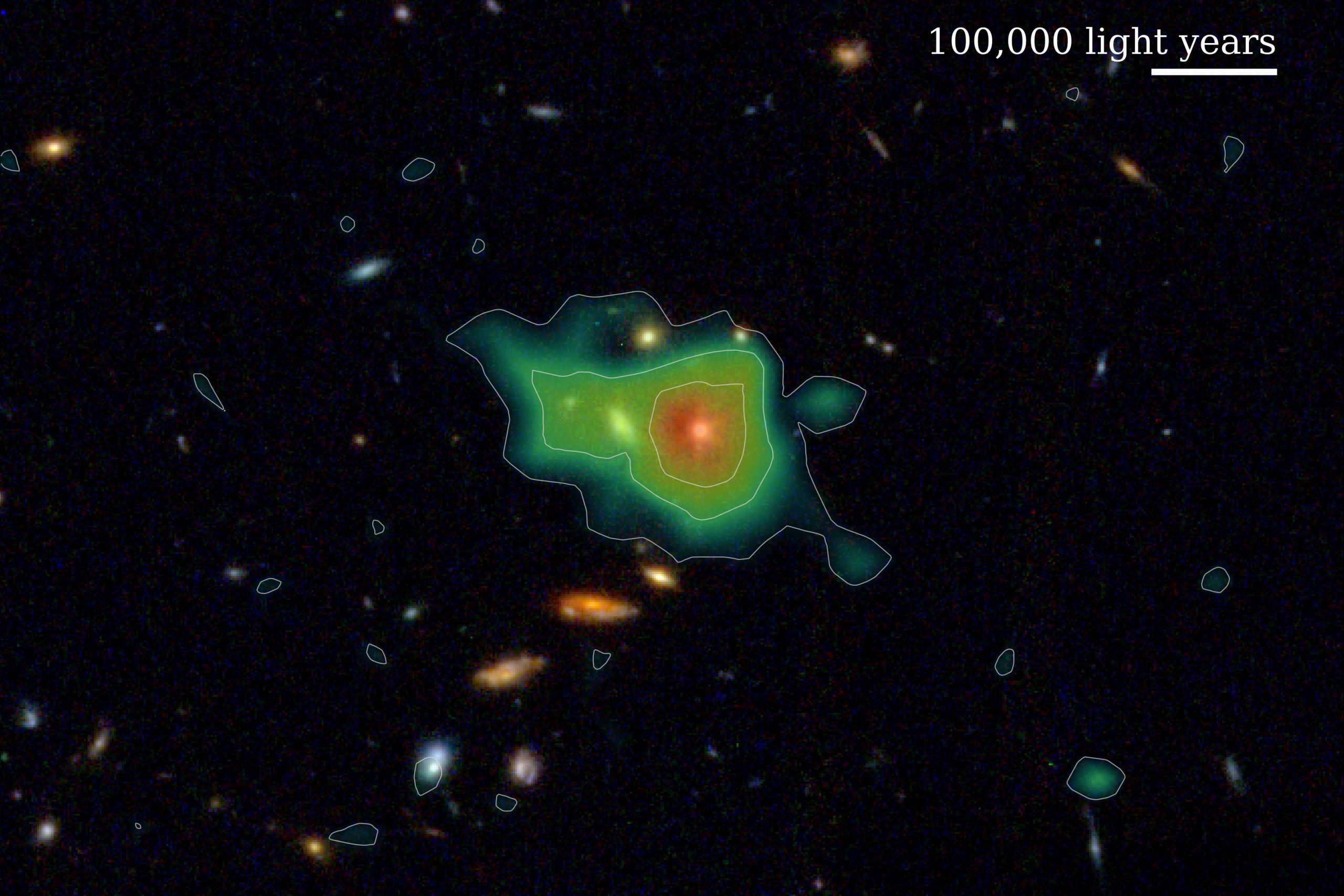
These newly identified halos range from tens of thousands to hundreds of thousands of light-years across. Some appear as simple, football-shaped clouds around a single galaxy, while others are large, irregular structures that contain multiple galaxies. “Those are the fun ones,” said Mentuch Cooper. “They look like giant amoebas with tendrils extending into space.”
Toward a Deeper Understanding of Galaxy Formation
To locate these halos, researchers selected the 70,000 brightest galaxies from more than 1.6 million early galaxies identified by HETDEX so far. Using supercomputers at the Texas Advanced Computing Center, they analyzed which of these galaxies showed signs of a surrounding halo, defined by a dense central region of hydrogen and a more diffuse outer cloud.
Nearly half of the galaxies showed this structure. However, this proportion is likely lower than the true value, according to Mentuch Cooper. “We suspect the faintest systems simply aren’t bright enough to fully reveal how large they are.”
The team expects this expanded catalog to support further research into the early universe, including how cosmic structures formed, how matter is distributed, and how galaxies move and interact. With more than 33,000 halos now identified, researchers can shift their focus from finding these objects to studying them in detail.
“There are various models for galaxies in this epoch that largely work and seem to make sense, but there are gaps and holes,” explained Davis. “Now we can focus in on individual halos and see at a greater detail the physics and mechanics of what’s going on. And then we can fix or throw out the models and try again.”
Reference: “Lyα Nebulae in HETDEX: The Largest Statistical Census Bridging Lyα Halos and Blobs across Cosmic Noon” by Erin Mentuch Cooper, Karl Gebhardt, Dustin Davis, Robin Ciardullo, Chris Byrohl, Chenxu Liu, 辰旭 刘, Maya H. Debski, Óscar A. Chávez Ortiz, Maximilian Fabricius, Daniel J. Farrow, Steven L. Finkelstein, Caryl Gronwall, Gary J. Hill, Maja Lujan Niemeyer, Brianna McKay, Shiro Mukae, Masami Ouchi, Huub Röttgering, Donald P. Schneider, Sarah Tuttle, Lutz Wisotzki, Gregory Zeimann and Sai Zhai, 11 March 2026, The Astrophysical Journal.
DOI: 10.3847/1538-4357/ae44f3
Never miss a breakthrough: Join the SciTechDaily newsletter.
Follow us on Google and Google News.