
Close Menu
    Facebook X (Twitter) Instagram
    SciTechDaily
    • Biology
    • Chemistry
    • Earth
    • Health
    • Physics
    • Science
    • Space
    • Technology
    Facebook X (Twitter) Pinterest YouTube RSS
    SciTechDaily
    Home»Space»Comet Survives after Close Brush With the Sun
    Space

    Comet Survives after Close Brush With the Sun

    By SciTechDailyDecember 18, 20111 Comment1 Min Read
    Facebook Twitter Pinterest Telegram LinkedIn WhatsApp Email Reddit
    Share
    Facebook Twitter LinkedIn Pinterest Telegram Email Reddit
    Comet Survives After Close Brush With The Sun
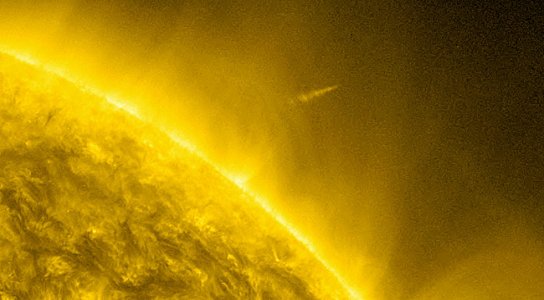
    Comet Lovejoy emerged on the sun’s other side after coming within 75,000 miles (120,000 km) of the fiery orb.

    Comet Lovejoy, discovered a few weeks ago, was supposed to melt as it came so close to the sun that the temperatures would hit several million degrees. Now we have word that the comet has miraculously survived its close fly-by.

    Astronomers watching live with NASA telescopes were surprised to see Lovejoy come out on the sun’s other side after coming within 75,000 miles (120,000 km) of the fiery orb. It has been described as a relatively small object, even a “dirty snowball,” so such a close pass should have killed it.

    Astronomers now think that the comet was larger than they thought. And I wonder if it was also made up of tougher material than they thought as well. Either that or its speed may have been faster than thought. Whatever the reasons, it has survived. American comet discoverer David H. Levy sums up the situation quite nicely, having once said, “Comets are like cats; they have tails, and they do precisely what they want.”

    Never miss a breakthrough: Join the SciTechDaily newsletter.
    Follow us on Google and Google News.

    Comet Lovejoy NASA Popular Sun
    Share. Facebook Twitter Pinterest LinkedIn Email Reddit

    Related Articles

    Astronomers Have Discovered Web-Like Plasma Structures on the Sun

    Powerful X-Class Solar Flare Erupts From Sun – Captured by NASA’s Solar Dynamics Observatory

    NASA’s Solar Dynamics Observatory Caught the Sun “Smiling”

    First of NASA’s SunRISE Satellites Complete – Will Track Hazardous Explosive Space Weather Events

    Incredible New Views of the Sun – As You’ve Never Seen It Before

    Sun Blasts Out 3 Powerful Bursts of Energy in Last 24 Hours

    Don’t Miss: Full Pink Moon, a Comet, a Meteor Shower, and Other Celestial Events

    Hubble Confirms Largest Comet Nucleus Ever Seen – A Staggering 500 Trillion Tons Headed This Way

    What Mercury’s Unusual Orbit Reveals About the Sun [Video]

    1 Comment

    1. Mike on December 19, 2011 1:01 pm

      Interesting!

      Reply
    Leave A Reply Cancel Reply

    • Facebook
    • Twitter
    • Pinterest
    • YouTube

    Don't Miss a Discovery

    Subscribe for the Latest in Science & Tech!

    Trending News

    JWST Finds a “Star” 100 Billion Times Brighter Than Any Star Should Be

    Scientists Find a Hidden Biological Link Across Different Forms of Autism

    Astronomers Discover a Ghostly River of Stars That Could Reveal Dark Matter

    Why Is Colorectal Cancer Rising in People Under 50? New Clues Point to the Environment

    Quantum Fluctuations Break a Crystal’s Symmetry Rules

    Why Does an Irregular Heartbeat Strike 40 Years Early in Some People?

    Scientists Reveal How ADHD Could Fuel Creative Thinking

    Scientists Find Just 3 Minutes of Sprinting Can Transform Blood Chemistry

    Follow SciTechDaily
    • Facebook
    • Twitter
    • YouTube
    • Pinterest
    • Newsletter
    • RSS
    SciTech News
    • Biology News
    • Chemistry News
    • Earth News
    • Health News
    • Physics News
    • Science News
    • Space News
    • Technology News
    Recent Posts
    • Ultra-Processed Foods Linked to 30% Higher Prostate Cancer Risk
    • More Screen Time, Better Thinking? An 8-Year Study Finds a Surprising Link
    • A Vast Clean Energy Source May Be Hiding Beneath Australia’s Red Soil
    • Scientists Uncover Signs of an Ancient Climate “Tipping Point”
    • Cleaner Cars May Be Hiding a New Pollution Problem
    Copyright © 1998 - 2026 SciTechDaily. All Rights Reserved.
    • Science News
    • About
    • Contact
    • Editorial Board
    • Privacy Policy
    • Terms of Use

    Type above and press Enter to search. Press Esc to cancel.