
Close Menu
    Facebook X (Twitter) Instagram
    SciTechDaily
    • Biology
    • Chemistry
    • Earth
    • Health
    • Physics
    • Science
    • Space
    • Technology
    Facebook X (Twitter) Pinterest YouTube RSS
    SciTechDaily
    Home»Space»What Mercury’s Unusual Orbit Reveals About the Sun [Video]
    Space

    What Mercury’s Unusual Orbit Reveals About the Sun [Video]

    By NASA's Goddard Space Flight Center,April 3, 20221 Comment3 Mins Read
    Facebook Twitter Pinterest Telegram LinkedIn WhatsApp Email Reddit
    Share
    Facebook Twitter LinkedIn Pinterest Telegram Email Reddit
    Iridescent Mercury
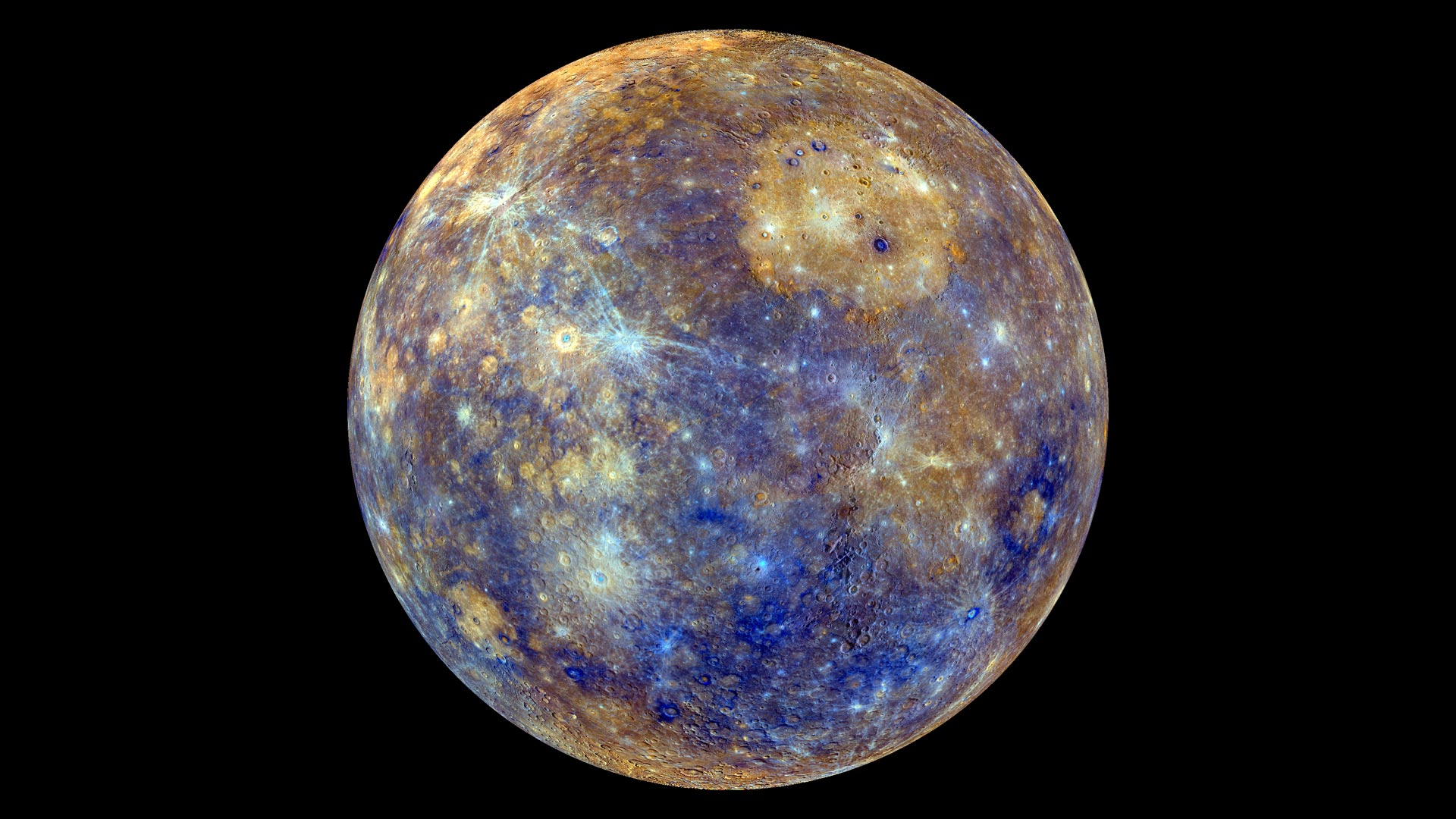
    To the human eye, Mercury may resemble a dull, grey orb but this enhanced-color image from NASA’s Messenger probe, tells a completely different story. Swathes of iridescent blue, sandy-colored plains, and delicate strands of greyish white, create an ethereal and colorful view of our Solar System’s innermost planet. Credit: NASA / JHU Applied Physics Lab / Carnegie Inst. Washington

    A study using MESSENGER data showed that Mercury generates more low-frequency solar wind waves when farther from the Sun. This finding supports the idea that the Sun’s magnetic field weakens with distance.

    Mercury is special. As the closest planet to the Sun, it occupies a region where the Sun’s influence is changing dramatically. The Sun’s magnetic field, which dominates space close to the Sun, is rapidly waning. And Mercury’s orbit – more elliptical or “oval-shaped” than any other planet – allows it to experience a wider range of solar magnetic field conditions than any other planet. As a result, Mercury provides a unique opportunity to study how the Sun’s influence on a planet varies with distance.

    In a new study published in Nature Communications, Goddard scientists Norberto Romanelli and Gina DiBraccio used data from NASA’s MESSENGER spacecraft to study the Sun’s changing interaction with Mercury. As Mercury moves through the solar wind, the steady stream of particles escaping the Sun, some of them strike Mercury’s magnetosphere and bounce back towards the Sun. These rebounding solar wind particles generate low-frequency waves that reverberate through space, traveling “upstream” in the solar wind towards the Sun.

    Romanelli and DiBraccio observed these waves emanating from Mercury and discovered that the rate of wave production varied throughout Mercury’s orbit. As Mercury moved farther from the Sun it generated more waves; as it got closer, the rate of wave production dropped. The results provide key evidence for a theory that these waves are affected, in part, by the strength of the Sun’s magnetic field, which grows weaker with distance.

    Video transcript:

    So Mercury is special not just because it’s the closest planet to the Sun but also because the distance it is from the Sun varies more than any other planet in our solar system.

    Mercury actually has a very oval-shaped orbit compared to the rest.

    Mercury is a natural laboratory for running experiments. We can observe the planet’s surroundings as it gets closer and farther away from the Sun and see what changes.

    When solar wind particles bounce off this magnetospheric boundary, they generate low-frequency waves. They’re like ripples traveling upstream in the solar wind.

    Farther from the Sun, the Sun’s magnetic field is weaker. We found that this is the key parameter that allows more waves to be generated.

    This is something we could only have measured with Mercury, thanks to how close it is to the Sun and the shape of its orbit.

    Reference: “Occurrence rate of ultra-low frequency waves in the foreshock of Mercury increases with heliocentric distance” by N. Romanelli and G. A. DiBraccio, 19 November 2021, Nature Communications.
    DOI: 10.1038/s41467-021-26344-2

    Never miss a breakthrough: Join the SciTechDaily newsletter.
    Follow us on Google and Google News.

    Astronomy Mercury NASA NASA Goddard Space Flight Center NASA MESSENGER Popular Sun
    Share. Facebook Twitter Pinterest LinkedIn Email Reddit

    Related Articles

    NASA Uncovers the Hidden Forces Behind the Sun’s Mysterious Moss

    Astronomers Discover Surprising Radio Signals Emanating From the Sun

    Incredible 10-Year Time Lapse of Sun From NASA’s Solar Dynamics Observatory [Video]

    10 Amazing Discoveries About the Sun From NASA’s Solar Dynamics Observatory

    Magnetic Explosions Observed on Sun – Unlike Anything Seen Before [Video]

    2019 Transit of Mercury Across the Sun in Stunning 4K [Video]

    NASA Research Reveals That Mercury is Active

    Scientists Unveil the First Global Topographic Model of Mercury

    NASA Captures Image of an M6.5 Class Flare

    1 Comment

    1. Dennis Shelton on April 5, 2022 3:58 am

      Toilet paper is nasty. It just smears toilet waste thinner and thinner but there’s still poo left on the skin even if it is very thin. Don’t believe me . Just smell it. LOL.

      Reply
    Leave A Reply Cancel Reply

    • Facebook
    • Twitter
    • Pinterest
    • YouTube

    Don't Miss a Discovery

    Subscribe for the Latest in Science & Tech!

    Trending News

    AI Could Detect Early Signs of Alzheimer’s in Under a Minute – Far Before Traditional Tests

    What if Dark Matter Has Two Forms? Bold New Hypothesis Could Explain a Cosmic Mystery

    This Metal Melts in Your Hand – and Scientists Just Discovered Something Strange

    Beef vs. Chicken: Surprising Results From New Prediabetes Study

    Alzheimer’s Breakthrough: Scientists Discover Key Protein May Prevent Toxic Protein Clumps in the Brain

    Quantum Reality Gets Stranger: Physicists Put a Lump of Metal in Two Places at Once

    Scientists May Have Found the Key to Jupiter and Saturn’s Moon Mystery

    Scientists Uncover Brain Changes That Link Pain to Depression

    Follow SciTechDaily
    • Facebook
    • Twitter
    • YouTube
    • Pinterest
    • Newsletter
    • RSS
    SciTech News
    • Biology News
    • Chemistry News
    • Earth News
    • Health News
    • Physics News
    • Science News
    • Space News
    • Technology News
    Recent Posts
    • Simple and Cheap Blood Test Could Detect Cancer and Other Diseases Before Symptoms Appear
    • Century-Old Cleaning Chemical Linked to 500% Increased Risk of Parkinson’s Disease
    • What if Your Memories Never Happened? Physicists Take a New Look at the Boltzmann Brain Paradox
    • Students Found an Ancient Star That Shouldn’t Be in the Milky Way
    • Astronomers Solve 50-Year Mystery and Reveal Hidden Culprit Behind Strange X-Ray Emissions
    Copyright © 1998 - 2026 SciTechDaily. All Rights Reserved.
    • Science News
    • About
    • Contact
    • Editorial Board
    • Privacy Policy
    • Terms of Use

    Type above and press Enter to search. Press Esc to cancel.