
Close Menu
    Facebook X (Twitter) Instagram
    SciTechDaily
    • Biology
    • Chemistry
    • Earth
    • Health
    • Physics
    • Science
    • Space
    • Technology
    Facebook X (Twitter) Pinterest YouTube RSS
    SciTechDaily
    Home»Space»Science Made Simple: What Are Supernovae?
    Space

    Science Made Simple: What Are Supernovae?

    By U.S. Department of EnergyDecember 28, 2021No Comments4 Mins Read
    Facebook Twitter Pinterest Telegram LinkedIn WhatsApp Email Reddit
    Share
    Facebook Twitter LinkedIn Pinterest Telegram Email Reddit
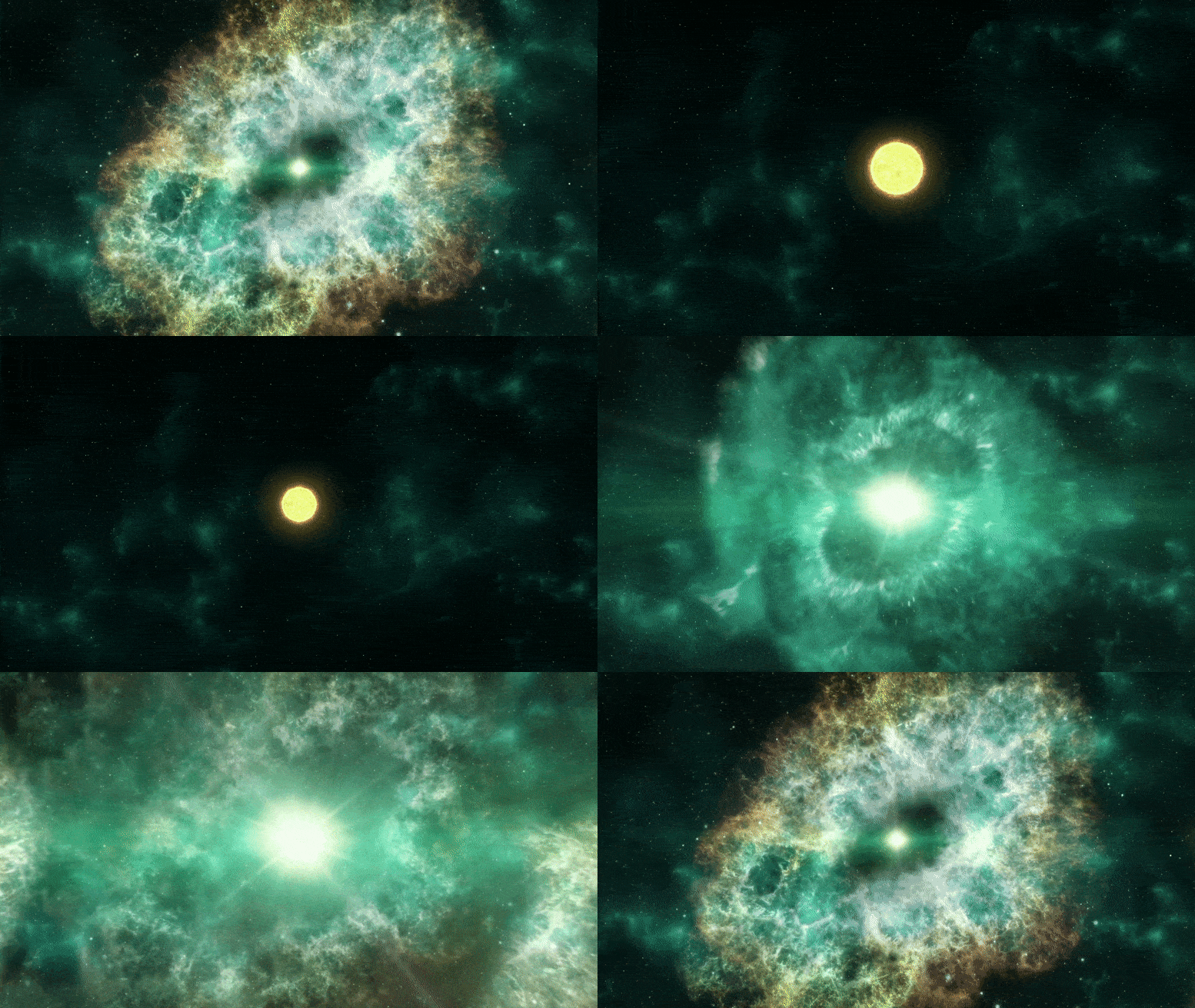
    Supernova Explosion Nebula
    Supernova explosion animation

    What Are Supernovae?

    A supernova is the colossal explosion of a star. Scientists have identified several types of supernova. One type, called a “core-collapse” supernova, occurs in the last stage in the life of massive stars that are at least eight times larger than our Sun. As these stars burn the fuel in their cores, they produce heat. This heat produces pressure that pushes outward against the forces of gravity that pull inward on the star. For most of the life of a star, inward gravity and outward pressure are in balance and the star is stable. But as a star burns through its fuel and begins to cool, the outward forces of pressure drop. When the pressure drops low enough in a massive star, gravity suddenly takes over and the star collapses in just seconds. This collapse produces the explosion we call a supernova.
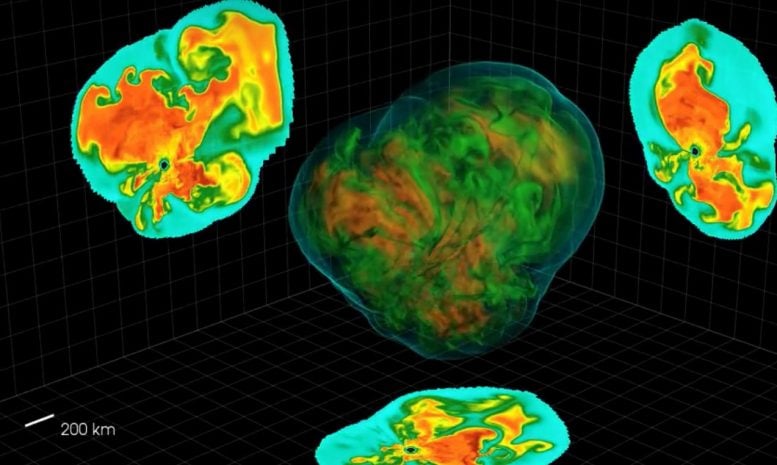
    Supernovae Models
    Researchers are using cutting-edge computers to build models of supernovae to understand these huge explosions. This image is a computer simulation of a supernova’s assumed heat signature, with projections shown at left, right, and bottom. Credit: Image courtesy of SciDAC

    Supernovae are so powerful they create new atomic nuclei. As a massive star collapses, it produces a shockwave that can induce fusion reactions in the star’s outer shell. These fusion reactions create new atomic nuclei in a process called nucleosynthesis.  Supernovae are considered one of the original sources of the elements heavier than iron in the Universe. Even the iron in your blood can be traced back to supernovae or similar cosmic explosions from long before our Sun had formed. Supernovae are thus essential to life.

    After a core collapse supernova, all that remains is a dense core and hot gas called a nebula. When stars are especially large, the core collapses into a black hole. Otherwise, the core becomes an ultra-dense neutron star.

    Another type of supernova, called a thermal runaway supernova, can occur when two stars orbit each other, and one or both of those stars is a white dwarf. White dwarfs are the remains of a star roughly the size of our Sun when it runs out of fuel. If the stars in one of these binary systems collide, or if one of the white dwarfs absorbs enough matter from the other star, the white dwarf can become a supernova.

    Fast Facts

    • A supernova occurs somewhere in the universe every 10 seconds.
    • Supernovae are sources in our universe of elements, radiation, and neutrinos.
    • Supernovae are cosmic particle accelerators that can be replicated in a laboratory in a project made possible with DOE Office of Science Fusion Energy Science program support.

    DOE Office of Science: Contributions to Supernova Research

    Through its Nuclear Physics program, the Department of Energy Office of Science supports research into the fundamental nature of matter. That includes how matter – including the elements – is created and the role of supernovae in that process. In partnership with other Office of Science programs, Nuclear Physics supports projects such as SciDAC, which advances the Scientific Computing Software and Hardware Infrastructure needed for projects such as simulating supernova explosions.

    The Office of Science’s High Energy Physics program also uses supernovae as a tool to develop maps of the universe. In fact, Saul Perlmutter at Lawrence Berkeley National Laboratory as well as scientists Brian Schmidt and Adam Riess won the Nobel Prize for their use of Type Ia supernovae to discover dark energy. Researchers supported by the Office of Science are also using machine learning techniques to identify, categorize, and measure supernovae and other celestial objects that can reveal information about the structure of the universe.

    Never miss a breakthrough: Join the SciTechDaily newsletter.
    Follow us on Google and Google News.

    Astronomy Astrophysics DOE Supernova
    Share. Facebook Twitter Pinterest LinkedIn Email Reddit

    Related Articles

    Previously Undetected Hybrid Neutron-Star Merger Event Revealed by Unusual Gamma-Ray Burst

    Twin Supernovae Open Up New Possibilities for Precision Cosmology

    How Do the Most Massive Stars Explode? Bubbles With Titanium Trigger Titanic Explosions

    “Hoinga” Surprise – Debris of Stellar Explosion Found at Unusual Location

    New Clues to Remains of Star That Exploded Just Outside Our Galaxy

    Super-Earth Atmospheres Probed With Sandia National Lab’s Powerful Z Machine

    Reclusive Neutron Star May Have Been Found in Famous Supernova SN 1987A

    New Metamaterial Structures for Studying the Oldest Light in the Universe

    Intriguing Remains of a Rare Stellar Explosion Discovered in Milky Way Center

    Leave A Reply Cancel Reply

    • Facebook
    • Twitter
    • Pinterest
    • YouTube

    Don't Miss a Discovery

    Subscribe for the Latest in Science & Tech!

    Trending News

    Scientists May Have Discovered How To Heal Damaged Kidneys

    Interstellar Visitor 3I/ATLAS Is Bursting With an Unexpected Chemical

    Scientists Just Found All 5 Genetic “Letters” of DNA and RNA on an Asteroid

    The 4,000-Year-Old City That Defied History’s Rules on Wealth and Power

    The World’s Biggest Population Fear Has Flipped – and It Could Change Everything

    This “Fake” Pill Improved Memory and Physical Performance in Just 3 Weeks

    Scientists Say Frequent Ejaculation May Improve Sperm Quality and Fertility

    Scientists Have Found “The Heaven Sword” After Years of Looking

    Follow SciTechDaily
    • Facebook
    • Twitter
    • YouTube
    • Pinterest
    • Newsletter
    • RSS
    SciTech News
    • Biology News
    • Chemistry News
    • Earth News
    • Health News
    • Physics News
    • Science News
    • Space News
    • Technology News
    Recent Posts
    • NASA’s Orbiting Quantum Lab Pushes Deeper Into the Unknown
    • NASA’s James Webb Discovers Bizarre Salt Clouds on the Pink Planet
    • Mysterious Signals Keep Coming From Space. Scientists May Finally Know Why
    • Scientists Discover Surprising Way To Help the Brain Recover After Stroke
    • The Surprising Therapy That Helps People Stop Fearing Failure
    Copyright © 1998 - 2026 SciTechDaily. All Rights Reserved.
    • Science News
    • About
    • Contact
    • Editorial Board
    • Privacy Policy
    • Terms of Use

    Type above and press Enter to search. Press Esc to cancel.