
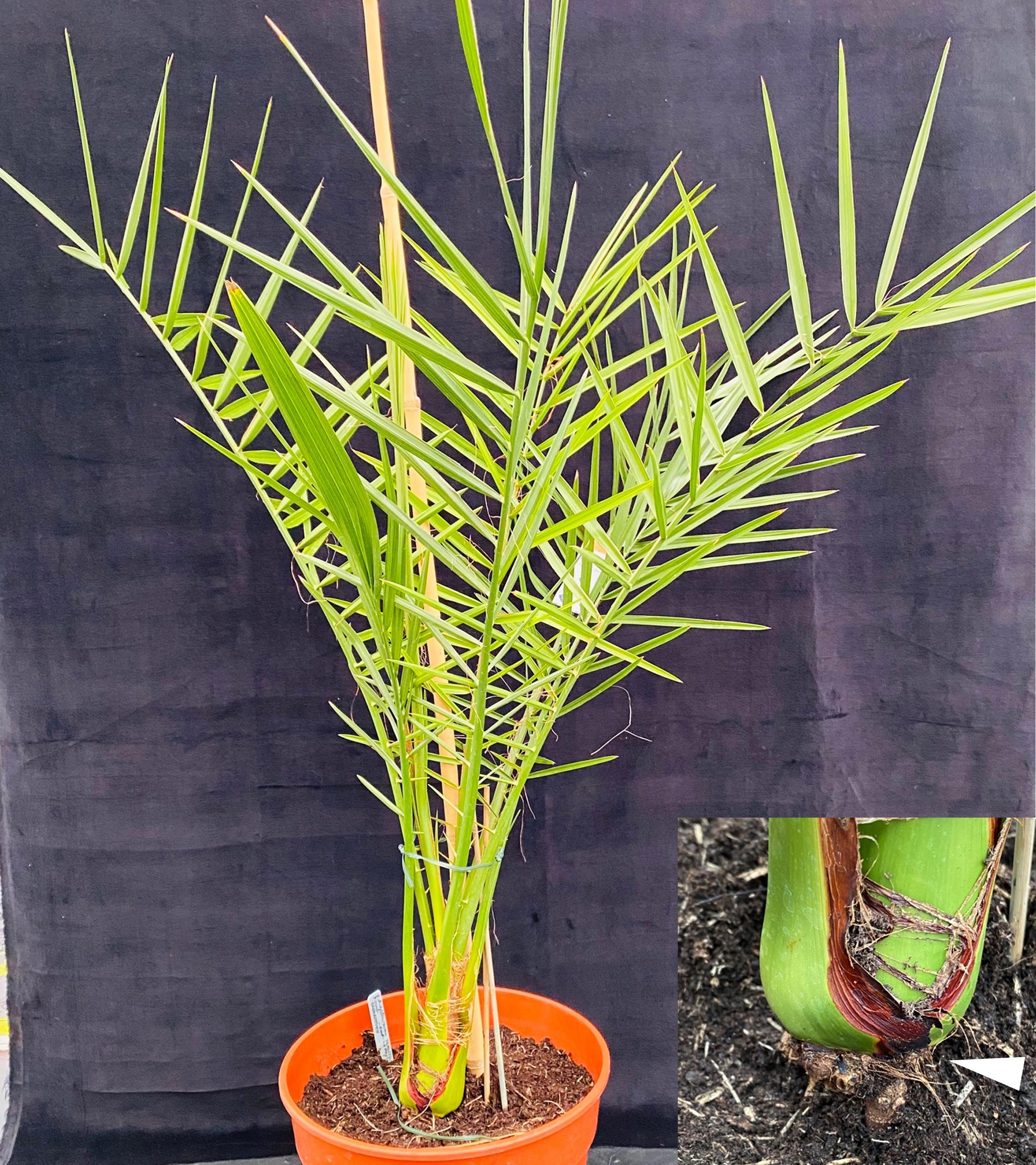
Scientists have found a novel way to combine two species of grass-like plants including banana, rice, and wheat, using embryonic tissue from their seeds. The technique allows beneficial characteristics, such as disease resistance or stress tolerance, to be added to the plants.
Grafting is the technique of joining the shoot of one plant with the root of another, so they continue to grow together as one. Until now it was thought impossible to graft grass-like plants in the group known as monocotyledons because they lack a specific tissue type, called the vascular cambium, in their stem.
Researchers at the University of Cambridge have discovered that root and shoot tissues taken from the seeds of monocotyledonous grasses – representing their earliest embryonic stages – fuse efficiently. Their results were published on December 22, 2021, in the journal Nature.
An estimated 60,000 plants are monocotyledons; many are crops that are cultivated at enormous scale, for example, rice, wheat, and barley.
The finding has implications for the control of serious soil-borne pathogens including Panama Disease, or ‘Tropical Race 4’, which has been destroying banana plantations for over 30 years. A recent acceleration in the spread of this disease has prompted fears of global banana shortages.
Grafting Technique Works Across Even Distantly Related Species
“We’ve achieved something that everyone said was impossible. Grafting embryonic tissue holds real potential across a range of grass-like species. We found that even distantly related species, separated by deep evolutionary time, are graft compatible,” said Professor Julian Hibberd in the University of Cambridge’s Department of Plant Sciences, senior author of the report.
The technique allows monocotyledons of the same species, and of two different species, to be grafted effectively. Grafting genetically different root and shoot tissues can result in a plant with new traits – ranging from dwarf shoots, to pest and disease resistance.
The scientists found that the technique was effective in a range of monocotyledonous crop plants including pineapple, banana, onion, tequila agave, and date palm. This was confirmed through various tests, including the injection of fluorescent dye into the plant roots – from where it was seen to move up the plant and across the graft junction.
“I read back over decades of research papers on grafting and everybody said that it couldn’t be done in monocots. I was stubborn enough to keep going – for years – until I proved them wrong,” said Dr. Greg Reeves, a Gates Cambridge Scholar in the University of Cambridge Department of Plant Sciences, and first author of the paper.
Disease-Resistant Bananas Without Genetic Modification
He added: “It’s an urgent challenge to make important food crops resistant to the diseases that are destroying them. Our technique allows us to add disease resistance, or other beneficial properties like salt-tolerance, to grass-like plants without resorting to genetic modification or lengthy breeding programs.”
The world’s banana industry is based on a single variety, called the Cavendish banana – a clone that can withstand long-distance transportation. With no genetic diversity between plants, the crop has little disease resilience. And Cavendish bananas are sterile, so disease resistance can’t be bred into future generations of the plant. Research groups around the world are trying to find a way to stop Panama Disease before it becomes even more widespread.
Grafting has been used widely since antiquity in another plant group called the dicotyledons. Dicotyledonous orchard crops including apples and cherries, and high-value annual crops including tomatoes and cucumbers, are routinely produced on grafted plants because the process confers beneficial properties – such as disease resistance or earlier flowering.
The researchers have filed a patent for their grafting technique through Cambridge Enterprise. They have also received funding from Ceres Agri-Tech, a knowledge exchange partnership between five leading UK universities and three renowned agricultural research institutes.
“Panama disease is a huge problem threatening bananas across the world. It’s fantastic that the University of Cambridge has the opportunity to play a role in saving such an important food crop,” said Dr. Louise Sutherland, Director Ceres Agri-Tech.
Reference: “Monocotyledonous plants graft at the embryonic root–shoot interface” by Gregory Reeves, Anoop Tripathi, Pallavi Singh, Maximillian R. W. Jones, Amrit K. Nanda, Constance Musseau, Melanie Craze, Sarah Bowden, Joseph F. Walker, Alison R. Bentley, Charles W. Melnyk and Julian M. Hibberd, 22 December 2021, Nature.
DOI: 10.1038/s41586-021-04247-y
Ceres Agri-Tech, led by the University of Cambridge, was created and managed by Cambridge Enterprise. It has provided translational funding as well as commercialization expertise and support to the project, to scale up the technique and improve its efficiency.
Never miss a breakthrough: Join the SciTechDaily newsletter.
Follow us on Google and Google News.