
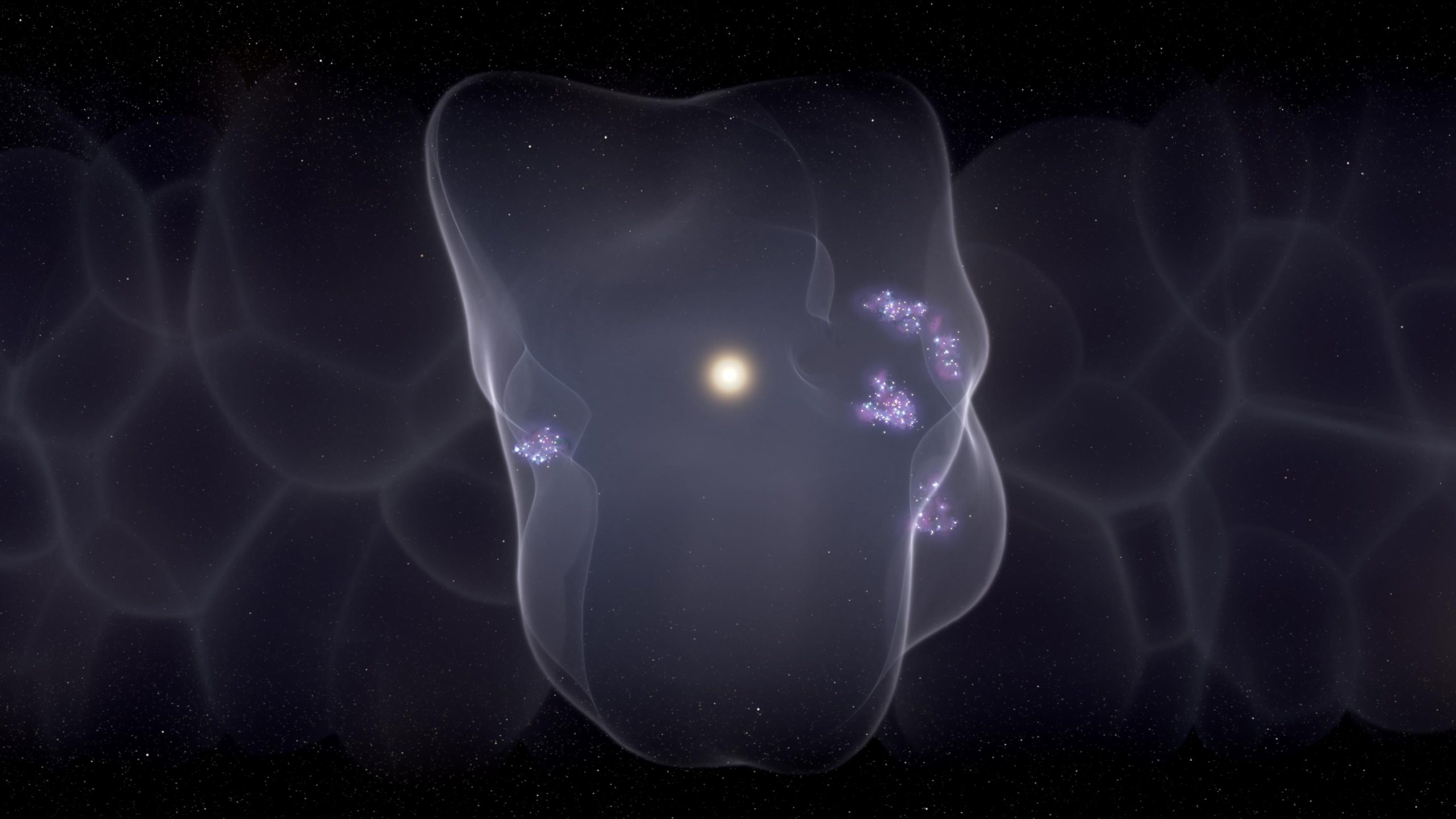
Astronomers have detailed the creation and impact of the Local Bubble on nearby star formation, attributing its origins to multiple supernovae over millions of years. This giant bubble serves as a nursery for young stars and is a central figure in understanding our galactic environment.
The Earth sits in a 1,000-light-year-wide void surrounded by thousands of young stars — but how did those stars form?
In a paper appearing today (January 12, 2022) in Nature, astronomers at the Center for Astrophysics | Harvard & Smithsonian (CfA) and the Space Telescope Science Institute (STScI) reconstruct the evolutionary history of our galactic neighborhood, showing how a chain of events beginning 14 million years ago led to the creation of a vast bubble that’s responsible for the formation of all nearby, young stars.
“This is really an origin story; for the first time we can explain how all nearby star formation began,” says astronomer and data visualization expert Catherine Zucker who completed the work during a fellowship at the CfA.
The paper’s central figure, a 3D spacetime animation, reveals that all young stars and star-forming regions — within 500 light-years of Earth — sit on the surface of a giant bubble known as the Local Bubble. While astronomers have known of its existence for decades, scientists can now see and understand the Local Bubble’s beginnings and its impact on the gas around it.
The Source of Our Stars: The Local Bubble
Using a trove of new data and data science techniques, the spacetime animation shows how a series of supernovae that first went off 14 million years ago, pushed interstellar gas outwards, creating a bubble-like structure with a surface that’s ripe for star formation.
Today, seven well-known star-forming regions or molecular clouds — dense regions in space where stars can form — sit on the surface of the bubble.
“We’ve calculated that about 15 supernovae have gone off over millions of years to form the Local Bubble that we see today,” says Zucker who is now a NASA Hubble Fellow at STScI.
The oddly-shaped bubble is not dormant and continues to slowly grow, the astronomers note.
“It’s coasting along at about 4 miles per second,” Zucker says. “It has lost most of its oomph though and has pretty much plateaued in terms of speed.”
The expansion speed of the bubble, as well as the past and present trajectories of the young stars forming on its surface, were derived using data obtained by Gaia, a space-based observatory launched by the European Space Agency.
“This is an incredible detective story, driven by both data and theory,” says Harvard professor and Center for Astrophysics astronomer Alyssa Goodman, a study co-author and founder of glue, data visualization software that enabled the discovery. “We can piece together the history of star formation around us using a wide variety of independent clues: supernova models, stellar motions, and exquisite new 3D maps of the material surrounding the Local Bubble.”
Bubbles Everywhere?
“When the first supernovae that created the Local Bubble went off, our Sun was far away from the action,” says co-author João Alves, a professor at the University of Vienna. “But about five million years ago, the Sun’s path through the galaxy took it right into the bubble, and now the Sun sits — just by luck — almost right in the bubble’s center.”
Today, as humans peer out into space from near the Sun, they have a front-row seat to the process of star formation occurring all around on the bubble’s surface.
Astronomers first theorized that superbubbles were pervasive in the Milky Way nearly 50 years ago. “Now, we have proof — and what are the chances that we are right smack in the middle of one of these things?” asks Goodman. Statistically, it is very unlikely that the Sun would be centered in a giant bubble if such bubbles were rare in our Milky Way Galaxy, she explains.
Goodman likens the discovery to a Milky Way that resembles very hole-y swiss cheese, where holes in the cheese are blasted out by supernovae, and new stars can form in the cheese around the holes created by dying stars.
Next, the team, including co-author and Harvard doctoral student Michael Foley, plans to map out more interstellar bubbles to get a full 3D view of their locations, shapes, and sizes. Charting out bubbles, and their relationship to each other, will ultimately allow astronomers to understand the role played by dying stars in giving birth to new ones, and in the structure and evolution of galaxies like the Milky Way.
Zucker wonders, “Where do these bubbles touch? How do they interact with each other? How do superbubbles drive the birth of stars like our Sun in the Milky Way?”
Additional co-authors on the paper are Douglas Finkbeiner and Diana Khimey of the CfA; Josefa Groβschedland Cameren Swiggum of the University of Vienna; Shmuel Bialy of the University of Maryland; Joshua Speagle of the University of Toronto; and Andreas Burkert of the University Observatory Munich.
The articles, analyzed data (on the Harvard Dataverse) and interactive figures and videos are all freely available to everyone through a dedicated website.
The results were presented at a press conference of the American Astronomical Society (AAS) Wednesday afternoon. The public can watch a recording of the conference here.
Reference: “Star Formation Near the Sun is Driven by Expansion of the Local Bubble” by Catherine Zucker, Alyssa A. Goodman, João Alves, Shmuel Bialy, Michael Foley, Joshua S. Speagle, Josefa Groβschedl, Douglas P. Finkbeiner, Andreas Burkert, Diana Khimey and Cameren Swiggum, 12 January 2022, Nature.
DOI: 10.1038/s41586-021-04286-5
Never miss a breakthrough: Join the SciTechDaily newsletter.
Follow us on Google and Google News.
13 Comments
How do I stop getting g your stuff
Go into the settings on your phone and look for “notifications” and you should be able to remove or disable them on there.
Might want to check that 14 million years figure…
The Source of Our Stars: The Local Bubble
Using a trove of new data and data science techniques, the spacetime animation shows how a series of supernovae that first went off 14 million years ago, pushed interstellar gas outwards, creating a bubble-like structure with a surface that’s ripe for star formation.
Space is just so awesome!
what could happen if the bubble pops ? if it formed then the possibility of it popping is equal to its existence
and I’m sorry but the time line is only speculation it’s a theory so I hate when scientist try to put a time on to something just proven to exist like really you don’t know … ANYTHING IS POSSIBLE if science would study more of the metaphysical world we live in they might find answers to alot of the mysteries of where we reside .. start at home then work your way out … just as an individual needs to start within in order to expand and reach out to others if we don’t know what’s going on here in our world on our earth then how can we n why would we keep reaching out further and further away from what really matters?
It’s most strange, that our sun and its planets are situated in the middle of such a huge gas bubble. Great news indeed 👍
Well, gas free bubble. Sorry
In a couple of places, “million” is used instead of the correct “billion”; surely, the solar system is older than 5 million years!
The five million figure only refers to how long ago our system entered the bubble.
But it *does* seem funny that we’re now at the center of it. Guess our Sun doesn’t care about the “Copernican Principle!”
Since Earth is at/near the center, is it possible for our Sun to have been the supernova that caused the bubble to have formed? Isn’t the estimated age of the Earth about the same as the estimate of this bubble’s
Another fascinating detail of how truly unique our planet and solar system are! Lucky us to be so sheltered from radiation outside our solar system and be in the habitable zone of the perfect star.
Its the best comedy ive read in years
You are having a laugh aren’t you
15 million years ago when the first supernova went off in our local oddly shaped minor superbubble the sun was far away from the action approximately 1000 light years distance away in the milky way galaxy
5 million years ago when the tenth supernova went off in our local oddly shaped minor superbubble of approximately 600 light years diameter the suns proper motion path through the milky way galaxy took it right through the outer surface circumference and into the 600 light years diameter minor superbubble
2022ad the suns proper motion path through the oddly shaped minor superbubble took it almost right into the bubbles centre where the sun moon and earth now sit
2022 january 12th
Star formation near the sun is driven by expansion of the local oddly shaped minor superbubble
1000 light year wide oddly shaped minor superbubble
Thousands of young stars within 500 light years are formed by the vast oddly shaped minor superbubble all young stars and seven star forming regions or dense molecular cloud regions sit on the surface circumference of the 1000 light year diameter oddly shaped minor superbubble
And its still growing known as the local 1000 light year diameter oddly shaped minor superbubble
And the best joke of the lot don’t ya know the sun in proper motion is going to be travelling directly right through the milky way galactic disk
So according to my predictions
It will take another 5 million years to travel another 300 light years from the centre to the far side of this oddly shaped minor superbubble
Only by then the local oddly shaped minor superbubble will be 1500 light years diameter wide
So 5 million years later it will have travelled right though to the far side
Which means the jokes on us
We will be through the galactic disc to the far side 10,000,000 years from now through an invisible shield of an oddly shaped bubble and hopefully no less than a scratch on bubble surface
As against a hammer blow crater impacted upon us without this shield
You are joking aren’t you that we will be travelling though the milky way galactic disk with this shield around us
Go on tell me it aint true that you were just having a laugh