
Close Menu
    Facebook X (Twitter) Instagram
    SciTechDaily
    • Biology
    • Chemistry
    • Earth
    • Health
    • Physics
    • Science
    • Space
    • Technology
    Facebook X (Twitter) Pinterest YouTube RSS
    SciTechDaily
    Home»Space»NASA’s Black Hole Orrery – Spectacular Visualization of 22 X-Ray Binary Systems That Host Black Holes
    Space

    NASA’s Black Hole Orrery – Spectacular Visualization of 22 X-Ray Binary Systems That Host Black Holes

    By NASAMay 9, 20221 Comment3 Mins Read
    Facebook Twitter Pinterest Telegram LinkedIn WhatsApp Email Reddit
    Share
    Facebook Twitter LinkedIn Pinterest Telegram Email Reddit
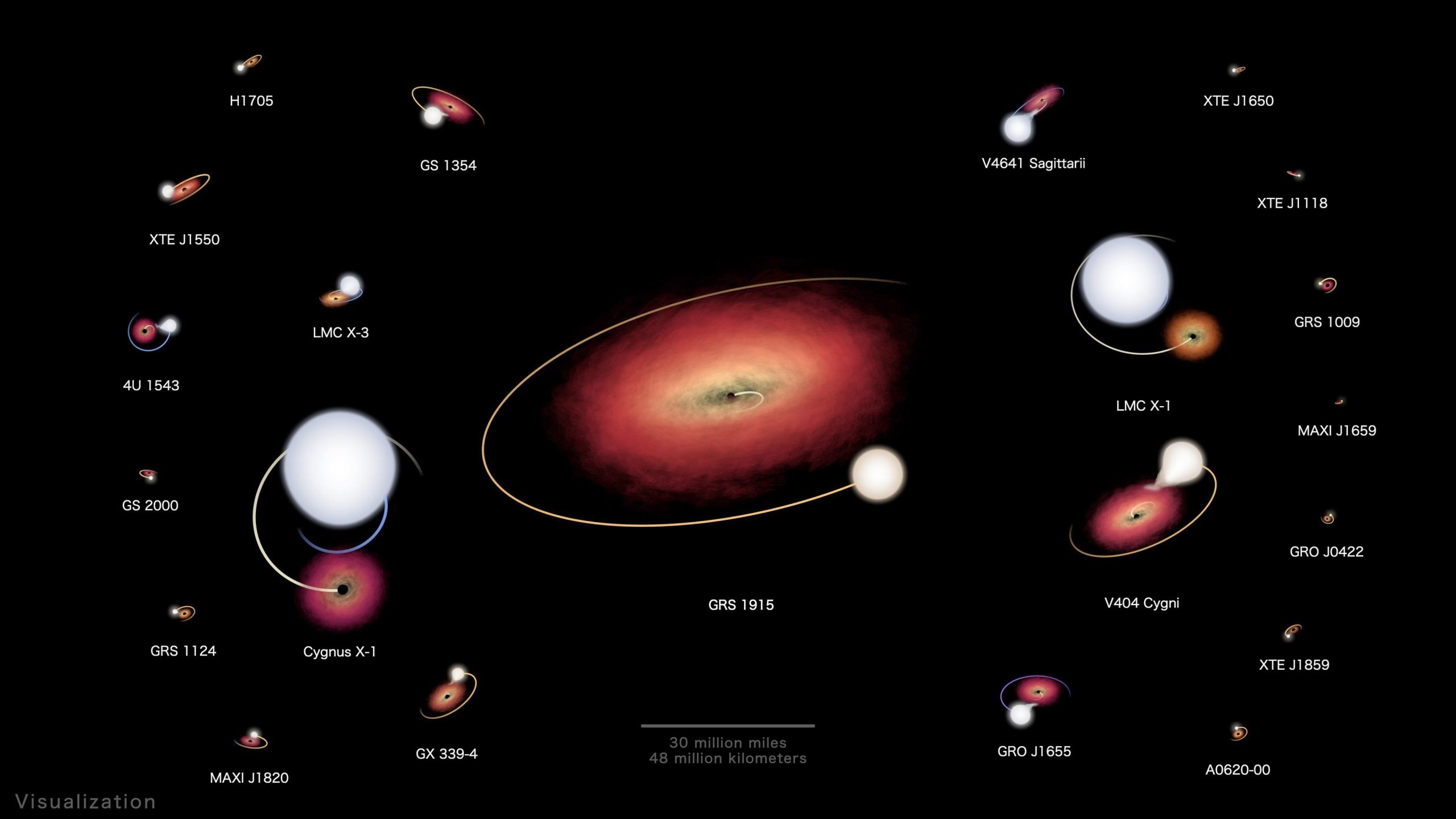
    NASA's Black Hole Orrery
    Learn more about the best-known black hole systems in our galaxy and its neighbor, the Large Magellanic Cloud. Credit: NASA’s Goddard Space Flight Center and Scientific Visualization Studio

    This visualization shows 22 X-ray binaries in our Milky Way galaxy and its nearest neighbor, the Large Magellanic Cloud, that host confirmed stellar-mass black holes. The systems are depicted at the same physical scale, and their orbital motion is sped up by nearly 22,000 times. The view of each binary replicates how we see it from Earth. The colors of the stars range from blue-white to reddish, representing temperatures from 45% cooler to 5 times hotter than our Sun.

    While the black holes appear on a scale reflecting their masses, all are depicted using spheres larger than their actual size. Cygnus X-1, with the largest companion star shown, is the first black hole ever confirmed and weighs about 21 times more than the Sun. But its surface – called its event horizon – spans only about 77 miles (124 kilometers). The enlarged spheres also cover up visible distortions produced by the black holes’ gravitational effects.

    In most of these systems, a stream of gas flows directly from the star toward the black hole, forming around it a broad, flattened structure called an accretion disk. In others, like Cygnus X-1, a massive star produces a thick outflow called a stellar wind, some of which becomes swept up by the black hole’s intense gravity. Gas in the accretion disk heats up as the material slowly spirals inward, glowing in visible, ultraviolet, and finally X-ray light. Because the accretion disks reach even higher temperatures than the stars, they use a different color scheme.

    Learn more about the best-known black hole systems in our galaxy and its neighbor, the Large Magellanic Cloud. This visualization presents 22 X-ray binary systems that host confirmed black holes at the same scale, with their orbits sped up by about 22,000 times. The view of each system reflects how we see it from Earth. Star colors ranging from blue-white to reddish represent temperatures from 45% cooler to 5 times hotter than our Sun.

    In most of these systems, a stream of matter from the star forms an accretion disk around the black hole. In others, like the famous system called Cygnus X-1, the star produces a hefty outflow that is partly swept up by the black hole’s gravity to form the disk. The accretion disks use a different color scheme because they sport even higher temperatures than the stars.

    The largest disk shown, belonging to a binary called GRS 1915, spans a distance greater than that separating Mercury from our Sun. The black holes themselves are shown larger than in reality using spheres scaled to reflect their masses.

    Never miss a breakthrough: Join the SciTechDaily newsletter.
    Follow us on Google and Google News.

    Astronomy Astrophysics Black Hole Large Magellanic Cloud NASA Popular
    Share. Facebook Twitter Pinterest LinkedIn Email Reddit

    Related Articles

    NASA’s X-Ray Explorer Unveils Black Hole’s Hidden Layers

    Centaurus A’s Massive 13,000 Light-Year Jet Captured in Stunning Detail

    The Big Bang’s Dark Legacy Revealed by Hubble: Unexpected Black Holes

    Astronomical Appetite: NASA Telescopes Decode a Supermassive Black Hole’s Snack Schedule

    From the Dawn of Time: Hunting for Primordial Black Holes With NASA’s Roman Space Telescope

    NASA’s Planet Hunter’s Rare Glimpse at Two Black Holes in a Faraway Galaxy

    Echoes of Creation: The Roman Telescope’s Quest for Primordial Black Holes

    Andromeda’s Supermassive Black Hole Feeding Habits Revealed by NASA’s Spitzer

    Telescopes Reveal Rapid Spin of Milky Way’s Black Hole Warping Spacetime

    1 Comment

    1. David Radzieta on May 9, 2022 5:28 am

      At the center of ever black hole mass is conserved as space and this space rushibg outeard is making the universe bigger. Pure mass, pure space. And pure energy are unstable. Our understanding of the universe is the interaction of these three interchangeable components. Eventually once all the mass is conserved as space, unstable space will be conserved as energy. Cycle starting over again.

      Reply
    Leave A Reply Cancel Reply

    • Facebook
    • Twitter
    • Pinterest
    • YouTube

    Don't Miss a Discovery

    Subscribe for the Latest in Science & Tech!

    Trending News

    Scientists Discover Cheap, Natural Remedy for High Blood Pressure

    Earth’s Upper Atmosphere Is Cooling Fast and Scientists Finally Know Why

    32,000 Olympic Pools of Magma Nearly Erupted Beneath Atlantic Island

    Exercise Changes the Heart in a Way Researchers Never Expected

    Too Much Sleep May Age Your Body Faster, New Study Warns

    Scientists Uncover Promising New Strategy To Stop Parkinson’s in Its Tracks

    Experts Reveal the Surprising Cancer Link Behind a Common Vitamin

    This Strange “Golden Orb” Found 2 Miles Deep Stumped Scientists for Years

    Follow SciTechDaily
    • Facebook
    • Twitter
    • YouTube
    • Pinterest
    • Newsletter
    • RSS
    SciTech News
    • Biology News
    • Chemistry News
    • Earth News
    • Health News
    • Physics News
    • Science News
    • Space News
    • Technology News
    Recent Posts
    • The Type of Alcohol You Drink Could Affect How Long You Live
    • 19-Year Study Reveals the Surprising Truth About Sitting and Dementia
    • This Common Vitamin May Help Stop Prediabetes From Turning Into Diabetes
    • Canada’s Billion-Year-Old Rocks Could Hold the Future of Clean Energy
    • Climate Change Is Quietly Choking Rivers Across the Planet
    Copyright © 1998 - 2026 SciTechDaily. All Rights Reserved.
    • Science News
    • About
    • Contact
    • Editorial Board
    • Privacy Policy
    • Terms of Use

    Type above and press Enter to search. Press Esc to cancel.