
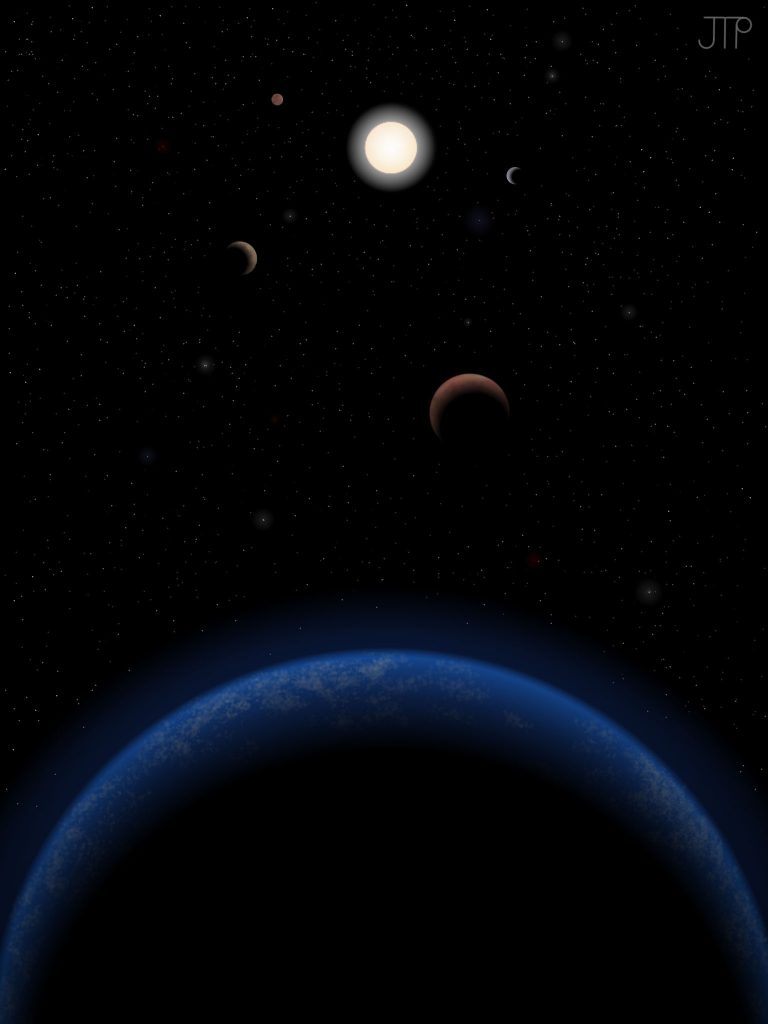
By combining more than six-thousand observations from three different instruments and using new data modeling techniques, an international team of astronomers greatly improved the sensitivity of searchers for small planets and now believes that Tau Ceti may host planet in the star’s habitable zone.
An international team of astronomers has discovered that Tau Ceti, one of the closest and most Sun-like stars, may host five planets, including one in the star’s habitable zone.
At a distance of twelve light years from Earth and visible to the naked eye in the evening sky, Tau Ceti is the closest single star that has the same spectral classification as our Sun. Its five planets are estimated to have masses between two and six times the mass of the Earth, making it the lowest-mass planetary system yet detected. One of the planets lies in the habitable zone of the star and has a mass around five times that of Earth, making it the smallest planet found to be orbiting in the habitable zone of any Sun-like star.
The international team of astronomers from the United Kingdom, Chile, United States, and Australia, combined more than six thousand observations from three different instruments and intensively modeled the data. Using new techniques, the team has found a method to detect signals half the size previously thought possible. This greatly improves the sensitivity of searches for small planets and suggests that Tau Ceti is not a lone star but has a planetary system. The team presented its findings in a paper that has been accepted for publication in Astronomy & Astrophysics.
“This discovery is in keeping with our emerging view that virtually every star has planets, and that the galaxy must have many such potentially habitable Earth-sized planets,” said coauthor Steve Vogt, a professor of astronomy and astrophysics at UC Santa Cruz. “We are now beginning to understand that nature seems to overwhelmingly prefer systems that have multiple planets with orbits of less than 100 days. This is quite unlike our own solar system, where there is nothing with an orbit inside that of Mercury. So our solar system is, in some sense, a bit of a freak and not the most typical kind of system that Nature cooks up.”
First author Mikko Tuomi of the University of Hertfordshire emphasized the importance of new techniques the team developed. “We pioneered new data modeling techniques by adding artificial signals to the data and testing our recovery of the signals with a variety of different approaches,” Tuomi said. “This significantly improved our noise modeling techniques and increased our ability to find low-mass planets.”
Hugh Jones, also at the University of Hertfordshire, said the researchers chose Tau Ceti for this noise-modeling study because they had thought it contained no signals. “As it is so bright and similar to our Sun, it is an ideal benchmark system to test out our methods for the detection of small planets,” Jones said.
Over 800 planets have been discovered orbiting other worlds, but planets in orbit around the nearest Sun-like stars are particularly valuable. “Tau Ceti is one of our nearest cosmic neighbors and so bright that we may be able to study the atmospheres of these planets in the not-too-distant future. Planetary systems found around nearby stars close to our Sun indicate that these systems are common in our Milky Way galaxy,” said James Jenkins of Universidad de Chile, a visiting fellow at the University of Hertfordshire.
The researchers discovered this planetary system using data from three state-of-the-art spectrographs: HARPS on the 3.6-meter telescope at the European Southern Observatory in La Silla, Chile (4864 data points); UCLES on the Anglo-Australian Telescope in Siding Spring, Australia (978 data points); and HIRES on the 10-meter Keck telescope on Mauna Kea, Hawaii (567 data points).
The result is based on spectra taken as part of the Anglo-Australian Planet Search with the UCLES spectrograph on the Anglo-Australian Telescope, HIRES on the Keck Telescope, and reanalysis of spectra taken with the HARPS spectrograph and available through the European Southern Observatory public archive. This work would have not been possible without the ESO public data policies and the excellent work of the ESO Software Development Division and the ESO Science Archive Facility.
Reference: “Signals embedded in the radial velocity noise. Periodic variations in the tau Ceti velocities” by Mikko Tuomi, Hugh R. A. Jones, James S. Jenkins, Chris G. Tinney, R. Paul Butler, Steve S. Vogt, John R. Barnes, Robert A. Wittenmyer, Simon O’Toole, Jonathan Horner, Jeremy Bailey, Brad D. Carter, Duncan J. Wright, Graeme S. Salter and David Pinfield, 26 February 2013, Astronomy & Astrophysics.
DOI: 10.1051/0004-6361/201220509
The international research team consists of Mikko Tuomi, Hugh Jones, John Barnes and David Pinfield (University of Hertfordshire); James Jenkins (University of Chile and University of Hertfordshire); Chris Tinney, Rob Wittenmyer, Jonathan Horner, Jeremy Bailey, Duncan Wright and Graeme Salter (University of New South Wales, Australia); Steve Vogt (UC Santa Cruz); Paul Butler (Carnegie Institution for Science); Simon O’Toole (Australian Astronomical Observatory); and Brad Carter (University of Southern Queensland).
Never miss a breakthrough: Join the SciTechDaily newsletter.
Follow us on Google and Google News.