
Close Menu
    Facebook X (Twitter) Instagram
    SciTechDaily
    • Biology
    • Chemistry
    • Earth
    • Health
    • Physics
    • Science
    • Space
    • Technology
    Facebook X (Twitter) Pinterest YouTube RSS
    SciTechDaily
    Home»Earth»Cloud Forest Trees Depend on Fog
    Earth

    Cloud Forest Trees Depend on Fog

    By SciTechDailyDecember 27, 2012No Comments3 Mins Read
    Facebook Twitter Pinterest Telegram LinkedIn WhatsApp Email Reddit
    Share
    Facebook Twitter LinkedIn Pinterest Telegram Email Reddit
    Cloud Forest Trees Absorb Water Through Their Leaves From Fog
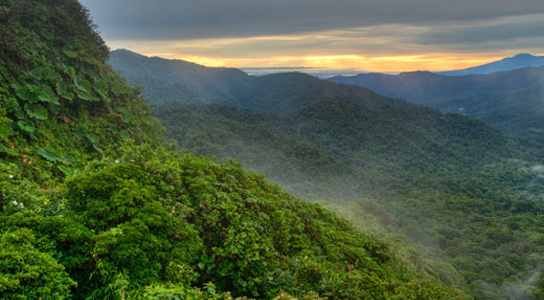
    Sunrise over the cloud forests of Monteverde, Costa Rica. Credit: Drew Fulton

    Trees in Costa Rica, as well as a number of plant species, in the tropical cloud forests quench their thirst by directly ingesting fog droplets through their leaves. These forests are in danger because of climate change, and a new study indicates that they’re even more fragile than previously thought.

    The scientists published their findings in the journal Ecology Letters. The mountainside cloud forest of Monteverde, Costa Rica, gets plenty of rain for nine months of the year. During three months, between February and April, precipitation is scarcer. But during these three months, some of the region’s forests are engulfed in fog for an average 13 hours a day. The fog comes from moisture that drifts in from the Caribbean Sea and condenses under the forest’s canopy. These milky-white threads weave through the greenery, and are enough to sustain the forest’s 2,000 plant species.
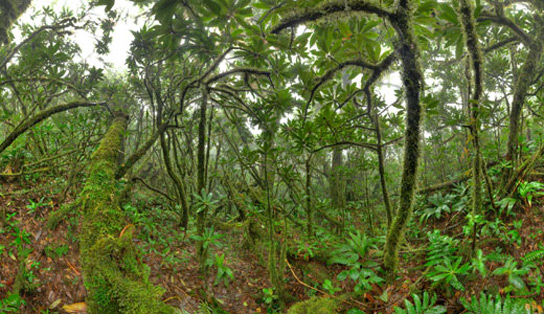
    Monteverde Cloud Forest Reserve
    Plants fill the Monteverde Cloud Forest Reserve in Monteverde, Costa Rica, with lush, green color. Credit: Drew Fulton

    A cascade of amphibians and migratory birds has been disappearing from Monteverde since 1989, when conservationists were first alarmed of the extinction of the golden toad (Bufo periglenes). Researchers have been studying the region’s animals intensely, but they know less about the region’s plants. Since climate change is expected to influence where the fog forms, the scientists hunted for clues to how the dry season influenced the trees by looking at foliar uptake, the ability to absorb water through leaves in addition to roots.

    Since the 1950s, scientists have discovered 40 species of plants that can absorb water through their leaves. There is plenty of foliar uptake in Monteverde. The scientists picked out 12 of the most common tree species in the cloud forest and 12 of the most common trees in a less foggy forest just 2 km (1.2 mi) downhill. They determined how often the leaves got damp by placing fake, plastic leaves on the tree branches, each with an incomplete electrical circuit that conducted electricity when wet. They also were able to determine how much the plants drank through their leaves by heating a spot on each plant’s branches during clear and foggy days. When the heat of the branch is measured, they could track the water moving inside. If the water traveled toward the leaf, it came from the roots and if the water traveled toward the trunk, it came from the leaves through foliar uptake.

    All of the trees inside and outside the cloud forest use foliar uptake. Analyses of dehydration levels indicate that the leaves in the tree cloud forest had a higher capacity to draw water in, storing 20% more water for growth and survival using foliar uptake than the other trees downhill.

    A warming climate presents a new problem for the conservation of cloud forests. As the moisture from the Caribbean Sea warms, it takes longer to cool off and condense into fog, which means that the fog might not appear until the wind has pushed moisture to a higher elevation than the cloud forest. If the plant population doesn’t migrate fast enough, the trees may suffer a water shortage.

    Reference: “The incidence and implications of clouds for cloud forest plant water relations” by Gregory R. Goldsmith, Nicholas J. Matzke and Todd E. Dawson, 6 December 2012, Ecology Letters.
    DOI: 10.1111/ele.12039

    Never miss a breakthrough: Join the SciTechDaily newsletter.
    Follow us on Google and Google News.

    Cloud Forest Conservation Ecology Ecosystems Trees
    Share. Facebook Twitter Pinterest LinkedIn Email Reddit

    Related Articles

    Roaming Bison Reawaken Yellowstone’s Ecosystem

    Otterly Amazing: How Sea Otters Are Saving California’s Coasts

    The Carbon Paradox: How Tree Plantations May Harm More Than Help

    Massive Carbon Storage: Protecting Very Old Trees Can Help Mitigate Climate Change

    Deforestation Adds More Atmospheric CO2 Than the Sum Total of Cars & Trucks on the World’s Roads

    UK’s 90 Million Ash Trees Are Likely to be Wiped Out

    Survey of Brazil’s Atlantic Forests Reveals Loss of Key Species

    Evidence Suggests that Earth May Be Headed Toward an Irreversible Change in the Biosphere

    Antarctic Ecosystems Threatened by Invasive Alien Species and Climate Change

    Leave A Reply Cancel Reply

    • Facebook
    • Twitter
    • Pinterest
    • YouTube

    Don't Miss a Discovery

    Subscribe for the Latest in Science & Tech!

    Trending News

    Scientists Discover Bizarre 100-Million-Year-Old Insect With Giant Claws

    Scientists Discover “Good” Gut Microbes That Could Protect Against Autism and ADHD

    Scientists Reveal That Eating Almonds Every Day Could Transform Your Gut, Metabolism, and Appetite

    Scientists May Have Solved Two of Fusion Energy’s Biggest Problems at Once

    Scientists Discover Hidden “Switch” That Burns Fat and Could Treat Bone Disease

    After 50 Years of Mystery, Researchers Identify New Human Blood Group

    Beyond Pain Relief: Scientists Discover a Protein That Could Stop Osteoarthritis in Its Tracks

    Scientists Discover Why Alcohol Prevents the Liver From Healing, Even After You Quit

    Follow SciTechDaily
    • Facebook
    • Twitter
    • YouTube
    • Pinterest
    • Newsletter
    • RSS
    SciTech News
    • Biology News
    • Chemistry News
    • Earth News
    • Health News
    • Physics News
    • Science News
    • Space News
    • Technology News
    Recent Posts
    • Earth’s Upper Atmosphere Is Cooling Fast and Scientists Finally Know Why
    • 32,000 Olympic Pools of Magma Nearly Erupted Beneath Atlantic Island
    • Scientists May Have Found Dark Matter’s Fingerprint in a Black Hole Collision
    • Exercise Changes the Heart in a Way Researchers Never Expected
    • Scientists Warn Ultra-Processed Foods Could Be Hurting Your Brain
    Copyright © 1998 - 2026 SciTechDaily. All Rights Reserved.
    • Science News
    • About
    • Contact
    • Editorial Board
    • Privacy Policy
    • Terms of Use

    Type above and press Enter to search. Press Esc to cancel.