
Washing dishes with superheated steam is more effective and Earth-friendly.
Simulations show steam kills bacteria on a plate in just 25 seconds — without soap.
Often, conventional dishwashers do not kill all the harmful microorganisms left on plates, bowls, and cutlery. They also require long cycle times that use large amounts of electricity. Additionally, the soap pumped in and out is released into water sources, polluting the environment.
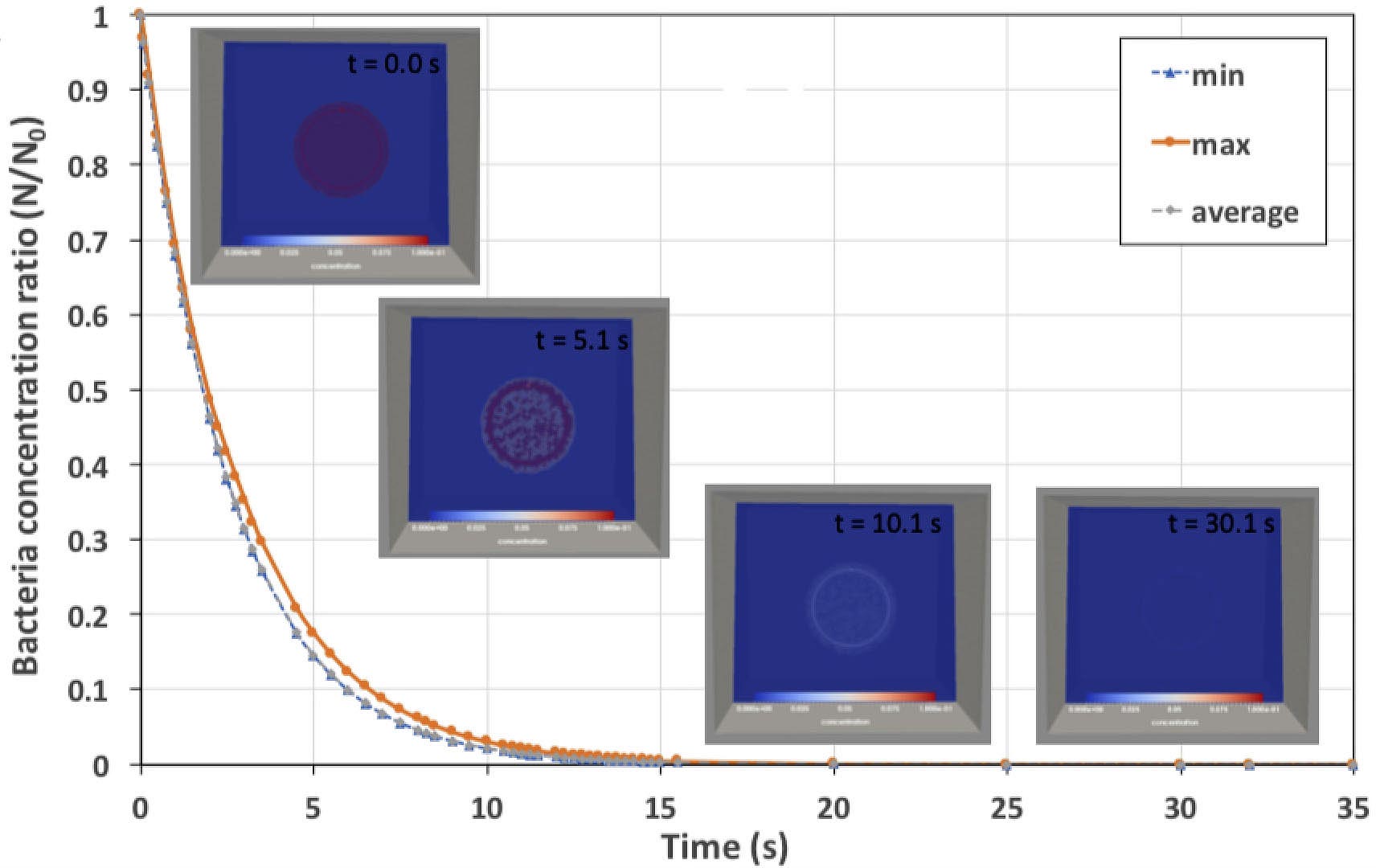
A more effective, environmentally friendly solution could be provided by superheated steam dishwashers. In a study published on August 30, 2022, in Physics of Fluids, by AIP Publishing, researchers from the Technical University of Dortmund and the Technical University of Munich simulated such a dishwasher. They found that it killed 99% of bacteria on a plate in just 25 seconds.
The model of an idealized dishwasher is represented by a box with solid side walls, a top opening, and a nozzle at the bottom. A plate, which is covered with a heat-resistant strain of bacteria, is placed directly above the nozzle. Once the plate reaches a certain threshold temperature in the simulation, the microorganisms can be considered inactivated.
Heat Transfer and Shock Waves in the Dishwasher
“Steam comes out of the nozzle at a very high velocity. We can see shocks, and the turbulent flow that is created has eddies and vortices,” said author Natalie Germann, of the Technical University of Dortmund. “We also include heat transfer, which shows how the heat changes in the simulation box and the condensation on the solid surfaces.”
The shock waves, created by the high velocity of the steam, are reflected at surfaces in the dishwasher. In the work, the team focused on bacteria. However, the shocks could be used to effectively remove food debris in the future.
“Our study helps determine the strength of the shocks, the position of the shocks, and the vortices that are created inside the dishwasher,” said author Laila Abu-Farah, of the Technical University of Munich. “These things are very important for arranging the items or objects inside the dishwasher and the placement and orientation of the nozzles.”
Fast, Effective, and Hygienic Dishwashing
While the simulations show quick inactivation of the bacteria, actual applications of the dishwasher would include more than one plate and would therefore require more time. However, the scientists believe it would still be much faster and more effective than conventional technology.
Although the superheated steam dishwasher would initially cost more, it would pay off in the long run with savings on water, electricity, and detergent. It would be ideal for use in places that must meet high hygienic standards, including restaurants, hotels, and hospitals.
“We confirmed that the dishwasher application using superheated steam is promising,” said Germann. “This is the first work combining fluid dynamics and heat transfer with phase change and bacterial inactivation. It thus lays the foundation for future computational research and further technical work.”
Reference: “Simulations of thermal phase changes and bacterial inactivation in a superheated steam dishwasher” by L. Abu-Farah and N. Germann, 30 August 2022, Physics of Fluids.
DOI: 10.1063/5.0090418
Never miss a breakthrough: Join the SciTechDaily newsletter.
Follow us on Google and Google News.
12 Comments
It seems this new technique not so much washes dishes, as it sterilizes them. The dishwasher soap is not just to sterilize, but to act as a surfactant enable the emulsion of fats in the wash water. Superheated steam would do a fine job of dissolving food particles left on the plates, but your dishwasher would need to be an ASME certified pressure vessel.
The superheated steam might be a sterilizing, and drying end of the cycle. Superheated steam is quite effective at evaporating liquid water. Once the interior of the washing machine reached a temperature a bit above the boiling point, there would be no more liqid water present, and the door could be opened to let the dishes cool, and so cooling steam would not condense on the inside of the dishwasher.
Modem dishwashers are very water and energy efficient so that is misleading
I literally wondered about this exact thing myself. Soap serves two primary purposes, to physically remove particles from surfaces, and to kill bacteria. I figured that high pressure and high temperature steam could do the same thing, especially when paired with an automated scrubber.
Should’ve put in a patent.
What about all of those plastic fancy patterned cups and plates I have? How well do they hold up to superheated steam? I guess that it’s usefulness in the home is, at best, still in the theoretical phase.
“Ryan | September 3, 2022 at 9:55 am | Reply
Modem dishwashers are very water and energy efficient so that is misleading”
Not even close to hand washing. So not good enough.
Hand-washing is terribly inefficient as performed by most people. https://onlinelibrary.wiley.com/doi/abs/10.1111/j.1470-6431.2011.01051.x
High pressured steam is exactly what we need in our kitchens, especially if you have little kids. What could go wrong, eh?
Simon Tremblay: looks like you’ve got some research to do!
Basic soap is a poor killer of pathogens. It’s main purpose is to reduce the stickiness of the bacterial cell membrane and allow the water to remove the bacteria down the drain.
Hmmm… super-heated-steam?…Probably going to melt the take-out-tupperware and sippy-cups…
This is well known to any dishwasher in a foodservice establishment. Try to wash dishes, pots and pans with Coldwater and any kind of dish soap. You will get greasy dirty dishes. I guess you have to be a super genius like Sheldon in The Big Bang Theory. I could have told them about the steam forming waves. I’ve seen it a million times. It’s called sheeting.
… there was a better way than that, all one would needed is micro waves, but the chemistry is well established in many countries and lobby run the shows… who cares about the nature, etc… Patent is stolen by big companies…