
Close Menu
    Facebook X (Twitter) Instagram
    SciTechDaily
    • Biology
    • Chemistry
    • Earth
    • Health
    • Physics
    • Science
    • Space
    • Technology
    Facebook X (Twitter) Pinterest YouTube RSS
    SciTechDaily
    Home»Physics»Simulations Reveal Fundamental Insights on Janus Particles
    Physics

    Simulations Reveal Fundamental Insights on Janus Particles

    By American Institute of PhysicsJanuary 31, 2022No Comments3 Mins Read
    Facebook Twitter Pinterest Telegram LinkedIn WhatsApp Email Reddit
    Share
    Facebook Twitter LinkedIn Pinterest Telegram Email Reddit
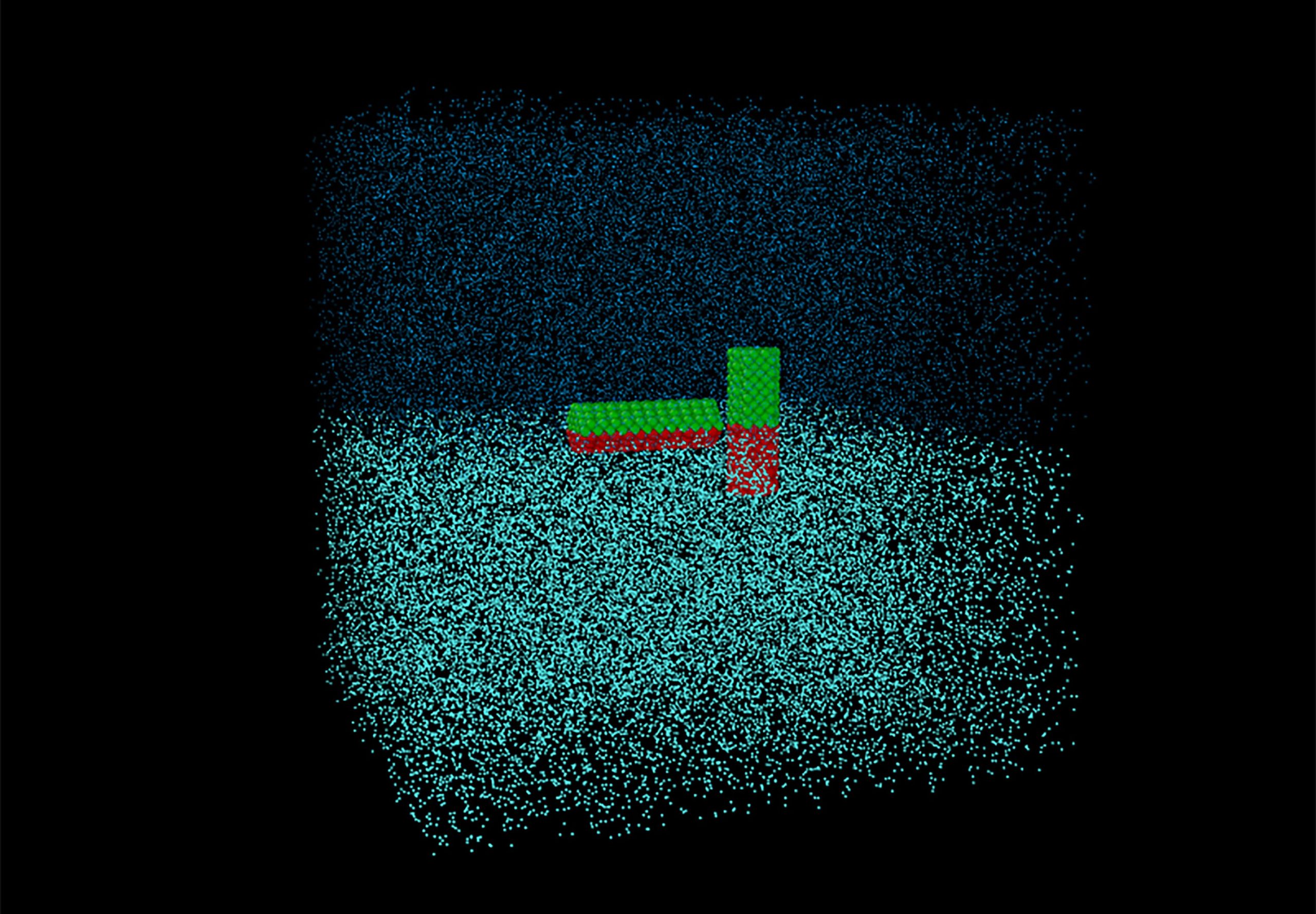
    Janus Rods Surface Characteristics
    Janus rods with the same surface characteristics except for the geometry of the coating are depicted. The particles assume completely different orientations, implying they also assume different mechanical properties for the overall interface. Credit: Giovanniantonio Natale

    Interfacial diffusion of nanoparticles strongly affected by their shape and surface coating.

    Named for a Roman god, Janus particles refer to nanoparticles that possess surfaces with two or more distinct physical chemical properties.

    The special nanoparticles were introduced to the scientific community by 1991 Nobel Prize winner Pierre-Gilles de Gennes, who pointed out that “objects with two sides of different wettability have the unique advantage of densely self-assembling at liquid-liquid interfaces,” and consequentially, generating new colloidal structures.

    Applications and Impact of Janus Particles

    The resulting chemical asymmetry led to the discovery of new and unusual molecular properties, making Janus particles relevant to a wide range of applications, from biomedicine to water-repellent textiles to fabrication of membranes with tunable properties.

    Scientists used dissipative particle dynamics (DPD) simulations to examine the translational diffusion of Janus nanoparticles at the interface between two immiscible fluids, incapable of mixing or attaining homogeneity. The study, by researchers from the University of Calgary, in Alberta, Canada, appears in Physics of Fluids, by AIP Publishing.

    Focusing on a cluster of spherical particles used to create a rigid body of Janus rods, the simulations shed light on the dynamic behavior of the nanoparticles, with varying surface coatings and sizes, at a water-oil interface. The work reveals a strong influence of their shape on their orientation at the interface as well as on their mobility.

    “As a result, these varying individual responses modify the interfacial tension of the entire system, which impacts rheology and, thus, processing schemes,” said co-author Giovanniantonio Natale.

    Insights into Janus Particles’ Orientation and Mobility

    Natale and his colleagues describe a “tilting and tumbling” effect due to the presence of local energy minima at the interface, an effect that varies with the aspect ratio of the Janus rods and the surface coverage of their coatings.

    Interfacial tension is shown to reduce with increased aspect ratio as particles shift from an upright position to a tilted orientation. The tension reduces when the coatings are horizontal rather than vertical, since the particles are more stabilized in their orientation.

    In theory, these findings imply the geometrical characteristics of Janus particles can be modified without their surface chemistries becoming altered to produce either stable or unstable emulsions.

    Altogether, the work provides significant and fundamental insight into the dynamics and self-assembly of anisotropic Brownian particles at interfaces, which may better inform the design and fabrication of engineered interfaces.

    “Moreover, we can employ our DPD simulations to optimize systems at the nanoscale, where performing and characterizing experiments is often extremely challenging and time-consuming,” said Natale.

    Reference: “Dynamics of Brownian Janus rods at a liquid–liquid interface” by Mohammad T. Hossain, Ian D. Gates and Giovanniantonio Natale, 25 January 2022, Physics of Fluids.
    DOI: 10.1063/5.0076148

    Never miss a breakthrough: Join the SciTechDaily newsletter.
    Follow us on Google and Google News.

    American Institute of Physics Fluid Dynamics Fluid Mechanics Nanoparticles
    Share. Facebook Twitter Pinterest LinkedIn Email Reddit

    Related Articles

    The Science Behind Skipping Stones: Gateway to Marine Engineering Advances

    Mesmerizing: Watch Water Droplets Merge on the International Space Station

    Sizzling Sound of Deep-Frying Reveals Complex Physics of Vapor Cavities

    Owl Wing Design With Serrated Edges Reduces Aircraft, Wind Turbine Noise Pollution

    Complex Fluid Dynamics May Explain Hydroplaning Phenomenon

    Yikes! Flushing Toilets Create Long-Lasting Clouds of Virus-Containing Particles

    Glug, Glug: Physics of Bubble Dynamics Reveals How to Empty Bottles Faster

    Laser Doppler Velocimetry Delivers New Insights Into Mysterious Fluid Motions

    Galileo’s Jupiter Entry Probe Vaporized – New Gaps Revealed in Heat Shield Modeling

    Leave A Reply Cancel Reply

    • Facebook
    • Twitter
    • Pinterest
    • YouTube

    Don't Miss a Discovery

    Subscribe for the Latest in Science & Tech!

    Trending News

    Scientists Say Love Follows Mathematical Patterns

    “Zombie Cells” Reveal a Hidden Weakness That Could Help Fight Aging

    Alien Signals May Be Hiding in a Radio Band SETI Has Barely Explored

    Earth’s Hidden Thermostat Has Regulated Climate for 60 Million Years

    This 518-Million-Year-Old Creature Reveals How Spiders Got Their Bite

    Scientists Built a Programmable Chip That Can Slow Light on Command

    The Backyard “Silly Sprinkler” That Cracked One of Physics’ Biggest Puzzles

    This Common Sleep Habit Could Be Making You Gain Weight

    Follow SciTechDaily
    • Facebook
    • Twitter
    • YouTube
    • Pinterest
    • Newsletter
    • RSS
    SciTech News
    • Biology News
    • Chemistry News
    • Earth News
    • Health News
    • Physics News
    • Science News
    • Space News
    • Technology News
    Recent Posts
    • Nanoreactor Mimics Living Cells To Supercharge Artificial Photosynthesis
    • New Semiconductor Device Turns Light Into a Directed Current
    • Scientists Develop a Groundbreaking Chip That Operates at Brain-Like Speed
    • Screen Time at Ages 1 and 6 Linked to Lasting Learning and Memory Effects
    • Brain Scans Reveal Which Disorders May Accelerate Brain Aging
    Copyright © 1998 - 2026 SciTechDaily. All Rights Reserved.
    • Science News
    • About
    • Contact
    • Editorial Board
    • Privacy Policy
    • Terms of Use

    Type above and press Enter to search. Press Esc to cancel.