
Close Menu
    Facebook X (Twitter) Instagram
    SciTechDaily
    • Biology
    • Chemistry
    • Earth
    • Health
    • Physics
    • Science
    • Space
    • Technology
    Facebook X (Twitter) Pinterest YouTube RSS
    SciTechDaily
    Home»Technology»99.7% in Only One Hour – New Nanocoating Kills More Bacteria Faster
    Technology

    99.7% in Only One Hour – New Nanocoating Kills More Bacteria Faster

    By University of British ColumbiaSeptember 23, 20221 Comment3 Mins Read
    Facebook Twitter Pinterest Telegram LinkedIn WhatsApp Email Reddit
    Share
    Facebook Twitter LinkedIn Pinterest Telegram Email Reddit
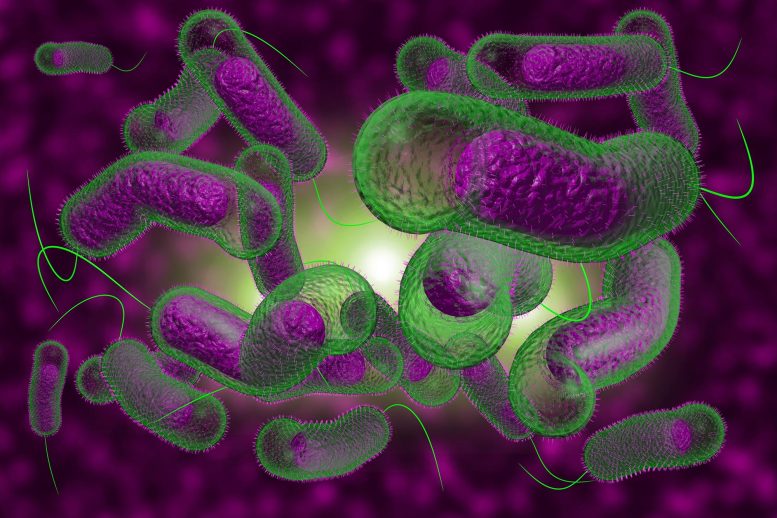
    Cholera Bacteria Illustration
    The coating only needed one hour to kill 99.7% of a common pathogen called Staphylococcus aureus.

    A New Copper Coating Could Be the Next Superbug Fighter

    A new copper covering that kills bacteria faster and in greater amounts than existing formulations might be available for hospitals and other high-traffic locations in the near future.

    Although current formulations comprised of pure copper are antibacterial and self-sanitizing, they kill certain forms of bacteria with a thicker cell wall (Gram-positive bacteria), more slowly than bacteria with a thinner cell wall (Gram-negative).

    Nano-Copper Coating with Zinc for Enhanced Effectiveness

    Using zinc and bacteria-killing nanoscale features, a team of the University of British Columbia researchers under the direction of Dr. Amanda Clifford, an assistant professor in the department of materials engineering, has created a nano-copper coating. Small bumps known as nanoscale features have the power to kill bacteria by rupturing their cell walls. In contrast to pure copper alone, zinc, which is similarly antibacterial, selectively oxidizes in the presence of copper and aids in the faster killing of bacteria.

    “Use of our coating could significantly reduce the incidence of contracting bacterial infections from high-touch surfaces in healthcare facilities, such as doorknobs and elevator buttons since it kills bacteria using multiple approaches,” says Dr. Clifford. “As it contains less copper than other existing coatings or whole copper parts, it would also be cheaper to make.”

    Faster Bacterial Elimination Compared to Pure Copper

    The team found that the material took just one hour to kill 99.7 percent of Staphylococcus aureus—a Gram-positive pathogen commonly responsible for hospital-acquired infections— compared with two hours for pure copper.

    “Not only does this coating kill pathogens faster than pure copper, it helps ensure antibiotics remain effective,” said Dr. Clifford. “By using this new formulation, we’re killing pathogens before patients become infected and need to use antibiotics against them, slowing the rise of antibiotic resistance.”

    The researchers have filed a provisional patent for the coating and fabrication process, which is described in a new paper in Advanced Materials Interfaces.

    “This is currently targeted for hospitals and health care settings because these locations are where the antibiotic-resistant pathogens, such as methicillin-resistant Staphylococcus aureus (MRSA), are an issue. We also don’t want to be at a place where we can’t use antibiotics,” says Dr. Clifford.

    The team plans to further evaluate the material against other pathogens, such as viruses, with hopes of eventually commercializing their work.

    Reference: “An Engineered Nanocomposite Copper Coating with Enhanced Antibacterial Efficacy” by Davood Nakhaie, Teresa C. Williams, Billie Velapatino, Elizabeth A. Bryce, Marthe K. Charles, Edouard Asselin and Amanda M. Clifford, 21 July 2022, Advanced Materials Interfaces.
    DOI: 10.1002/admi.202201009

    The work is funded in partnership with Teck Resources Limited, which has installed copper surfaces on high-contact surfaces in the faculty of applied science buildings at UBC through its Copper & Health program.

    Never miss a breakthrough: Join the SciTechDaily newsletter.
    Follow us on Google and Google News.

    Bacteria Materials Science Nanotechnology Popular University of British Columbia
    Share. Facebook Twitter Pinterest LinkedIn Email Reddit

    Related Articles

    Niobium Nanowire Yarns Make High-Performance Supercapacitors

    New Non-Invasive MRI Technology Detects Alzheimer’s Disease Early

    MIT Develops Membrane That Can Separate Highly Mixed Oil-Spill Residues

    New Approach for Mixing Nanoparticles to Produce Composite Materials

    Controlled Graphene Crumpling Used as Artificial Muscle Actuators

    Nanoscale Coating Repels Virtually Any Liquid

    Nanosheet-Flower Structure Boosts Energy Storage

    Spray Paint Battery Can be Painted on Virtually Any Surface

    Engineered Nanoparticles Deliver Antibiotics Directly to Bacteria

    1 Comment

    1. John Bayer on September 26, 2022 2:16 am

      FYI that ain’t Staph in the illustration.

      Reply
    Leave A Reply Cancel Reply

    • Facebook
    • Twitter
    • Pinterest
    • YouTube

    Don't Miss a Discovery

    Subscribe for the Latest in Science & Tech!

    Trending News

    289-Million-Year-Old Reptile Mummy Reveals Origin of Human Breathing System

    New Brain Discovery Challenges Long-Held Theory of Teenage Brain Development

    Scientists Discover Plants “Scream” – We Just Couldn’t Hear Them Until Now

    Scientists Discover a Surprising Reason Intermittent Fasting Extends Life

    This Simple Fruit Wash Could Make Produce Safer and Last Days Longer

    Scientists Say Adding This Unusual Seafood to Your Diet Could Reverse Signs of Aging

    Scientists Say a Hidden Structure May Exist Inside Earth’s Core

    Doctors Surprised by the Power of a Simple Drug Against Colon Cancer

    Follow SciTechDaily
    • Facebook
    • Twitter
    • YouTube
    • Pinterest
    • Newsletter
    • RSS
    SciTech News
    • Biology News
    • Chemistry News
    • Earth News
    • Health News
    • Physics News
    • Science News
    • Space News
    • Technology News
    Recent Posts
    • Nearly 1 in 5 Gray Whales That Enter San Francisco Bay Die There
    • The Ozone Layer Is Healing, But There’s a Hidden Catch
    • Earth’s Crust Is Tearing Open in Africa, and It Could Form a New Ocean
    • Breakthrough Bowel Cancer Trial Leaves Patients Cancer-Free for Nearly 3 Years
    • New Immune Pathway Could Supercharge mRNA Cancer Vaccines
    Copyright © 1998 - 2026 SciTechDaily. All Rights Reserved.
    • Science News
    • About
    • Contact
    • Editorial Board
    • Privacy Policy
    • Terms of Use

    Type above and press Enter to search. Press Esc to cancel.