
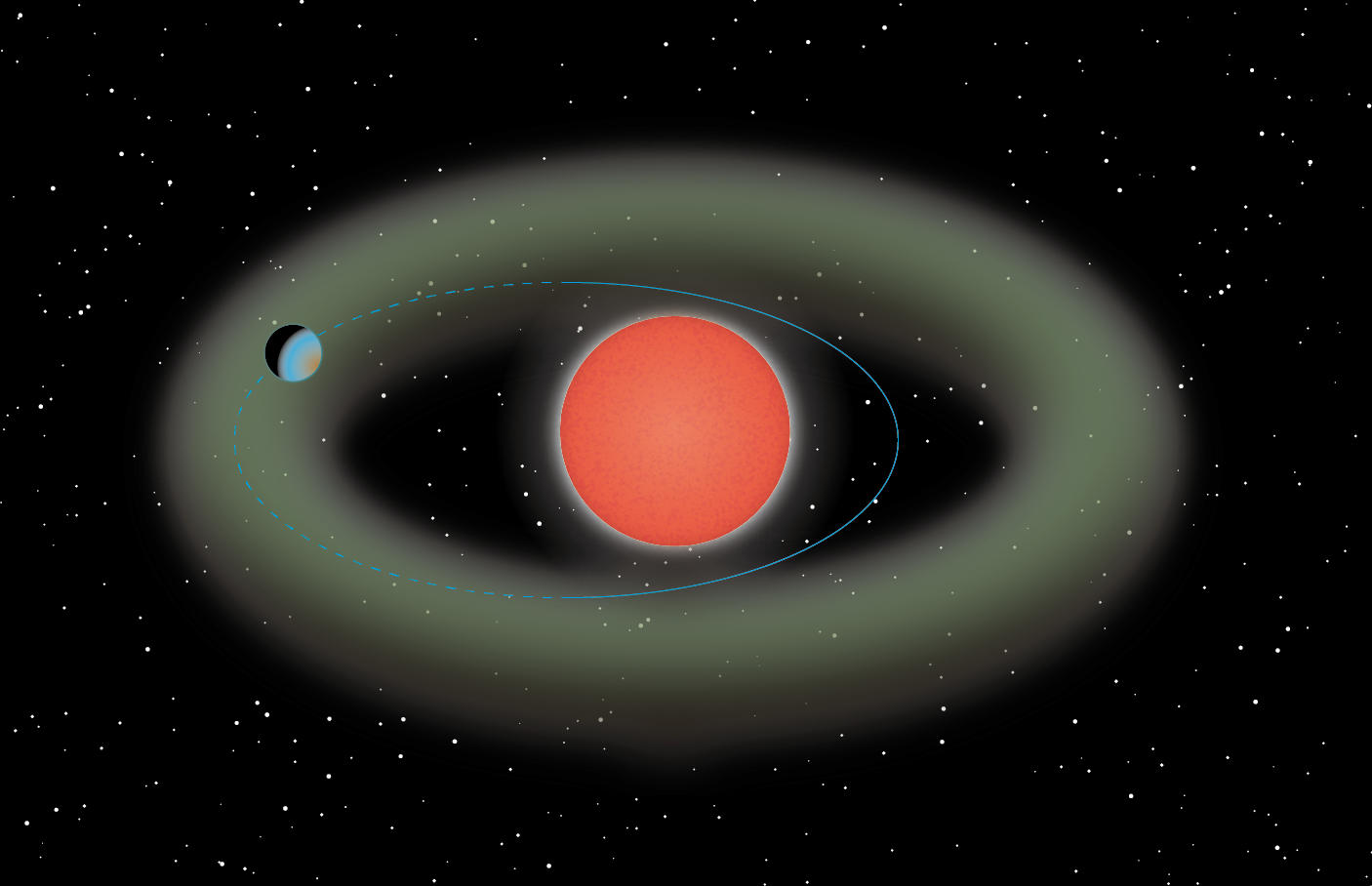
A New Super-Earth Planet Was Found 37 Light Years From Earth
Only 37 light-years from Earth, a super-Earth planet has been discovered close to a red dwarf star’s habitable zone. This is the first finding made by a brand-new instrument on the Subaru Telescope, and it presents an opportunity to look into the possibility of life existing on planets around nearby stars. With such a promising initial finding, we can hope the Subaru Telescope finds more, perhaps even better, candidates for habitable planets near red dwarfs in the future.
Three-quarters of the stars in the Milky Way Galaxy are red dwarfs, which are smaller than the Sun and abundant in the solar neighborhood. They are thus crucial targets in the hunt for nearby extrasolar planets and extraterrestrial life. Red dwarfs are cooler than other kinds of stars and produce less visible light, which makes it challenging to study them.
Red dwarfs are more visible at infrared wavelengths. In order to look for evidence of planets surrounding red dwarf stars, the Astrobiology Center in Japan created an infrared observational instrument mounted atop the Subaru Telescope. The instrument is called IRD for Infrared Doppler, the observational method used in this search.
Potential for Habitable Conditions on Ross 508 b
The first fruits of this search are signs of a super-Earth four times the mass of the Earth circling the star Ross 508, located 37 light-years away in the constellation Serpens. This planet, Ross 508 b, has a year of only 11 Earth-days and lies at the inner edge of the habitable zone around its host star. Interestingly, there are indications that the orbit is elliptical, which would mean that for part of the orbit the planet would be in the habitable zone, the region where conditions would be right for liquid water to exist on the surface of the planet. Whether or not there is actually water or life are questions of further study.
To have the very first planet discovered by this new method be so tantalizingly close to the habitable zone seems too good to be true and bodes well for future discoveries. Bun’ei Sato, a Professor at the Tokyo Institute of Technology and the principal investigator in this search comments, “It has been 14 years since the start of IRD’s development. We have continued our development and research with the hope of finding a planet exactly like Ross 508 b.”
Reference: “A super-Earth orbiting near the inner edge of the habitable zone around the M4.5 dwarf Ross 508” by Hiroki Harakawa, Takuya Takarada, Yui Kasagi, Teruyuki Hirano, Takayuki Kotani, Masayuki Kuzuhara, Masashi Omiya, Hajime Kawahara, Akihiko Fukui, Yasunori Hori, Hiroyuki Tako Ishikawa, Masahiro Ogihara, John Livingston, Timothy D Brandt, Thayne Currie, Wako Aoki, Charles A Beichman, Thomas Henning, Klaus Hodapp, Masato Ishizuka, Hideyuki Izumiura, Shane Jacobson, Markus Janson, Eiji Kambe, Takanori Kodama, Eiichiro Kokubo, Mihoko Konishi, Vigneshwaran Krishnamurthy, Tomoyuki Kudo, Takashi Kurokawa, Nobuhiko Kusakabe, Jungmi Kwon, Yuji Matsumoto, Michael W McElwain, Koyu Mitsui, Takao Nakagawa, Norio Narita, Jun Nishikawa, Stevanus K Nugroho, Eugene Serabyn, Takuma Serizawa, Aoi Takahashi, Akitoshi Ueda, Taichi Uyama, Sébastien Vievard, Ji Wang, John Wisniewski, Motohide Tamura and Bun’ei Sato, 30 June 2022, Publications of the Astronomical Society of Japan.
DOI: 10.1093/pasj/psac044
Never miss a breakthrough: Join the SciTechDaily newsletter.
Follow us on Google and Google News.
2 Comments
The space-time motion is the interaction of countless topological vortex fields. That is the nature of world.
Fun fun fun
In the sun sun sun