
Close Menu
    Facebook X (Twitter) Instagram
    SciTechDaily
    • Biology
    • Chemistry
    • Earth
    • Health
    • Physics
    • Science
    • Space
    • Technology
    Facebook X (Twitter) Pinterest YouTube RSS
    SciTechDaily
    Home»Space»Four Minute Video Shows Three Years of SDO Images
    Space

    Four Minute Video Shows Three Years of SDO Images

    By Karen C. Fox and Scott Wiessinger, NASA's Goddard Space Flight Center; NASAApril 23, 20131 Comment3 Mins Read
    Facebook Twitter Pinterest Telegram LinkedIn WhatsApp Email Reddit
    Share
    Facebook Twitter LinkedIn Pinterest Telegram Email Reddit
    Three Years of SDO Images in a Four Minute Video
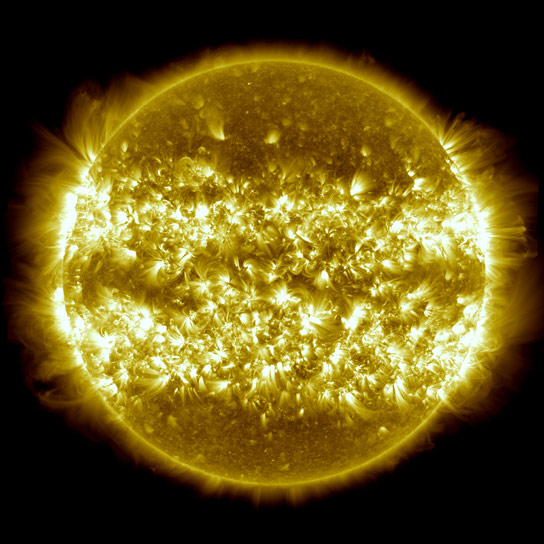
    This image is a composite of 25 separate images spanning the period of April 16, 2012, to April 15, 2013. It uses the SDO AIA wavelength of 171 angstroms and reveals the zones on the sun where active regions are most common during this part of the solar cycle. Credit: NASA/SDO/AIA/S. Wiessinger

    NASA’s Solar Dynamics Observatory has had consistent coverage of the sun’s rise toward solar maximum since 2010 and now that data has been compressed into a four-minute video at a pace of two images per day.

    In the three years since it first provided images of the sun in the spring of 2010, NASA’s Solar Dynamics Observatory (SDO) has had virtually unbroken coverage of the sun’s rise toward solar maximum, the peak of solar activity in its regular 11-year cycle. This video shows those three years of the sun at a pace of two images per day. Each image is displayed for two frames at a 29.97 frame rate.

    SDO’s Atmospheric Imaging Assembly (AIA) captures a shot of the sun every 12 seconds in 10 different wavelengths. The images shown here are based on a wavelength of 171 Angstroms, which is in the extreme ultraviolet range and shows solar material at around 600,000 Kelvin (600,000 Celsius or 1.1 million Fahrenheit). In this wavelength it is easy to see the sun’s 25-day rotation as well as how solar activity has increased over three years.

    During the course of the video, the sun subtly increases and decreases in apparent size. This is because the distance between the SDO spacecraft and the sun varies over time. The image is, however, remarkably consistent and stable despite the fact that SDO orbits the Earth at 6,876 miles (11,065 kilometers) per hour and the Earth orbits the sun at 67,062 miles (107,926 kilometers) per hour.

    Such stability is crucial for scientists, who use SDO to learn more about our closest star. These images have regularly caught solar flares and coronal mass ejections in the act, types of space weather that can send radiation and solar material toward Earth and interfere with satellites in space. SDO’s glimpses into the violent dance on the sun help scientists understand what causes these giant explosions – with the hopes of someday improving our ability to predict this space weather.

    The four-wavelength view at the end of the video shows light at 4500 Angstroms, which is basically the visible light view of the sun, and reveals sunspots; light at 193 Angstroms which highlights material at 1 million Kelvin and reveals more of the sun’s corona; light at 304 Angstroms which highlights material at around 50,000 Kelvin (90,000 Fahrenheit) and shows features in the transition region and chromosphere of the sun; and light at 171 Angstroms.

    Noteworthy events that appear briefly in the main sequence of this video:

    • 00:30;24 Partial eclipse by the moon
    • 00:31;16 Roll maneuver
    • 01:11;02 August 9, 2011, X6.9 Flare, currently the largest of this solar cycle
    • 01:28;07 Comet Lovejoy, December 15, 2011
    • 01:42;29 Roll Maneuver
    • 01:51;07 Transit of Venus, June 5, 2012
    • 02:28;13 Partial eclipse by the moon

    Never miss a breakthrough: Join the SciTechDaily newsletter.
    Follow us on Google and Google News.

    NASA Solar Dynamics Observatory Sun
    Share. Facebook Twitter Pinterest LinkedIn Email Reddit

    Related Articles

    NASA Just Found the Sun’s Secret Warning Before Massive Solar Flares

    Solar Fury Erupts: Sun Rings In the New Year With X1.8 Flare

    NASA’s SDO Reveals Images of X4.9-Class Solar Flare

    NASA’s Solar Dynamics Observatory Views Two New Solar Flares

    Scientists Overturn Previous Notions of How the Sun’s Writhing Insides Move

    Sun’s Magnetic Field Weaker Than a Normal Fridge Magnet

    New Light Shed on the Origins of Extreme Space Storms

    NASA Solar Dynamics Observatory Captures Eruption in Extreme UV

    Solar Dynamics Observatory Measures Magnetic Fields on Sun’s Surface

    1 Comment

    1. John Eric Otter on October 19, 2014 9:00 pm

      There is also a giraffe that appears in the 193 angstroms segment!

      Reply
    Leave A Reply Cancel Reply

    • Facebook
    • Twitter
    • Pinterest
    • YouTube

    Don't Miss a Discovery

    Subscribe for the Latest in Science & Tech!

    Trending News

    Bees Have a Hidden Nutritional Superpower, Oxford Study Reveals

    A Century-Old Belief About Diamond Has Just Been Overturned

    The Universe Can Expand Faster Than Light Without Breaking Physics

    The Exercise Paradox: Why Workouts Don’t Guarantee Weight Loss

    This Ancient Sea Animal Fights Viruses in the Opposite Way Humans Do

    39 Sweeteners Put to the Test Produced Surprising Gut Changes

    This Experimental Drug Repaired the Gut and Reversed Severe Fatty Liver Disease

    Physicists Just Turned a Black Hole Energy Theory Into Reality

    Follow SciTechDaily
    • Facebook
    • Twitter
    • YouTube
    • Pinterest
    • Newsletter
    • RSS
    SciTech News
    • Biology News
    • Chemistry News
    • Earth News
    • Health News
    • Physics News
    • Science News
    • Space News
    • Technology News
    Recent Posts
    • Scientists Watch Chemistry Unfold Atom by Atom
    • 20 Years in the Making: Physicists Confirm Long-Standing Quantum Prediction
    • Scientists Build the First 3D Cloak That Makes Objects Invisible To Heat
    • Researchers Warn Women About Viral Exercise Myths
    • Common Diet Advice About Water and Spicy Food May Be Completely Wrong
    Copyright © 1998 - 2026 SciTechDaily. All Rights Reserved.
    • Science News
    • About
    • Contact
    • Editorial Board
    • Privacy Policy
    • Terms of Use

    Type above and press Enter to search. Press Esc to cancel.