
Close Menu
    Facebook X (Twitter) Instagram
    SciTechDaily
    • Biology
    • Chemistry
    • Earth
    • Health
    • Physics
    • Science
    • Space
    • Technology
    Facebook X (Twitter) Pinterest YouTube RSS
    SciTechDaily
    Home»Space»NASA Solar Dynamics Observatory Captures Eruption in Extreme UV
    Space

    NASA Solar Dynamics Observatory Captures Eruption in Extreme UV

    By SciTechDailyApril 9, 2012No Comments2 Mins Read
    Facebook Twitter Pinterest Telegram LinkedIn WhatsApp Email Reddit
    Share
    Facebook Twitter LinkedIn Pinterest Telegram Email Reddit
    CME-solar-flare-mercury
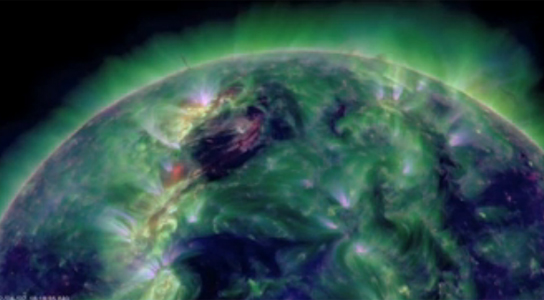
    Coronal Mass Ejection (CME) in UV light.

    The NASA Solar Dynamics Observatory was able to capture this incredible video of a recent coronal mass ejection (CME) on April 7th from the sun’s surface. What makes this video unique is that it was captured in extreme ultraviolet light, giving it an otherworldly feel.

    It’s been widely reported that Sol is entering an active phase, implying that 2012 will be filled with solar flares and solar storms. Chaotic field lines have been cracking around the sun for the past few days. One of these lines produced a modest solar flare in the late hours of April 7th.

    The flare generated a CME, which is basically a massive cloud of charged particles that were hurled into space, that can cause auroras. However, in this case, models run by the Goddard Space Weather Lab suggest that it will miss Earth and hit Mercury on April 9th around 02:29 UT. Since Mercury’s magnetic field is comparatively weak, about 10% of Earth’s, and its atmosphere is relatively thin, the particles will hit the planet’s surface and scour it as well as add material to its comet-like tail.


    On April 7th 2012, a coronal mass ejection was lofted towards Mercury and set to slam into its ultra-thin atmosphere on April 9th. The Solar Dynamics Observatory captured the blast in extreme ultraviolet. Credit: NASA / SDO / Mash Mix: SPACE.com / Original Music by Mark C. Petersen, Loch Ness Productions

    Never miss a breakthrough: Join the SciTechDaily newsletter.
    Follow us on Google and Google News.

    Coronal Mass Ejections Eruption NASA Popular Sol Solar Dynamics Observatory Sun
    Share. Facebook Twitter Pinterest LinkedIn Email Reddit

    Related Articles

    Fury Unleashed: Sun Emits Monumental X6.3 Flare, the Strongest in 6 Years

    Sun Unleashes X3.3 Fury – NASA’s SDO Captures Powerful Solar Flare

    NASA Captures Sun’s Fury: Strongest Solar Flare Since 2017

    Intensely Powerful X1.0 Solar Flare Witnessed by NASA’s Solar Dynamics Observatory

    Radiant Fury: Sun Unleashes Powerful X1.0 Class Solar Flare

    New Clues To Predict When and Where the Sun’s Next Flare Might Explode

    Powerful X-Class Solar Flare Erupts From Sun – Captured by NASA’s Solar Dynamics Observatory

    NASA’s Solar Dynamics Observatory Caught the Sun “Smiling”

    Sun Blasts Out 3 Powerful Bursts of Energy in Last 24 Hours

    Leave A Reply Cancel Reply

    • Facebook
    • Twitter
    • Pinterest
    • YouTube

    Don't Miss a Discovery

    Subscribe for the Latest in Science & Tech!

    Trending News

    1.4-Million-Year-Old Footprints Reveal a Giant Human Relative

    Astronomers May Have Found the First Moon Beyond Our Solar System

    Underwater Cameras Expose the Secret Lives of Whale Sharks

    Why Dreaming Leaves the Brain Running Low on Energy

    CERN Experiments Detect Signs of the Universe’s Primordial Matter

    Study Finds a Surprising Link Between Gut Microbes and Aging

    Frequent Cannabis Users Wake Up With More “Stress Hormone”

    Scientists Reveal Hidden DNA Traces in the Shroud of Turin

    Follow SciTechDaily
    • Facebook
    • Twitter
    • YouTube
    • Pinterest
    • Newsletter
    • RSS
    SciTech News
    • Biology News
    • Chemistry News
    • Earth News
    • Health News
    • Physics News
    • Science News
    • Space News
    • Technology News
    Recent Posts
    • A Daily Multivitamin May Help Older Adults Stay Active
    • Blood Test May Reveal Alzheimer’s Risk Years Before Symptoms
    • Scientists Thought SuperAgers Had Lucky Genes. They Were Wrong
    • Humans and Mice May Process Smells in Very Similar Ways
    • These Beautiful Flowers Can Paralyze You, but Their Chemistry Could Save Lives
    Copyright © 1998 - 2026 SciTechDaily. All Rights Reserved.
    • Science News
    • About
    • Contact
    • Editorial Board
    • Privacy Policy
    • Terms of Use

    Type above and press Enter to search. Press Esc to cancel.