
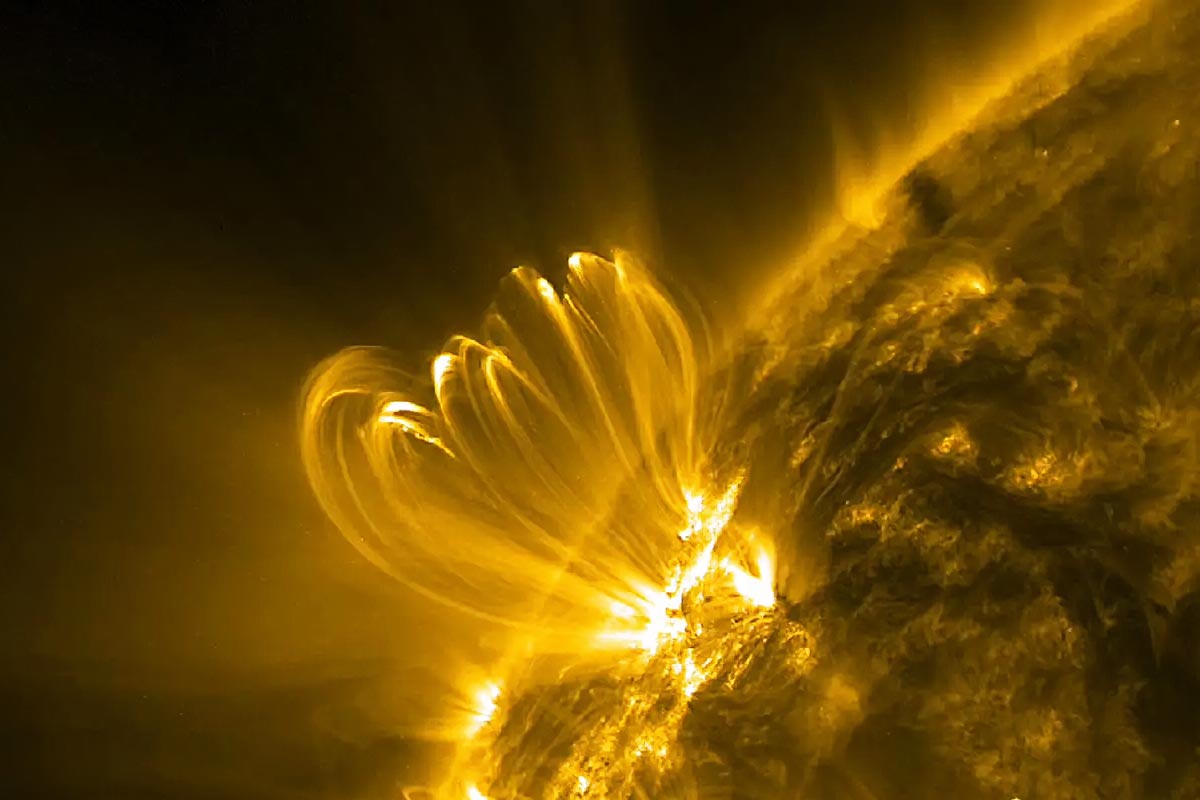
Scientists have long struggled to accurately predict solar flares, but a recent breakthrough using NASA’s Solar Dynamics Observatory has uncovered a promising new sign: flickering coronal loops.
These arch-like structures in the Sun’s atmosphere show erratic brightness fluctuations just hours before a flare, potentially providing a much-needed early warning system. With the potential to predict flares with significant accuracy, this discovery could revolutionize how we protect astronauts, satellites, and power grids from hazardous space weather.
Unveiling Solar Flare Predictors
For many years scientists have struggled to accurately predict solar flares — powerful bursts of energy from the Sun that can send charged particles racing through the solar system. Now, using data from NASA’s Solar Dynamics Observatory (SDO), researchers have discovered flickering loops in the Sun’s atmosphere, known as the corona, that may serve as an early warning sign of an impending solar flare.
This discovery could help NASA and other organizations protect astronauts, satellites, and ground-based technology from the potentially harmful effects of space weather.
Studying Coronal Loops for Clues
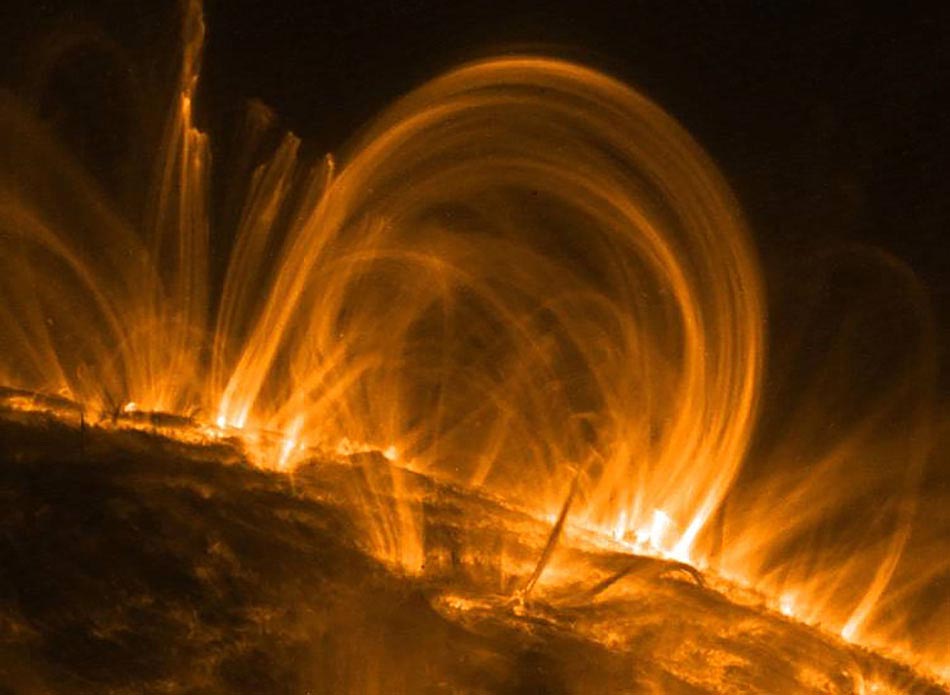
The research team, led by heliophysicist Emily Mason from Predictive Sciences Inc. in San Diego, California, focused on coronal loops — arching structures that extend from the Sun’s surface. These loops form in magnetically active regions, the same areas where solar flares originate.
The team looked at coronal loops near 50 strong solar flares, analyzing how their brightness in extreme ultraviolet light varied in the hours before a flare compared to loops above non-flaring regions. Like flashing warning lights, the loops above flaring regions varied much more than those above non-flaring regions.
The four panels in this movie show brightness changes in coronal loops in four different wavelengths of extreme ultraviolet light (131, 171, 193, and 304 angstroms) before a solar flare in December 2011. The images were taken by the Atmospheric Imaging Assembly (AIA) on NASA’s Solar Dynamics Observatory and processed to reveal flickering in the coronal loops. Credit: NASA/Solar Dynamics Observatory/JHelioviewer/E. Mason
Erratic Flickers: A Crucial Discovery
“We found that some of the extreme ultraviolet light above active regions flickers erratically for a few hours before a solar flare,” Mason explained. “The results are really important for understanding flares and may improve our ability to predict dangerous space weather.”
Published in the Astrophysical Journal Letters in December 2024 and presented on January 15, 2025, at a press conference during the 245th meeting of the American Astronomical Society, the results also hint that the flickering reaches a peak earlier for stronger flares. However, the team says more observations are needed to confirm this link.
Other researchers have tried to predict solar flares by examining magnetic fields on the Sun, or by looking for consistent trends in other coronal loop features. However, Mason and her colleagues believe that measuring the brightness variations in coronal loops could provide more precise warnings than those methods — signaling oncoming flares 2 to 6 hours ahead of time with 60 to 80 percent accuracy.
Predicting Solar Flares with Precision
“A lot of the predictive schemes that have been developed are still predicting the likelihood of flares in a given time period and not necessarily exact timing,” said team member Seth Garland of the Air Force Institute of Technology at Wright-Patterson Air Force Base in Ohio.
“Each solar flare is like a snowflake — every single flare is unique.”
Kara kniezewski, Air Force Institute of Technology
“The Sun’s corona is a dynamic environment, and each solar flare is like a snowflake — every single flare is unique,” said team member Kara Kniezewski, a graduate student at the Air Force Institute of Technology and lead author of the paper. “We find that searching for periods of ‘chaotic’ behavior in the coronal loop emission, rather than specific trends, provide a much more consistent metric and may also correlate with how strong a flare will be.”
From Research to Real-World Applications
The scientists hope their findings about coronal loops can eventually be used to help keep astronauts, spacecraft, electrical grids, and other assets safe from the harmful radiation that accompanies solar flares. For example, an automated system could look for brightness changes in coronal loops in real-time images from the Solar Dynamics Observatory and issue alerts.
“Previous work by other researchers reports some interesting prediction metrics,” said co-author Vadim Uritsky of NASA’s Goddard Space Flight Center in Greenbelt, Maryland, and the Catholic University of Washington in D.C. “We could build on this and come up with a well-tested and, ideally, simpler indicator ready for the leap from research to operations.”
Reference: “131 and 304 Å Emission Variability Increases Hours Prior to Solar Flare Onset” by Kara L. Kniezewski, E. I. Mason, Vadim M. Uritsky and Seth H. Garland, 6 December 2024, The Astrophysical Journal Letters.
DOI: 10.3847/2041-8213/ad94dd
Never miss a breakthrough: Join the SciTechDaily newsletter.
Follow us on Google and Google News.