
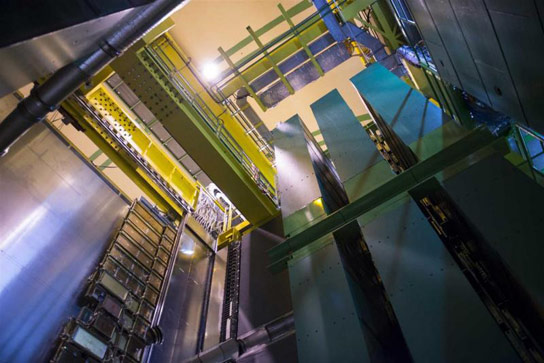
A new study from the LHCb collaboration at CERN details the first observation of matter-antimatter asymmetry in the decays of the particle known as the B0s, viewing a preference for matter over antimatter known as CP-violation in the decay of neutral B0s particles.
The LHCb collaboration at CERN today submitted a paper to Physical Review Letters on the first observation of matter-antimatter asymmetry in the decays of the particle known as the B0s. It is only the fourth subatomic particle known to exhibit such behavior.
Matter and antimatter are thought to have existed in equal amounts at the beginning of the universe, but today the universe appears to be composed essentially of matter. By studying subtle differences in the behavior of particles and antiparticles, experiments at the LHC are seeking to cast light on this dominance of matter over antimatter.
Now the LHCb experiment has observed a preference for matter over antimatter known as CP-violation in the decay of neutral B0s particles. The results are based on the analysis of data collected by the experiment in 2011. “The discovery of the asymmetric behavior in the B0S particle comes with a significance of more than 5 sigma – a result that was only possible thanks to the large amount of data provided by the LHC and to the LHCb detector’s particle identification capabilities,” says Pierluigi Campana, spokesperson of the LHCb collaboration [see video interview]. “Experiments elsewhere have not been in a position to accumulate a large enough number of B0s decays.”
Violation of the CP symmetry was first observed at Brookhaven Laboratory in the US in the 1960s in neutral particles called kaons. About 40 years later, experiments in Japan and the US found similar behavior in another particle, the B0 meson. More recently, experiments at the so-called B factories and the LHCb experiment at CERN have found that the B+ meson also demonstrates CP violation.
All of these CP violation phenomena can be accounted for in the Standard Model, although some interesting discrepancies demand more detailed studies. “We also know that the total effects induced by Standard Model CP violation are too small to account for the matter-dominated universe,” says Campana. “However, by studying these CP violation effects we are looking for the missing pieces of the puzzle, which provide stringent tests of the theory and are a sensitive probe for revealing the presence of physics beyond the Standard Model.”
Reference: “First observation of CP violation in the decays of Bs mesons” by LHCb collaboration: R. Aaij, C. Abellan Beteta, B. Adeva, M. Adinolfi, C. Adrover, A. Affolder, Z. Ajaltouni, J. Albrecht, F. Alessio, M. Alexander, S. Ali, G. Alkhazov, P. Alvarez Cartelle, A.A. Alves Jr, S. Amato, S. Amerio, Y. Amhis, L. Anderlini, J. Anderson, R. Andreassen, R.B. Appleby, O. Aquines Gutierrez, F. Archilli, A. Artamonov, M. Artuso, E. Aslanides, G. Auriemma, S. Bachmann, J.J. Back, C. Baesso, V. Balagura, W. Baldini, R.J. Barlow, C. Barschel, S. Barsuk, W. Barter, Th. Bauer, A. Bay, J. Beddow, F. Bedeschi, I. Bediaga, S. Belogurov, K. Belous, I. Belyaev, E. Ben-Haim, G. Bencivenni, S. Benson, J. Benton, A. Berezhnoy, R. Bernet, M.-O. Bettler, M. van Beuzekom, A. Bien, S. Bifani, T. Bird, A. Bizzeti, P.M. Bjørnstad, T. Blake, F. Blanc, J. Blouw, S. Blusk, V. Bocci, A. Bondar, N. Bondar, W. Bonivento, S. Borghi, A. Borgia, T.J.V. Bowcock, E. Bowen, C. Bozzi, T. Brambach, J. van den Brand, J. Bressieux, D. Brett, M. Britsch, T. Britton, N.H. Brook, H. Brown, I. Burducea, A. Bursche, G. Busetto, J. Buytaert, S. Cadeddu, O. Callot, M. Calvi, M. Calvo Gomez, A. Camboni, P. Campana, D. Campora Perez, A. Carbone, G. Carboni, R. Cardinale, A. Cardini, H. Carranza-Mejia, L. Carson, K. Carvalho Akiba, G. Casse, L. Castillo Garcia, M. Cattaneo , Ch. Cauet, M. Charles, Ph. Charpentier, P. Chen, N. Chiapolini, M. Chrzaszcz, K. Ciba, X. Cid Vidal, G. Ciezarek, P.E.L. Clarke, M. Clemencic, H.V. Cliff, J. Closier, C. Coca, V. Coco, J. Cogan, E. Cogneras, P. Collins, A. Comerma-Montells, A. Contu, A. Cook, M. Coombes, S. Coquereau, G. Corti, B. Couturier, G.A. Cowan, D.C. Craik, S. Cunliffe, R. Currie, C. D’Ambrosio, P. David, P.N.Y. David, A. Davis, I. De Bonis, K. De Bruyn, S. De Capua, M. De Cian, J.M. De Miranda, L. De Paula, W. De Silva, P. De Simone, D. Decamp, M. Deckenhoff, L. Del Buono, N. Déléage, D. Derkach, O. Deschamps, F. Dettori, A. Di Canto, F. Di Ruscio, H. Dijkstra, M. Dogaru, S. Donleavy, F. Dordei, A. Dosil Suárez, D. Dossett, A. Dovbnya, F. Dupertuis, R. Dzhelyadin, A. Dziurda, A. Dzyuba, S. Easo, U. Egede, V. Egorychev, S. Eidelman, D. van Eijk, S. Eisenhardt, U. Eitschberger, R. Ekelhof, L. Eklund, I. El Rifai, Ch. Elsasser, D. Elsby, A. Falabella, C. Färber, G. Fardell, C. Farinelli, S. Farry, V. Fave, D. Ferguson, V. Fernandez Albor, F. Ferreira Rodrigues, M. Ferro-Luzzi, S. Filippov, M. Fiore, C. Fitzpatrick, M. Fontana, F. Fontanelli, R. Forty, O. Francisco, M. Frank, C. Frei, M. Frosini, S. Furcas, E. Furfaro, A. Gallas Torreira, D. Galli, M. Gandelman, P. Gandini, Y. Gao, J. Garofoli, P. Garosi, J. Garra Tico, L. Garrido, C. Gaspar, R. Gauld, E. Gersabeck, M. Gersabeck, T. Gershon, Ph. Ghez, V. Gibson, V.V. Gligorov, C. Göbel, D. Golubkov, A. Golutvin, A. Gomes, H. Gordon, M. Grabalosa Gándara, R. Graciani Diaz, L.A. Granado Cardoso, E. Graugés, G. Graziani, A. Grecu, E. Greening, S. Gregson, P. Griffith, O. Grünberg, B. Gui, E. Gushchin, Yu. Guz, T. Gys, C. Hadjivasiliou, G. Haefeli, C. Haen, S.C. Haines, S. Hall, T. Hampson, S. Hansmann-Menzemer, N. Harnew, S.T. Harnew, J. Harrison, T. Hartmann, J. He, V. Heijne, K. Hennessy, P. Henrard, J.A. Hernando Morata, E. van Herwijnen, E. Hicks, D. Hill, M. Hoballah, C. Hombach, P. Hopchev, W. Hulsbergen, P. Hunt, T. Huse, N. Hussain, D. Hutchcroft, D. Hynds, V. Iakovenko, M. Idzik, P. Ilten, R. Jacobsson, A. Jaeger, E. Jans, P. Jaton, A. Jawahery, F. Jing, M. John, D. Johnson, C.R. Jones, C. Joram, B. Jost, M. Kaballo, S. Kandybei, M. Karacson, T.M. Karbach, I.R. Kenyon, U. Kerzel, T. Ketel, A. Keune, B. Khanji, O. Kochebina, I. Komarov, R.F. Koopman, P. Koppenburg, M. Korolev, A. Kozlinskiy, L. Kravchuk, K. Kreplin, M. Kreps, G. Krocker, P. Krokovny, F. Kruse, M. Kucharczyk, V. Kudryavtsev, T. Kvaratskheliya, V.N. La Thi, D. Lacarrere, G. Lafferty, A. Lai, D. Lambert, R.W. Lambert, E. Lanciotti, G. Lanfranchi, C. Langenbruch, T. Latham, C. Lazzeroni, R. Le Gac, J. van Leerdam, J.-P. Lees, R. Lefévre, A. Leflat, J. Lefrançois, S. Leo, O. Leroy, T. Lesiak, B. Leverington, Y. Li, L. Li Gioi, M. Liles, R. Lindner, C. Linn, B. Liu, G. Liu, S. Lohn, I. Longstaff, J.H. Lopes, E. Lopez Asamar, N. Lopez-March, H. Lu, D. Lucchesi, J. Luisier, H. Luo, F. Machefert, I.V. Machikhiliyan, F. Maciuc, O. Maev, S. Malde, G. Manca, G. Mancinelli, U. Marconi, R. Märki, J. Marks, G. Martellotti, A. Martens, L. Martin, A. Martín Sánchez, M. Martinelli, D. Martinez Santos, D. Martins Tostes, A. Massafferri, R. Matev, Z. Mathe, C. Matteuzzi, E. Maurice, A. Mazurov, J. McCarthy, A. McNab, R. McNulty, B. Meadows, F. Meier, M. Meissner, M. Merk, D.A. Milanes, M.-N. Minard, J. Molina Rodriguez, S. Monteil, D. Moran, P. Morawski, M.J. Morello, R. Mountain, I. Mous, F. Muheim, K. Müller, R. Muresan, B. Muryn, B. Muster, P. Naik, T. Nakada, R. Nandakumar, I. Nasteva, M. Needham, N. Neufeld, A.D. Nguyen, T.D. Nguyen, C. Nguyen-Mau, M. Nicol, V. Niess, R. Niet, N. Nikitin, T. Nikodem, A. Nomerotski, A. Novoselov, A. Oblakowska-Mucha, V. Obraztsov, S. Oggero, S. Ogilvy, O. Okhrimenko, R. Oldeman, M. Orlandea, J.M. Otalora Goicochea, P. Owen, A. Oyanguren, B.K. Pal, A. Palano, M. Palutan, J. Panman, A. Papanestis, M. Pappagallo, C. Parkes, C.J. Parkinson, G. Passaleva, G.D. Patel, M. Patel, G.N. Patrick … Z. Yang, R. Young, X. Yuan, O. Yushchenko, M. Zangoli, M. Zavertyaev, F. Zhang, L. Zhang, W.C. Zhang, Y. Zhang, A. Zhelezov, A. Zhokhov, L. Zhong and A. Zvyagin, 30 May 2013, Physical Review Letters.
DOI: 10.1103/PhysRevLett.110.221601
Never miss a breakthrough: Join the SciTechDaily newsletter.
Follow us on Google and Google News.
3 Comments
IT SHOULD BE OBVIOUS THAT MATTER IS DOMINANT OVER ANTIMATTER DUE TO THE PRESENCE OF A LARGE AMOUNT OF MATTER IN THE UNIVERSE IF THIS WERE NOT THE CASE THEN WE WOULD NOT BE HAVING THIS DISCUSSION BECAUSE MATTER WOULD RARELY EXIST.
…It is obvious. That’s not the point. We’re asking why
You made the assuption that only the matter is proper to sustain the life. Do you have some reason for this assuption?