
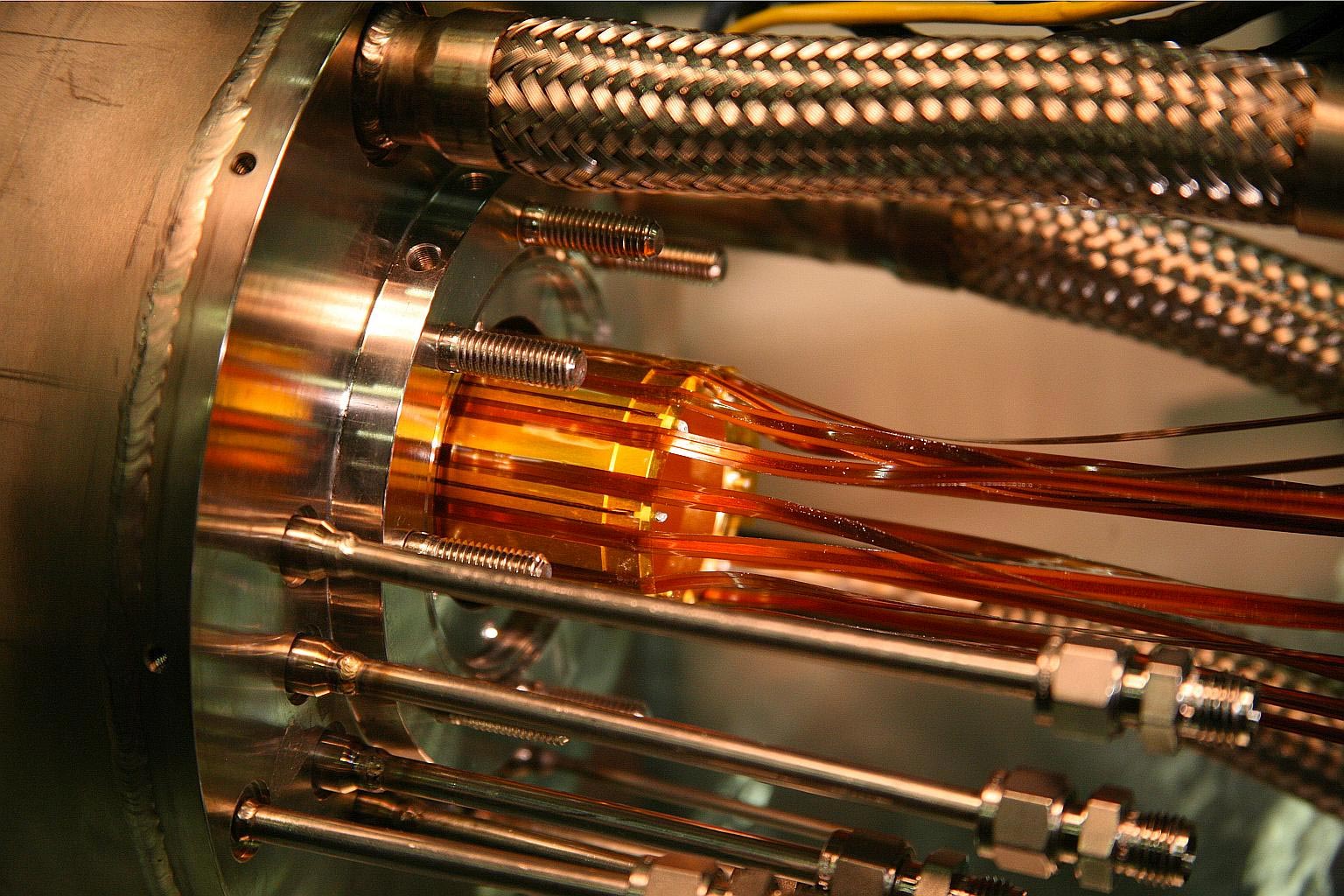
A new study published today shows the first measurements of the antihydrogen spectrum. The ALPHA collaboration at CERN has been researching antimatter and has routinely trapped antihydrogen atoms for long periods of time. The hope is that this new finding will lead to precision comparisons between atoms of ordinary matter and atoms of antimatter.
In a paper published online today (March 7, 2012) by the journal Nature, the ALPHA collaboration at CERN reports an important milestone on the way to measuring the properties of antimatter atoms. This follows news reported in June last year that the collaboration had routinely trapped antihydrogen atoms for long periods of time. ALPHA’s latest advance is the next important milestone on the way to being able to make precision comparisons between atoms of ordinary matter and atoms of antimatter, thereby helping to unravel one of the deepest mysteries in particle physics and perhaps understanding why a Universe of matter exists at all.
“We’ve demonstrated that we can probe the internal structure of the antihydrogen atom,” said ALPHA collaboration spokesman, Jeffrey Hangst, “and we’re very excited about that. We now know that it’s possible to design experiments to make detailed measurements of antiatoms.”
Today, we live in a Universe that appears to be made entirely of matter, yet at the Big Bang, matter and antimatter would have existed in equal amounts. The mystery is that all the antimatter seems to have gone, leading to the conclusion that nature must have a slight preference for matter over antimatter. If antihydrogen atoms can be studied in detail, as ALPHA’s latest result suggests, they may provide a powerful tool for investigating this preference.
Hydrogen atoms consist of an electron orbiting a nucleus. By firing light at them the atoms can be excited, with the electrons jumping to higher orbits, and eventually relaxing back to their so-called ground state by emitting light. The frequency distribution of the light emitted forms a very precisely measured spectrum that, in the matter world, is unique to hydrogen. Basic principles of physics say that antihydrogen should have an identical spectrum to hydrogen, and measuring this spectrum is the ultimate goal of the ALPHA collaboration.
“Hydrogen is the most abundant element in the universe and we understand its structure extremely well,” said Hangst. “Now we can finally begin to coax the truth out of antihydrogen. Are they different? We can confidently say that time will tell.”
In the paper published today, ALPHA reports the first, albeit modest, measurement of the antihydrogen spectrum. In the ALPHA apparatus, antihydrogen atoms are trapped by a sophisticated arrangement of magnetic fields acting on the magnetic orientation of the antihydrogen atoms. By shining microwaves with a precisely tuned frequency on the antihydrogen atoms, the collaboration flips the antiatoms’ magnetic orientation, thereby liberating antihydrogen from the trap. When this happens, the antihydrogen meets ordinary matter and annihilates, leaving a characteristic pattern in particle detectors surrounding the trap.
This measurement shows that it is possible to set up experiments in which the internal properties of antihydrogen atoms can be changed by shining microwaves on them. In the near future, ALPHA will work at improving the precision of the microwave measurements, and undertake complementary measurements of the antihydrogen spectrum using lasers.
Reference: “Resonant quantum transitions in trapped antihydrogen atoms” by C. Amole, M. D. Ashkezari, M. Baquero-Ruiz, W. Bertsche, P. D. Bowe, E. Butler, A. Capra, C. L. Cesar, M. Charlton, A. Deller, P. H. Donnan, S. Eriksson, J. Fajans, T. Friesen, M. C. Fujiwara, D. R. Gill, A. Gutierrez, J. S. Hangst, W. N. Hardy, M. E. Hayden, A. J. Humphries, C. A. Isaac, S. Jonsell, L. Kurchaninov, A. Little, N. Madsen, J. T. K. McKenna, S. Menary, S. C. Napoli, P. Nolan, K. Olchanski, A. Olin, P. Pusa, C. Ø. Rasmussen, F. Robicheaux, E. Sarid, C. R. Shields, D. M. Silveira, S. Stracka, C. So, R. I. Thompson, D. P. van der Werf and J. S. Wurtele, 7 March 2012, Nature.
DOI: 10.1038/nature10942
Never miss a breakthrough: Join the SciTechDaily newsletter.
Follow us on Google and Google News.