
Close Menu
    Facebook X (Twitter) Instagram
    SciTechDaily
    • Biology
    • Chemistry
    • Earth
    • Health
    • Physics
    • Science
    • Space
    • Technology
    Facebook X (Twitter) Pinterest YouTube RSS
    SciTechDaily
    Home»Space»Hubble Views Galaxy Cluster Abell S1077
    Space

    Hubble Views Galaxy Cluster Abell S1077

    By European Space Agency (ESA)May 15, 2013No Comments2 Mins Read
    Facebook Twitter Pinterest Telegram LinkedIn WhatsApp Email Reddit
    Share
    Facebook Twitter LinkedIn Pinterest Telegram Email Reddit
    Hubble Views Galaxy Cluster Abell S1077
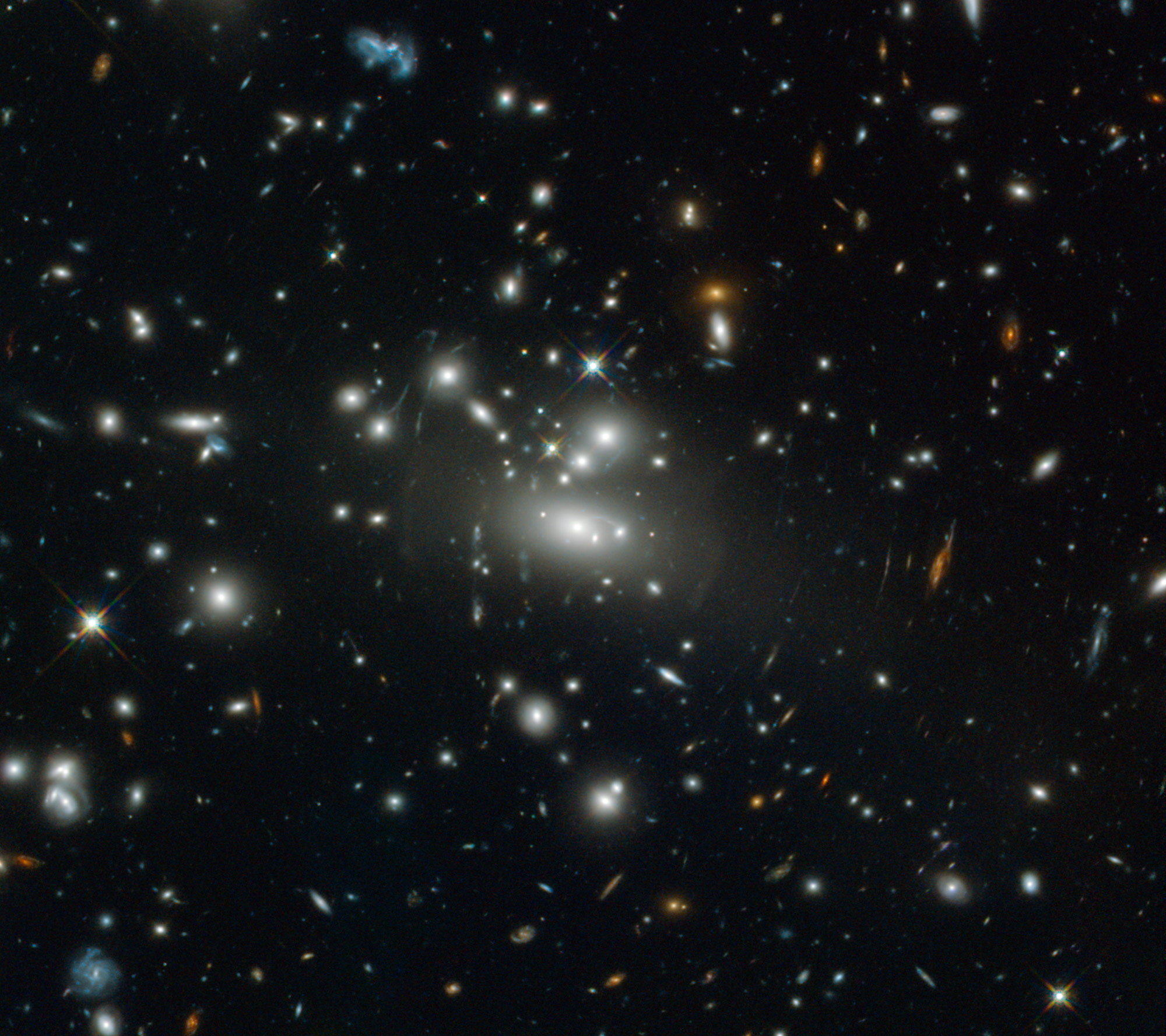
    Galaxy cluster Abell S1077, as seen by the NASA/ESA Hubble Space Telescope’s Wide Field Camera 3 and the Advanced Camera for Surveys. The cluster acts as a magnifying glass, its gravity high enough to warp even the fabric of space-time. This effect distorts the path that light from distant galaxies takes when it travels through the cluster, as can be seen here in the bright arcs smeared around the center of Abell S1077. The phenomenon of gravitational lensing allows astronomers to see objects that are aligned behind the cluster and that would otherwise be undetectable from Earth. Credit: ESA/Hubble & NASA; Acknowledgment: N. Rose

    This new Hubble images shows galaxy cluster Abell S1077 and is based in part on data spotted by Nick Rose in the Hubble’s Hidden Treasures image processing competition.

    Bright arcs are smeared around the heart of galaxy cluster Abell S1077 in this image taken by the NASA/ESA Hubble space telescope. The arcs are stretched images of distant galaxies distorted by the cluster’s enormous gravitational field.

    Galaxy clusters are large groupings of galaxies, each hosting millions of stars. They are the largest existing structures in the Universe, bound by the gravitational attraction between them.

    The amount of matter condensed in such groupings is so high that their gravity is enough to warp even the fabric of space-time, distorting the path that light takes when it travels through the cluster.

    In some cases, this phenomenon produces an effect somewhat like a magnifying lens, allowing us to see objects that are aligned behind the cluster and that would otherwise be undetectable from Earth.

    In this image, stretched stripes that look like scratches on a lens are in fact galaxies whose light is heavily distorted by the gravitational field of the cluster.

    Astronomers use the effects of gravitational lensing to peer far back in time and space to see the furthest objects located in the early Universe.

    One of the record holders is galaxy MACS0647-JD, whose light was magnified by galaxy cluster MACS J0647+7015 and has been traveling for 13.3 billion years to reach Earth.

    Never miss a breakthrough: Join the SciTechDaily newsletter.
    Follow us on Google and Google News.

    Astronomy European Space Agency Hubble Space Telescope
    Share. Facebook Twitter Pinterest LinkedIn Email Reddit

    Related Articles

    A Diamond Necklace of Cosmic Proportions

    Hubble Snaps a Stunning Close-Up of a Magnificent Spiral Galaxy

    Extraordinary Hubble Image: Light Bends From the Beyond

    Hubble Space Telescope Sees Volcanic Activity Reforming the Atmosphere on a Rocky Exoplanet

    Hubble Spies a Luminous Heart With Dark Tendrils

    Spectacular Return to the Veil Nebula

    Hubble Spots a Peculiar Sight: Unusual Spiral Galaxy With a Heavy Arm

    A Flash of Life: Hubble Spies an Unusual Planetary Nebula

    Through the Cosmic Clouds: Hubble Spots a Beautiful Stellar Nursery

    Leave A Reply Cancel Reply

    • Facebook
    • Twitter
    • Pinterest
    • YouTube

    Don't Miss a Discovery

    Subscribe for the Latest in Science & Tech!

    Trending News

    This Copper Drug Clears Alzheimer’s Brain Toxins and Boosts Memory

    Adults Over 65 Lost Massive Amounts of Weight With Ozempic

    How Flocking Birds “Defy” One of Physics’ Most Fundamental Laws

    Physicists Create a New Kind of Schrödinger’s Cat State From Exotic Quantum Building Blocks

    Your Diet Could Be Missing the Key Ingredient for Heart Protection

    Researchers Warn Widely Prescribed Blood Pressure Drugs Could Be Harming Diabetic Kidneys

    James Webb Spots Something Strange Between Day and Night on an Alien Planet

    How Ancient People Moved a 6-Ton Stone 700 Kilometers to Stonehenge

    Follow SciTechDaily
    • Facebook
    • Twitter
    • YouTube
    • Pinterest
    • Newsletter
    • RSS
    SciTech News
    • Biology News
    • Chemistry News
    • Earth News
    • Health News
    • Physics News
    • Science News
    • Space News
    • Technology News
    Recent Posts
    • Scientists Uncover Cause of Inflammatory Bowel Disease Solving Decades-Old Mystery
    • The Surprising Reason Swimming Could Be Better for Your Heart Than Running
    • Could Vitamin C Be the Secret to Keeping Your Brain Younger?
    • The Surprising Fix for Robot Traffic Jams
    • Near Absolute Zero, This Transistor Starts Acting Like a Brain Cell
    Copyright © 1998 - 2026 SciTechDaily. All Rights Reserved.
    • Science News
    • About
    • Contact
    • Editorial Board
    • Privacy Policy
    • Terms of Use

    Type above and press Enter to search. Press Esc to cancel.