
Close Menu
    Facebook X (Twitter) Instagram
    SciTechDaily
    • Biology
    • Chemistry
    • Earth
    • Health
    • Physics
    • Science
    • Space
    • Technology
    Facebook X (Twitter) Pinterest YouTube RSS
    SciTechDaily
    Home»Space»TW Hydrae Provides Insight About the Birth of Our Sun
    Space

    TW Hydrae Provides Insight About the Birth of Our Sun

    By Harvard-Smithsonian Center for AstrophysicsJune 6, 2013No Comments4 Mins Read
    Facebook Twitter Pinterest Telegram LinkedIn WhatsApp Email Reddit
    Share
    Facebook Twitter LinkedIn Pinterest Telegram Email Reddit
    TW Hydrae Suggests our Sun Was a Feisty Toddler
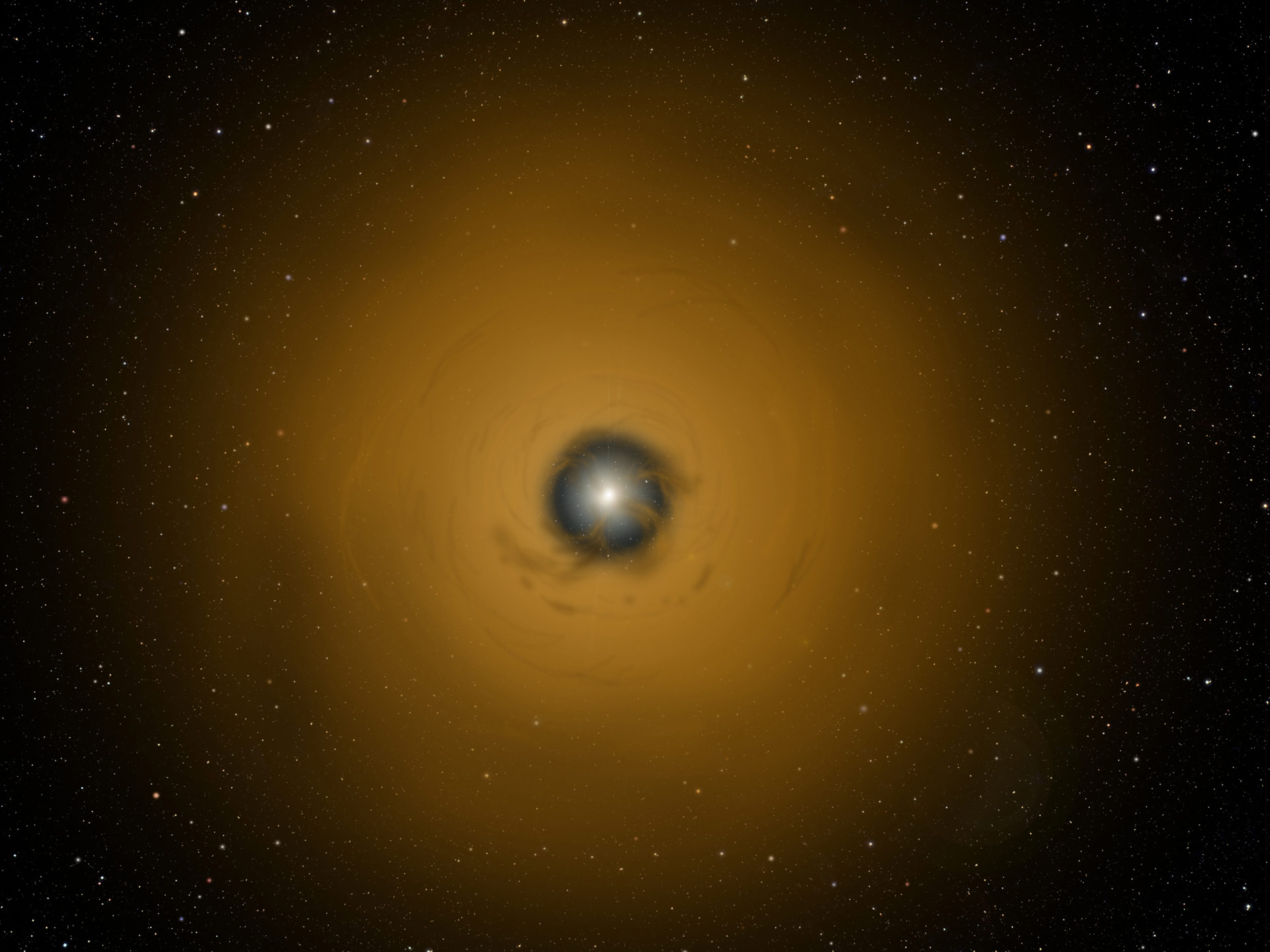
    This artist’s conception illustrates what we would see if we could zoom in on the TW Hydrae system. We are viewing the star nearly pole-on, where streamers of gas from the surrounding protoplanetary disk funnel onto the star. Research shows that this growth process, also known as accretion, is clumpy and episodic. By studying TW Hydrae we can learn what our Sun was like when it was only 10 million years old. Credit: David A. Aguilar (CfA)

    By studying TW Hydrae, researchers are getting a glimpse of what happened to our Sun some four and a half billion years ago.

    Indianapolis, IN – If you had a time machine that could take you anywhere in the past, what time would you choose? Most people would probably pick the era of the dinosaurs in hopes of spotting a T. rex. But many astronomers would choose the period, four and a half billion years ago, that our solar system formed.

    In lieu of a working time machine, we learn about the birth of our Sun and its planets by studying young stars in our galaxy. New work suggests that our Sun was both active and “feisty” in its infancy, growing in fits and starts while burping out bursts of X-rays.

    “By studying TW Hydrae, we can watch what happened to our Sun when it was a toddler,” said Nancy Brickhouse of the Harvard-Smithsonian Center for Astrophysics (CfA). She presented the findings today in a press conference at a meeting of the American Astronomical Society.

    Brickhouse and her colleagues reached this conclusion by studying the young star TW Hydrae, located about 190 light-years from Earth in the southern constellation Hydra the Water Snake. TW Hydrae is an orange, type K star weighing about 80 percent as much as our Sun. It is about 10 million years old, and is still accreting gas from a surrounding disk of material. That same disk might contain newborn planets.

    In order to grow, the star “eats” gas from the disk. However, the disk doesn’t extend all the way to the star’s surface, so the star can’t dine from it directly. Instead, infalling gas gets funneled along magnetic field lines to the star’s poles.

    Fortunately, we are looking almost directly down on one of the star’s poles. As a result, we can study the accretion process in detail.

    “We’re looking right where the action is,” said team member Andrea Dupree of the CfA.

    Infalling material smashes into the star, creating a shock wave and heating the accreting gas to temperatures greater than 5 million degrees Fahrenheit. The gas glows with high-energy X-rays. As it continues moving inward, the gas cools and its glow shifts to optical wavelengths of light. To study the process, Brickhouse and her team combined observations from NASA’s Chandra X-ray Observatory with those from ground-based optical telescopes.

    “By gathering data in multiple wavelengths we followed the gas all the way down. We traced the whole accretion process for the first time,” explained Brickhouse.

    They found that accretion was clumpy and episodic in building a star. At one point the amount of material landing on the star changed by a factor of five over the course of a few days.

    “The accretion process changes from night to night. Things are happening all the time,” stated Dupree.

    Some of the infalling material is pushed away in a stellar wind much like the solar wind that fills our solar system. Some gets channeled into giant loops and stellar prominences.

    Astronomers have known that young stars are much more magnetically active than our middle-aged Sun, but now they can actually probe the interplay between the star’s magnetic fields and the protoplanetary disk.

    “The very process of accretion is driving magnetic activity on TW Hydrae,” added Brickhouse.

    Headquartered in Cambridge, Massachusetts, the Harvard-Smithsonian Center for Astrophysics (CfA) is a joint collaboration between the Smithsonian Astrophysical Observatory and the Harvard College Observatory. CfA scientists, organized into six research divisions, study the origin, evolution, and ultimate fate of the universe.

    Never miss a breakthrough: Join the SciTechDaily newsletter.
    Follow us on Google and Google News.

    Astronomy Astrophysics Harvard-Smithsonian Center for Astrophysics Stellar Evolution Sun
    Share. Facebook Twitter Pinterest LinkedIn Email Reddit

    Related Articles

    Spacecraft Enters the Sun’s Blistering Hot Corona for the First Time in History

    A “Living Catalog” of Solar Stream Interactions

    Astronomers Discover “Old Young” Stars in the Eagle Nebula

    New Theoretical Models Could Aid in the Hunt for Habitable Planets

    Sun’s Loops are Tapered, Wider at the Top and Narrower at the Ends

    New Observations Help Astronomers Learn How Young Stars Accrete Material and Grow

    Herschel Discovers the Earliest Known Starburst Galaxy

    New Model Advances the Understanding of How Solar Wind Works

    Masers as Evolutionary Indicators for Star Formation

    Leave A Reply Cancel Reply

    • Facebook
    • Twitter
    • Pinterest
    • YouTube

    Don't Miss a Discovery

    Subscribe for the Latest in Science & Tech!

    Trending News

    This Copper Drug Clears Alzheimer’s Brain Toxins and Boosts Memory

    Adults Over 65 Lost Massive Amounts of Weight With Ozempic

    How Flocking Birds “Defy” One of Physics’ Most Fundamental Laws

    Physicists Create a New Kind of Schrödinger’s Cat State From Exotic Quantum Building Blocks

    Your Diet Could Be Missing the Key Ingredient for Heart Protection

    Researchers Warn Widely Prescribed Blood Pressure Drugs Could Be Harming Diabetic Kidneys

    James Webb Spots Something Strange Between Day and Night on an Alien Planet

    How Ancient People Moved a 6-Ton Stone 700 Kilometers to Stonehenge

    Follow SciTechDaily
    • Facebook
    • Twitter
    • YouTube
    • Pinterest
    • Newsletter
    • RSS
    SciTech News
    • Biology News
    • Chemistry News
    • Earth News
    • Health News
    • Physics News
    • Science News
    • Space News
    • Technology News
    Recent Posts
    • Scientists Uncover Cause of Inflammatory Bowel Disease Solving Decades-Old Mystery
    • The Surprising Reason Swimming Could Be Better for Your Heart Than Running
    • Could Vitamin C Be the Secret to Keeping Your Brain Younger?
    • The Surprising Fix for Robot Traffic Jams
    • Near Absolute Zero, This Transistor Starts Acting Like a Brain Cell
    Copyright © 1998 - 2026 SciTechDaily. All Rights Reserved.
    • Science News
    • About
    • Contact
    • Editorial Board
    • Privacy Policy
    • Terms of Use

    Type above and press Enter to search. Press Esc to cancel.