
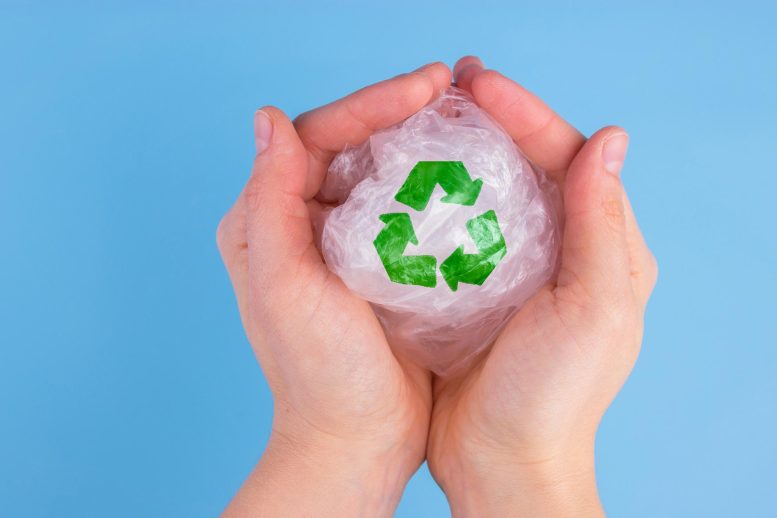
A circular bioeconomy can dramatically rein in the fast-growing plastic sector’s climate, pollution, and resource consumption impacts. Under current policies, global plastic production will likely triple by the year 2100. Today, the plastic sector is responsible for almost 5% of all greenhouse gas emissions. By providing a circular, bio-based plastic industry with emissions-free electricity, and by avoiding waste incineration, the sector may even grow to become a form of carbon sink. That is the conclusion of an article in the journal Nature, published recently by researchers from Utrecht University, the Netherlands Environmental Assessment Agency (PBL), the Netherlands Association for Sustainable Energy (NVDE) and the Netherlands Organisation for Applied Scientific Research (TNO).
None of the models used for the reports of the Intergovernmental Panel on Climate Change (IPCC) have elaborated the details of the plastic industry. Therefore, the researchers developed a new model to investigate four scenarios for the global plastic sector. These showed that a high price for greenhouse gas emissions, meeting the Paris Climate Accord’s two-degree goal, is not enough in itself to encourage the plastic sector to switch from fossil feedstocks to bio-based raw materials and a circular economy. Climate policy may even lead to more plastic landfilling, as it avoids CO2 emissions and is cheaper than other forms of waste treatment.
The Limits of Circular Strategies
A scenario with more policies geared towards a circular plastic sector (including stricter requirements for product design and standardization of plastic types) would greatly increase the recycling of plastic waste, lower resource consumption, and further reduce the CO2 emissions of the plastic sector until 2050, while preventing large-scale disposal in landfills. However, solely aiming for circularity would limit further emission reductions in the second half of the century, because the role of plastic for biogenic (and therefore non-fossil) carbon storage is underutilized. Moreover, there is not enough plastic waste available to meet the growing plastic demand via recycling. Therefore, a fully circular plastic sector is only possible if demand for plastics is curbed.
Carbon Storage by a Circular Bioeconomy
A circular plastic sector that also uses bio-based raw materials presents significant opportunities for achieving negative emissions via biogenic carbon storage. A combination of bio-based raw materials with emissions-free electricity, high-quality recycling, and a minimization of waste incineration could potentially turn the sector into a carbon sink. By 2050, 13% of the biomass currently used to generate energy could be utilized as a raw material for plastics. Plastics with a long service life, such as building materials, represent the largest stock of plastic on earth. Producing these materials from bio-based raw materials would result in net negative emissions. If all plastics cumulatively produced until 2100 were bio-based, with a lifetime of decades, or even centuries, then in theory we could capture the equivalent of nine times the current annual energy-related greenhouse gas emissions.
Requirements for High-Quality Recycling
To achieve a high share of recycling, we will need improved waste collection and sorting processes and a circular product design. Moreover, the industry will also have to make greater use of chemical recycling to continue the supply of high-quality plastic. In that process, the contaminants are removed, providing high-quality raw materials for new plastics. In mechanical recycling plastics are ground into particles for re-processing, reducing the plastic quality and potentially leaving contaminants, which makes mechanically recycled plastic unsuitable for applications such as food packaging.
Reference: “Plastic futures and their CO2 emissions” by Paul Stegmann, Vassilis Daioglou, Marc Londo, Detlef P. van Vuuren and Martin Junginger, 7 December 2022, Nature.
DOI: 10.1038/s41586-022-05422-5
Never miss a breakthrough: Join the SciTechDaily newsletter.
Follow us on Google and Google News.
2 Comments
“emissions-free electricity”, and “lower resource consumption”, do tell! How are you going to grow, collect, and process biomass then manufacture using it without emissions? That assumes the bioplastic objects will grow on trees, because they’re more expensive right now due to their materials and manufacturing having higher resource consumption (ie. worse for the environment). How are you going to generate electricity without emitting or manufacturing anything? Are you going to find lumps of pure copper on the ground next to some magnets and bio-bearings, and roll them in mud until it dries into the shape and consistency of a wind turbine?
This is an interesting new way to do science. Assuming a dozen false premises, they’ve concluded there’s no problem at all.
Im afraid i have to agree with hot and bothered…and add to it: where is all the plant matter for bioplastics supposedly going to be grown? We are already at the end of the line with agriculture to feed people and make ethanol and diesel biofuels. Reality check?