
Close Menu
    Facebook X (Twitter) Instagram
    SciTechDaily
    • Biology
    • Chemistry
    • Earth
    • Health
    • Physics
    • Science
    • Space
    • Technology
    Facebook X (Twitter) Pinterest YouTube RSS
    SciTechDaily
    Home»Technology»Nanotech Scientists Created Something Unexpected: Tiny Metallic Snowflakes
    Technology

    Nanotech Scientists Created Something Unexpected: Tiny Metallic Snowflakes

    By University of AucklandDecember 20, 2022No Comments3 Mins Read
    Facebook Twitter Pinterest Telegram LinkedIn WhatsApp Email Reddit
    Share
    Facebook Twitter LinkedIn Pinterest Telegram Email Reddit
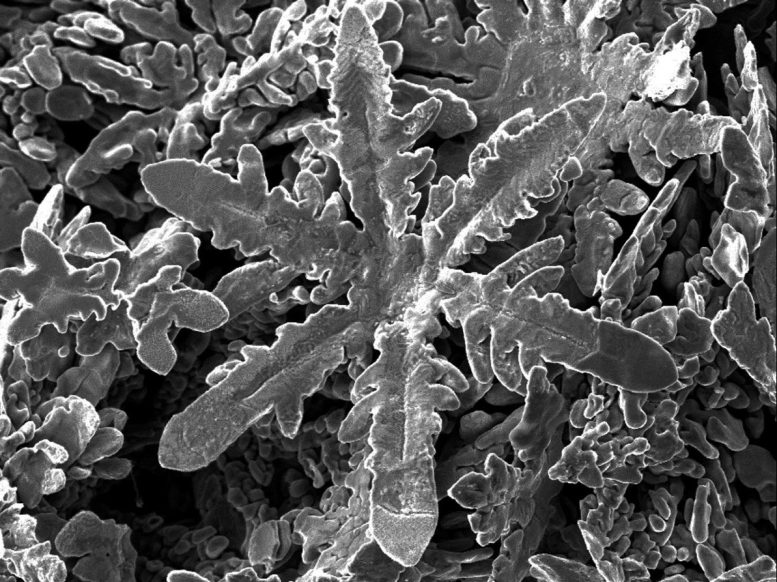
    Nano Particle Metallic Snowflakes
    Nano-scale snowflake from Gallium solvent. Credit: Waipapa Taumata Rau, University of Auckland

    Adventures in Nanotech: Growing a Metallic Snowflake

    Scientists working at the level of atoms are manipulating metals, opening up possibilities for creating new materials.

    Working at the level of atoms, scientists in New Zealand and Australia created something unexpected: tiny metallic snowflakes.

    Why’s that significant? Because coaxing individual atoms to cooperate is leading to a revolution in engineering and technology via nanomaterials. (And creating snowflakes is cool.)

    Nanoscale structures (a nanometer is one billionth of a meter or about 50,000 times smaller than the diameter of a human hair) can aid electronic manufacturing, make materials stronger yet lighter, or aid environmental clean-ups by binding to toxins.

    Gallium: The Key to Crystal Formation

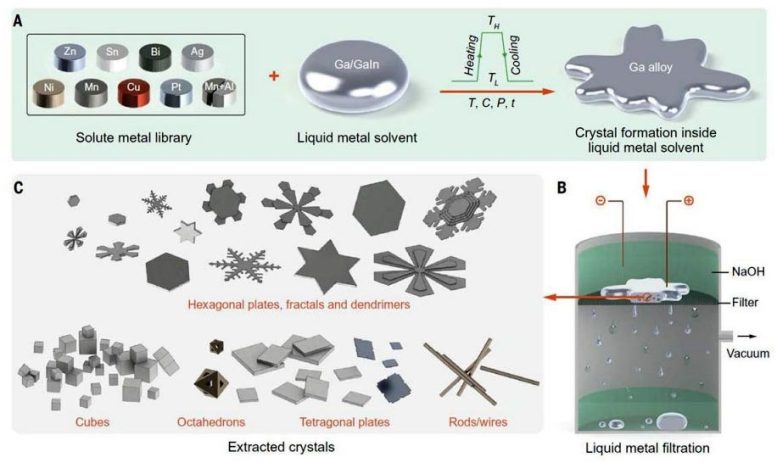
    To create metallic nanocrystals, New Zealand and Australian scientists have been conducting experiments with gallium, a soft, silvery metal that is used in semiconductors and has the unusual property of liquifying at slightly above room temperature.

    Their results were reported on December 8 in the journal Science.

    Professor Nicola Gaston and research fellow Dr. Steph Lambie, both of Waipapa Taumata Rau, University of Auckland, and Dr. Krista Steenbergen of Te Herenga Waka, Victoria University of Wellington, collaborated with colleagues in Australia led by Professor Kourosh Kalantar-Zadeh at the University of New South Wales.

    The Australian team worked in the lab with nickel, copper, zinc, tin, platinum, bismuth, silver, and aluminum. Metals were dissolved in gallium at high temperatures. Once cooled, the metallic crystals emerged while the gallium remained liquid.
    Growing Metallic Snowflake
    Credit: University of Auckland

    The New Zealand team, part of the MacDiarmid Institute for Advanced Materials and Nanotechnology, a national Centre of Research Excellence, carried out simulations of molecular dynamics to explain why differently shaped crystals emerge from different metals. (The government’s Marsden Fund supported the research.)

    “What we are learning is that the structure of the liquid gallium is very important,” says Gaston. “That’s novel because we usually think of liquids as lacking structure or being only randomly structured.”

    Interactions between the atomistic structures of the different metals and the liquid gallium cause differently shaped crystals to emerge, the scientists showed.

    The crystals included cubes, rods, hexagonal plates, and the zinc snowflake shapes. The six-branched symmetry of zinc, with each atom surrounded by six neighbors at equivalent distances, accounts for the snowflake design.

    Advancing Nanotechnology with Bottom-Up Assembly

    “In contrast to top-down approaches to forming nanostructure – by cutting away material – this bottom-up approach relies on atoms self-assembling,” says Gaston. “This is how nature makes nanoparticles, and is both less wasteful and much more precise than top-down methods.”

    She says the research has opened up a new, unexplored pathway for metallic nanostructures. “There’s also something very cool in creating a metallic snowflake!”

    Reference: “Liquid metal synthesis solvents for metallic crystals” by Shuhada A. Idrus-Saidi, Jianbo Tang, Stephanie Lambie, Jialuo Han, Mohannad Mayyas, Mohammad B. Ghasemian, Francois-Marie Allioux, Shengxiang Cai, Pramod Koshy, Peyman Mostaghimi, Krista G. Steenbergen, Amanda S. Barnard, Torben Daeneke, Nicola Gaston and Kourosh Kalantar-Zadeh, 8 December 2022, Science.
    DOI: 10.1126/science.abm2731

    Never miss a breakthrough: Join the SciTechDaily newsletter.
    Follow us on Google and Google News.

    Nanomaterials Nanotechnology Popular
    Share. Facebook Twitter Pinterest LinkedIn Email Reddit

    Related Articles

    “Wonder Material” Graphene Verified Safe in Groundbreaking Human Study

    Revolutionary 3D Printing Technology a “Game Changer” for Discovering and Manufacturing New Materials

    Caltech Engineers Have Developed an Unusually Tough New Material

    On the Edge: New Magnetic Phenomenon Discovered With Industrial Potential

    Pivotal Discovery of Nanomaterial for LEDs: New Low-Cost, Energy-Efficient Light Source

    Tougher Than Kevlar and Steel: Ultralight Material Withstands Supersonic Microparticle Impacts

    Harvesting Light Like Nature Does: Synthesizing a New Class of Bio-Inspired, Light-Capturing Nanomaterials

    New MIT Research Suggests Coal Could Be Used to Make a Variety of Useful Devices

    Stanford’s Self-Healing Plastic Skin Could Lead to Improved Prosthetics

    Leave A Reply Cancel Reply

    • Facebook
    • Twitter
    • Pinterest
    • YouTube

    Don't Miss a Discovery

    Subscribe for the Latest in Science & Tech!

    Trending News

    Mezcal “Worm” in a Bottle Mystery: DNA Testing Reveals a Surprise

    New Research Reveals That Your Morning Coffee Activates an Ancient Longevity Switch

    This Is What Makes You Irresistible to Mosquitoes

    Shockingly Powerful Giant Octopuses Ruled the Seas 100 Million Years Ago

    Scientists Stunned by New Organic Molecules Found on Mars

    Rewriting Dinosaur Evolution: Scientists Unearth Remarkable 150-Million-Year-Old Stegosaur Skull

    Omega-3 Supplements Linked to Cognitive Decline in Surprising New Study

    First-of-Its-Kind Discovery: Homer’s Iliad Found Embedded in a 1,600-Year-Old Egyptian Mummy

    Follow SciTechDaily
    • Facebook
    • Twitter
    • YouTube
    • Pinterest
    • Newsletter
    • RSS
    SciTech News
    • Biology News
    • Chemistry News
    • Earth News
    • Health News
    • Physics News
    • Science News
    • Space News
    • Technology News
    Recent Posts
    • A Common Vitamin Could Hold the Key to Treating Fatty Liver Disease
    • New Research Shows Vitamin B12 May Hold the Key to Healthy Aging
    • Scientists Map Thousands of Brain Connections With RNA Barcodes
    • This Gene Tweak Turns Strawberries Into Healthier, Tastier Superfruit
    • This New Chip Could Make GPUs Far More Efficient
    Copyright © 1998 - 2026 SciTechDaily. All Rights Reserved.
    • Science News
    • About
    • Contact
    • Editorial Board
    • Privacy Policy
    • Terms of Use

    Type above and press Enter to search. Press Esc to cancel.