
Close Menu
    Facebook X (Twitter) Instagram
    SciTechDaily
    • Biology
    • Chemistry
    • Earth
    • Health
    • Physics
    • Science
    • Space
    • Technology
    Facebook X (Twitter) Pinterest YouTube RSS
    SciTechDaily
    Home»Space»NASA’s New Horizons Has Discovered Methane Snow on Pluto’s Peaks
    Space

    NASA’s New Horizons Has Discovered Methane Snow on Pluto’s Peaks

    By NASAMarch 3, 2016No Comments2 Mins Read
    Facebook Twitter Pinterest Telegram LinkedIn WhatsApp Email Reddit
    Share
    Facebook Twitter LinkedIn Pinterest Telegram Email Reddit
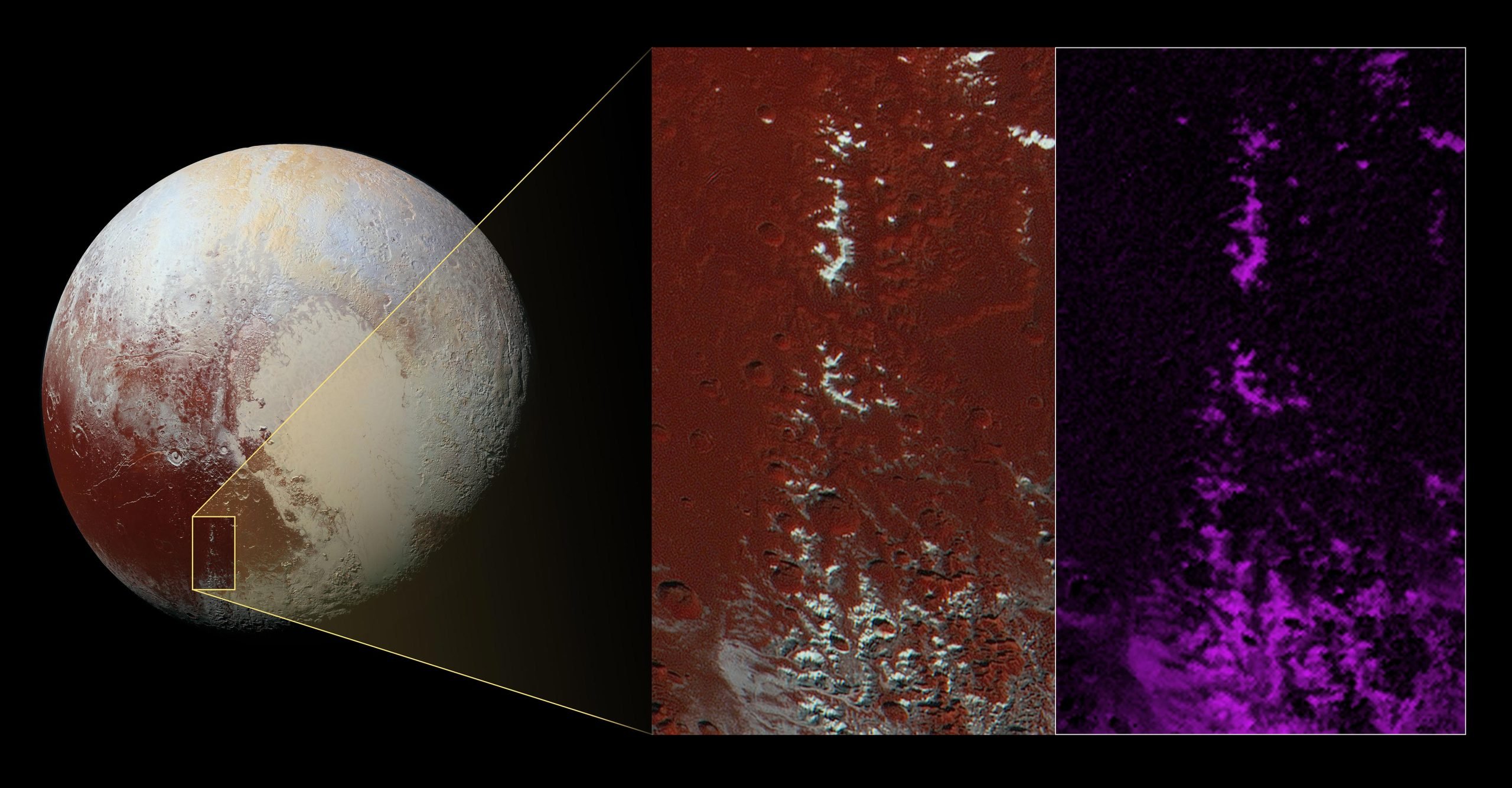
    Pluto Cthulhu Regio Snowcapped Mountains
    A chain of exotic snowcapped mountains stretching across the dark expanse on Pluto informally named Cthulhu Regio has been discovered by New Horizons researchers. Credit: NASA/JHUAPL/SwRI

    The New Horizons team has discovered a chain of exotic snowcapped mountains stretching across the dark expanse on Pluto informally named Cthulhu Regio.

    One of Pluto’s most identifiable features, Cthulhu (pronounced kuh-THU-lu) stretches nearly halfway around Pluto’s equator, starting from the west of the great nitrogen ice plains known as Sputnik Planum. Measuring approximately 1,850 miles (3,000 kilometers) long and 450 miles (750 kilometers) wide, Cthulhu is a bit larger than the state of Alaska.

    Cthulhu’s appearance is characterized by a dark surface, which scientists think is due to being covered by a layer of dark tholins – complex molecules that form when methane is exposed to sunlight. Cthulhu’s geology exhibits a wide variety of landscapes—from mountainous to smooth, and to heavily cratered and fractured.

    The reddish enhanced color image shown as the left inset reveals a mountain range located in southeast Cthulhu that’s 260 miles (420 kilometers) long. The range is situated among craters, with narrow valleys separating its peaks. The upper slopes of the highest peaks are coated with a bright material that contrasts sharply with the dark red color of the surrounding plains.

    Scientists think this bright material could be predominantly methane that has condensed as ice onto the peaks from Pluto’s atmosphere. “That this material coats only the upper slopes of the peaks suggests methane ice may act like water in Earth’s atmosphere, condensing as frost at high altitude,” said John Stansberry, a New Horizons science team member from Space Telescope Science Institute, Baltimore, Maryland. Compositional data from the Ralph/Multispectral Visible Imaging Camera (MVIC) on NASA’s New Horizons spacecraft, shown in the right inset, indicates that the location of the bright ice on the mountain peaks correlates almost exactly with the distribution of methane ice, shown in false color as purple.

    The resolution of the enhanced color image is about 2,230 feet (680 meters) per pixel. The image measures approximately 280 miles (450 kilometers) long by 140 miles (225 kilometers) wide. It was obtained by New Horizons at a range of approximately 21,100 miles (33,900 kilometers) from Pluto, about 45 minutes before the spacecraft’s closest approach to Pluto on July 14, 2015.

    Never miss a breakthrough: Join the SciTechDaily newsletter.
    Follow us on Google and Google News.

    NASA New Horizons Planets
    Share. Facebook Twitter Pinterest LinkedIn Email Reddit

    Related Articles

    Opposite World: Pluto’s Ice Caps Made of Methane, Turns Earth’s Process Upside Down

    New ScienceCast Video – Countdown to Pluto

    Planets Aligning in Rare Triple Conjunction

    Kepler Data Used to Identify 41 New Transiting Planets

    Astronomers Discover a Fifth Moon Orbiting Pluto

    Schumann Resonance Could Help Reveal the Solar System’s Origins

    Saturn’s Moon Phoebe Has Planet-Like Qualities

    Three Earthlike Planets Could be Hospitable to Life

    Juno Spacecraft Completes First Trajectory Correction Maneuver

    Leave A Reply Cancel Reply

    • Facebook
    • Twitter
    • Pinterest
    • YouTube

    Don't Miss a Discovery

    Subscribe for the Latest in Science & Tech!

    Trending News

    Two Drinks a Day May Be Riskier Than Many Americans Think

    A Lost Human Lineage May Have Left a Genetic Legacy in People Today

    Study Reveals a Surprising Link Between Birth Control Pills and Binge Eating

    NASA’s HiRISE Captures Perseverance Rover Completing a Marathon on Mars

    Ancient DNA Reveals the Hidden Origins of China’s Mysterious Shimao Civilization

    Scientists Discover a Surprising Link Between Sleep, Genes, and Alzheimer’s

    Popular Childhood Drinks Linked to Higher Blood Pressure Later in Life

    Scientists Just Challenged a 70-Year-Old Myth About the Human Brain

    Follow SciTechDaily
    • Facebook
    • Twitter
    • YouTube
    • Pinterest
    • Newsletter
    • RSS
    SciTech News
    • Biology News
    • Chemistry News
    • Earth News
    • Health News
    • Physics News
    • Science News
    • Space News
    • Technology News
    Recent Posts
    • Scientists Discover a Surprising Way To Protect the Brain: Less Oxygen
    • Blue Light Breakthrough Could Speed Up Drug Discovery
    • Scientists Discover AI Models May Not Think Like the Brain After All
    • The World’s Highest-Living Mammal Is Rewriting the Limits of Life
    • Brain Breakthrough Could Help Older Adults Live Longer and Stay Steady
    Copyright © 1998 - 2026 SciTechDaily. All Rights Reserved.
    • Science News
    • About
    • Contact
    • Editorial Board
    • Privacy Policy
    • Terms of Use

    Type above and press Enter to search. Press Esc to cancel.