
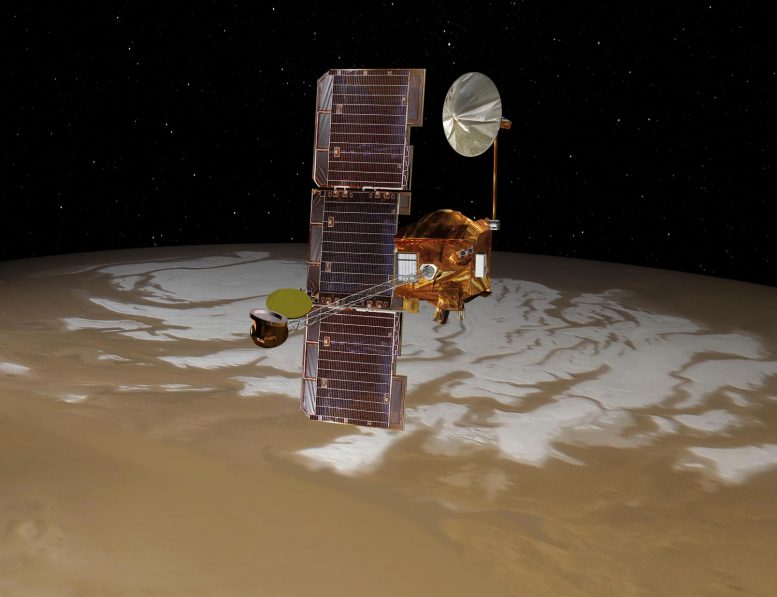
Measuring the fuel supply on Odyssey, a decades-old spacecraft without a fuel gauge, is no easy task.
Since NASA launched the 2001 Mars Odyssey Orbiter to the Red Planet almost 22 years ago, the spacecraft has looped around Mars more than 94,000 times. That’s about the equivalent of 1.37 billion miles (2.21 billion kilometers), a distance that has required extremely careful management of the spacecraft’s fuel supply. This feat is all the more impressive given that Odyssey has no fuel gauge; engineers have had to rely on math instead.
Their work has helped Odyssey build a scientific legacy: The spacecraft has mapped minerals across the Martian surface, allowing scientists to better understand the planet’s history. Odyssey has found ice deposits that could be used by future astronauts. It’s studied radiation that could harm those same astronauts. And it’s scouted potential landing sites for missions to come. Odyssey is also among a small constellation of orbiters that relays data back to Earth from NASA’s rovers and landers (almost 150 gigabytes to date, and counting).
But last year, Odyssey looked as if it might be running out of gas: Calculations indicated its hydrazine fuel was much lower than expected.
Odyssey launched in 2001 with almost 500 pounds (225.3 kilograms) of hydrazine propellant. Because there’s no fuel gauge, engineers have used a variety of ways to infer how much hydrazine the spacecraft has consumed over time. One way to measure Odyssey’s fuel is to apply heat to the spacecraft’s two propellant tanks and watch how long they take to reach a certain temperature. As with a teapot, a nearly empty fuel tank would heat up faster than a full one.
That is, in fact, what appeared to occur with a fuel estimate performed on Odyssey in the summer of 2021. The math seemed to show that about 11 pounds (5 kilograms) of propellant remained available – less than the mission’s modeling had predicted. Another estimate in January 2022 indicated only 6 pounds (2.8 kilograms) of hydrazine remained.
If the figures were accurate, Odyssey would be running on empty in less than a year. Either the spacecraft had experienced some kind of failure, like a leak, or something was off in the team’s measurements.
Months of testing and intense investigation ensued. After studying the mystery of the “missing” fuel, mission engineers have learned new things about how the aging spacecraft’s complex fuel system behaves in flight. Their conclusion: The orbiter should actually have enough to last at least through the end of 2025.
How Odyssey Uses Hydrazine
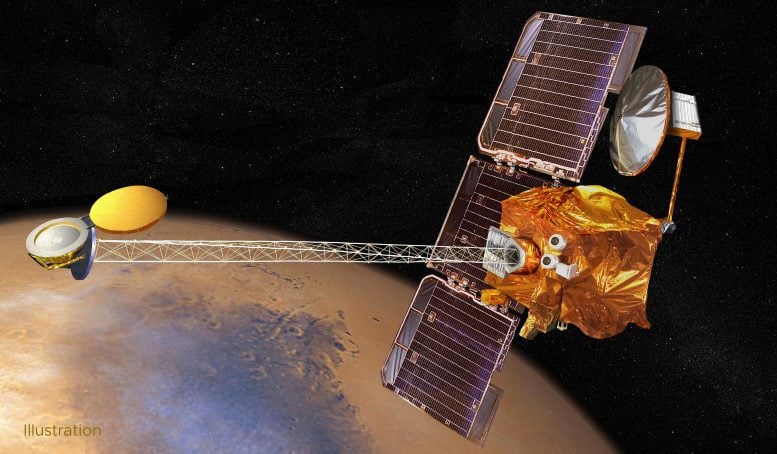
Odyssey doesn’t need a lot of hydrazine to get by on any given day. Solar panels power its systems, while three strategically placed reaction wheels help the orbiter point its science instruments at the Martian surface. As the reaction wheels spin inside the spacecraft bus, or body, they create torque that causes Odyssey to move in the opposite direction.
“These reaction wheels have to work together to maintain the spacecraft’s pointing,” said Odyssey’s mission manager, Jared Call of NASA’s Jet Propulsion Laboratory in Southern California. “But with Odyssey completing a full loop every orbit, you need a way to unload the increasing momentum.”
That’s where Odyssey’s hydrazine comes in. The spacecraft’s thrusters release this propellant in small, calculated bursts to counter the reaction wheels’ building momentum.
Teamwork
So when the team’s calculations showed that their propellant supply was lower than expected, engineers at JPL got to work with those at Lockheed Martin Space, which built Odyssey, maintains mission operations, and provides spacecraft engineering support.
“First, we had to verify the spacecraft was OK,” said Joseph Hunt, Odyssey’s project manager at JPL. “After ruling out the possibility of a leak or that we were burning more fuel than estimated, we started looking at our measuring process.”
The team agreed that they needed some fresh eyes to assess the situation. They brought in Boris Yendler, an outside consultant who also specializes in spacecraft propellant estimation.
Like all spacecraft, Odyssey relies on heaters to keep various parts, including the fuel tanks, working in the cold of space. Yendler wondered whether heat was being added to the propellant from some other source on the spacecraft, complicating the fuel measurement. After lots of experimentation, the team confirmed that was the case: Heaters along a fuel line connecting the tanks were warming them faster than expected, making it seem as if the tanks were nearly empty.
“Our method of measurement was fine. The problem was that the fluid dynamics occurring on board Odyssey are more complicated than we thought,” Call said.
After figuring out how much heat wasn’t being accounted for in their calculations, the team concluded that Odyssey has about 9 pounds (4 kilograms) of hydrazine left. It’s enough to last the mission for a few more years. Although the number could change as the team works to refine the measurements and improve their accuracy, the team is resting easier now that they better understand their spacecraft.
“It’s a little like our process for scientific discovery,” Call said. “You explore an engineering system not knowing what you’ll find. And the longer you look, the more you find that you didn’t expect.”
Mars Odyssey Orbiter is a spacecraft launched by NASA in April 2001 to study Mars, the fourth planet from the sun. The spacecraft is named after Arthur C. Clarke’s science fiction novel “2001: A Space Odyssey” and is part of NASA’s Mars Exploration Program.
The main objective of the Mars Odyssey Orbiter mission is to study the composition and radiation environment of Mars in order to better understand the planet’s geology, climate, and potential habitability. The spacecraft carries a suite of scientific instruments including a thermal emission imaging system, a gamma ray spectrometer, and a neutron spectrometer.
The Mars Odyssey Orbiter was the first spacecraft to successfully use a technique called “gravity assist” to enter Mars’ orbit. This technique involves using the gravity of a planet or moon to help the spacecraft gain speed and change its trajectory.
The mission has been extended several times since its launch and has provided important data and images of Mars’ surface and atmosphere. The Mars Odyssey Orbiter continues to orbit the planet and transmit data back to Earth to this day.
Never miss a breakthrough: Join the SciTechDaily newsletter.
Follow us on Google and Google News.