
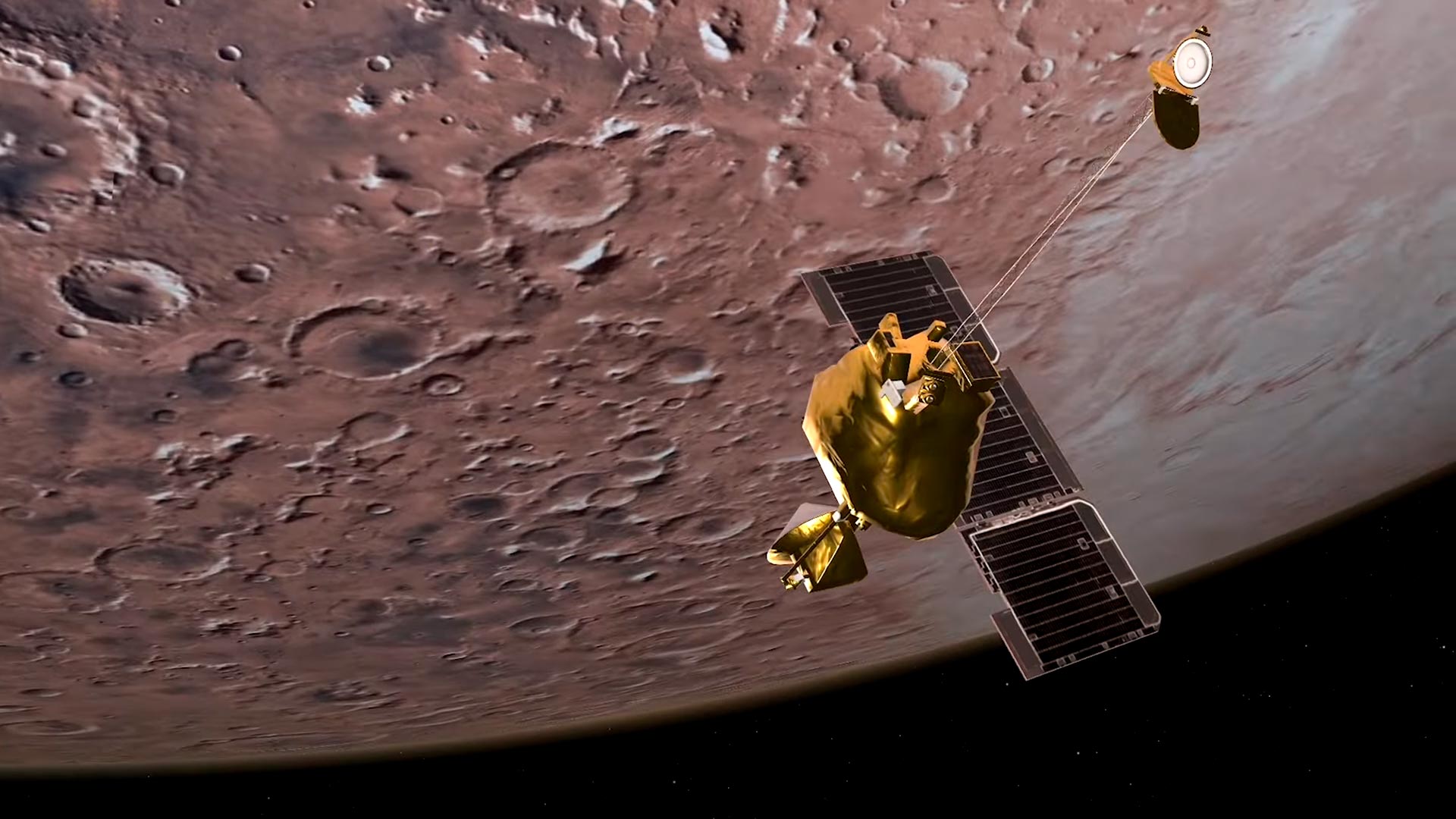
NASA’s Mars Odyssey orbiter has provided new panoramic images of Mars and its moon Phobos, offering fresh insights into the Martian landscape and atmosphere.
The Odyssey orbiter captured clouds and dust in the Red Planet’s skies, along with one of its two tiny moons.
Astronauts often react with awe when they see the curvature of the Earth below the International Space Station. Now Mars scientists are getting a taste of what that’s like, thanks to NASA’s 2001 Mars Odyssey orbiter, which completed its 22nd year at the Red Planet last month.
The spacecraft captured a series of panoramic images that showcased the curving Martian landscape below gauzy layers of clouds and dust. Stitched end to end, the 10 images offer not only a fresh, and stunning, view of Mars, but also one that will help scientists gain new insights into the Martian atmosphere.
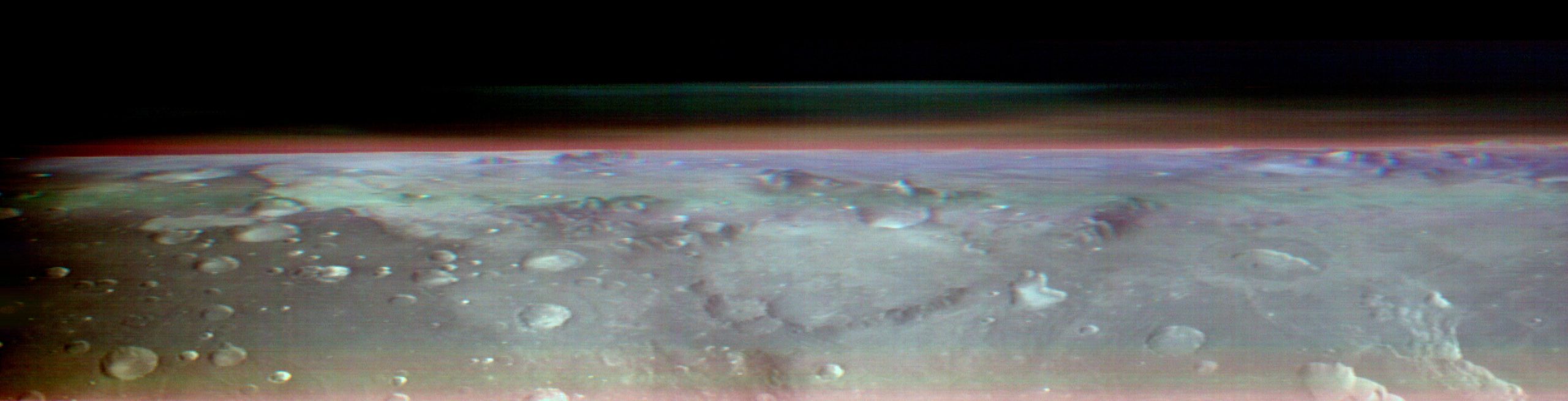
The spacecraft took the images in May from an altitude of about 250 miles (400 kilometers) – the same altitude at which the space station flies above Earth.
“If there were astronauts in orbit over Mars, this is the perspective they would have,” said Jonathon Hill of Arizona State University, operations lead for Odyssey’s camera, called the Thermal Emission Imaging System, or THEMIS. “No Mars spacecraft has ever had this kind of view before.”
NASA’s Mars Odyssey orbiter captured the first-ever views of Mars that showcase the curving horizon and layers of atmosphere, similar to what an astronaut sees of Earth from the International Space Station. While there are no astronauts yet at Mars, this view gives us a sense of what they might see. Laura Kerber, deputy project scientist for NASA’s Mars Odyssey orbiter, explains how and why the spacecraft captured a view of the Red Planet similar to the International Space Station’s view of Earth. Credit: NASA/JPL-Caltech
How It Was Done
The reason why the view is so uncommon is because of the challenges involved in creating it. Engineers at NASA’s Jet Propulsion Laboratory in Southern California, which manages the mission, and Lockheed Martin Space, which built Odyssey and co-leads day-to-day operations, spent three months planning the THEMIS observations. The infrared camera’s sensitivity to warmth enables it to map ice, rock, sand, and dust, along with temperature changes, on the planet’s surface.
It can also measure how much water ice or dust is in the atmosphere, but only in a narrow column directly below the spacecraft. That’s because THEMIS is fixed in place on the orbiter; it usually points straight down.
The mission wanted a more expansive view of the atmosphere. Seeing where those layers of water-ice clouds and dust are in relation to each other – whether there’s one layer or several stacked on top of each other – helps scientists improve models of Mars’ atmosphere.
“I think of it as viewing a cross-section, a slice through the atmosphere,” said Jeffrey Plaut, Odyssey’s project scientist at JPL. “There’s a lot of detail you can’t see from above, which is how THEMIS normally makes these measurements.

Because THEMIS can’t pivot, adjusting the angle of the camera requires adjusting the position of the whole spacecraft. In this case, the team needed to rotate the orbiter almost 90 degrees while making sure the Sun would still shine on the spacecraft’s solar panels but not on sensitive equipment that could overheat. The easiest orientation turned out to be one where the orbiter’s antenna pointed away from Earth. That meant the team was out of communication with Odyssey for several hours until the operation was complete.
The Odyssey mission hopes to take similar images in the future, capturing the Martian atmosphere across multiple seasons.
Over the Moon
To make the most of their effort, the mission also captured imagery of Mars’ little moon Phobos. This marks the seventh time in 22 years that the orbiter has pointed THEMIS at the moon in order to measure temperature variations across its surface.
“We got a different angle and lighting conditions of Phobos than we’re used to,” Hill said. “That makes it a unique part of our Phobos dataset.”
The new imagery provides insight into the composition and physical properties of the moon. Further study could help settle a debate over whether Phobos, which measures about 16 miles (25 kilometers) across, is a captured asteroid or an ancient chunk of Mars that was blasted off the surface by an impact.
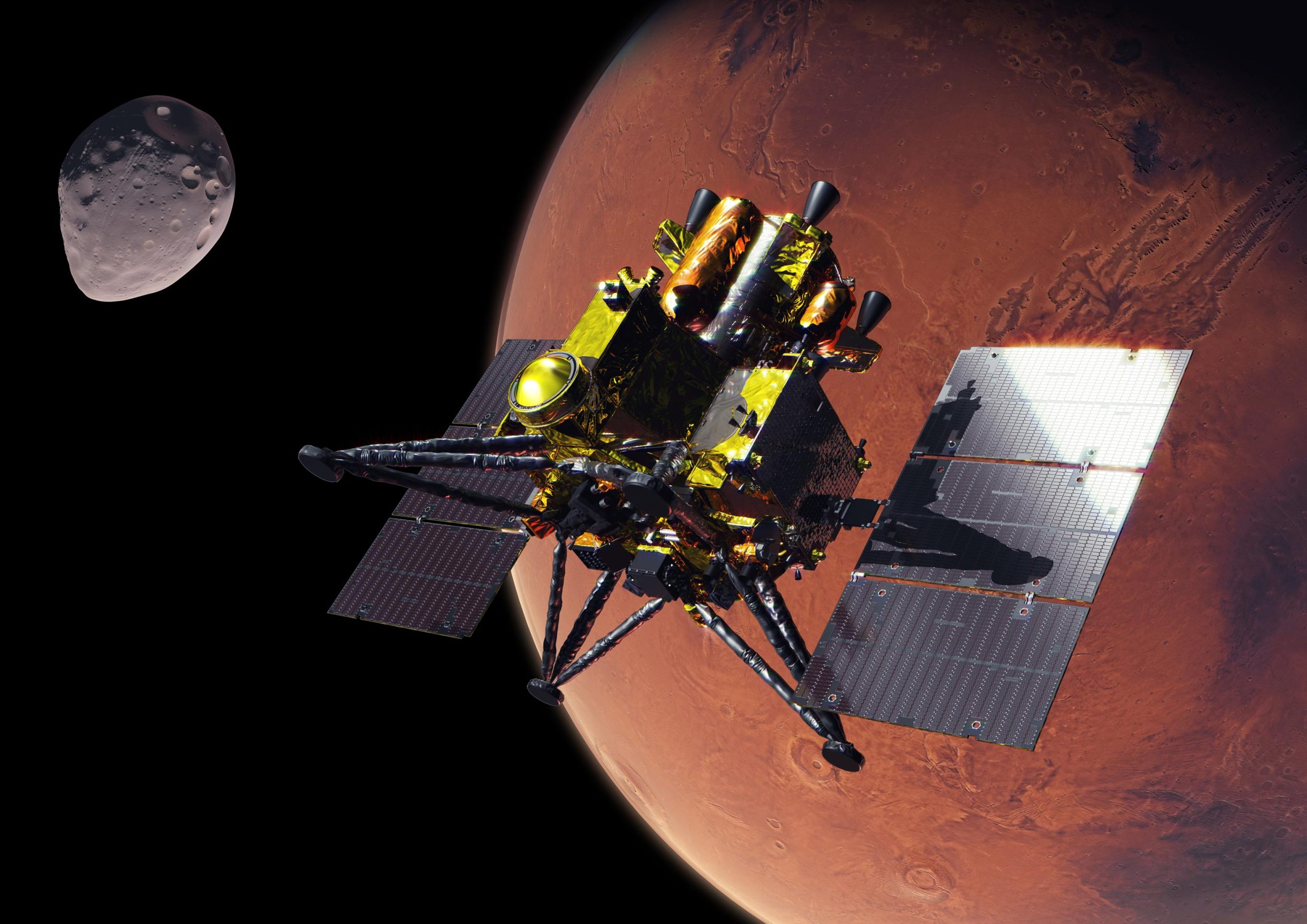
NASA is participating with JAXA (Japan Aerospace Exploration Agency) in a sample return mission to Phobos and its sister moon, Deimos, called Mars Moon eXplorer, or MMX. Odyssey’s Phobos imagery will be helpful to scientists working on both Odyssey as well as MMX.
More About the Mission
THEMIS was built and is operated by Arizona State University in Tempe. JPL is a division of Caltech in Pasadena.
Never miss a breakthrough: Join the SciTechDaily newsletter.
Follow us on Google and Google News.