

NASA’s 2001 Mars Odyssey orbiter has captured a breathtaking new view of the massive volcano Arsia Mons rising through morning ice clouds, offering a rare astronaut-like glimpse of the Martian horizon.
This marks a shift in Odyssey’s mission toward atmospheric science, using horizon images to track seasonal changes in dust and water ice layers. The towering Arsia Mons stands out not just for its size, twice the height of Mauna Loa, but for generating dense cloud formations during Mars’ colder seasons.
Dawn Over Mars: A Volcano Breaks Through the Clouds
A spectacular new panorama from NASA’s Mars Odyssey orbiter reveals one of the Red Planet’s tallest volcanoes, Arsia Mons, rising through a glowing layer of early morning clouds. The image shows the volcano just before dawn, standing out against a sky filled with water ice clouds, a striking sight on a planet also known for its carbon dioxide cloud formations.
Arsia Mons is part of the Tharsis Montes, a trio of massive volcanoes near Mars’ equator. This is the first time one of them has been seen on the Martian horizon, giving scientists and the public a view of Mars similar to how astronauts see Earth from space aboard the International Space Station (ISS).
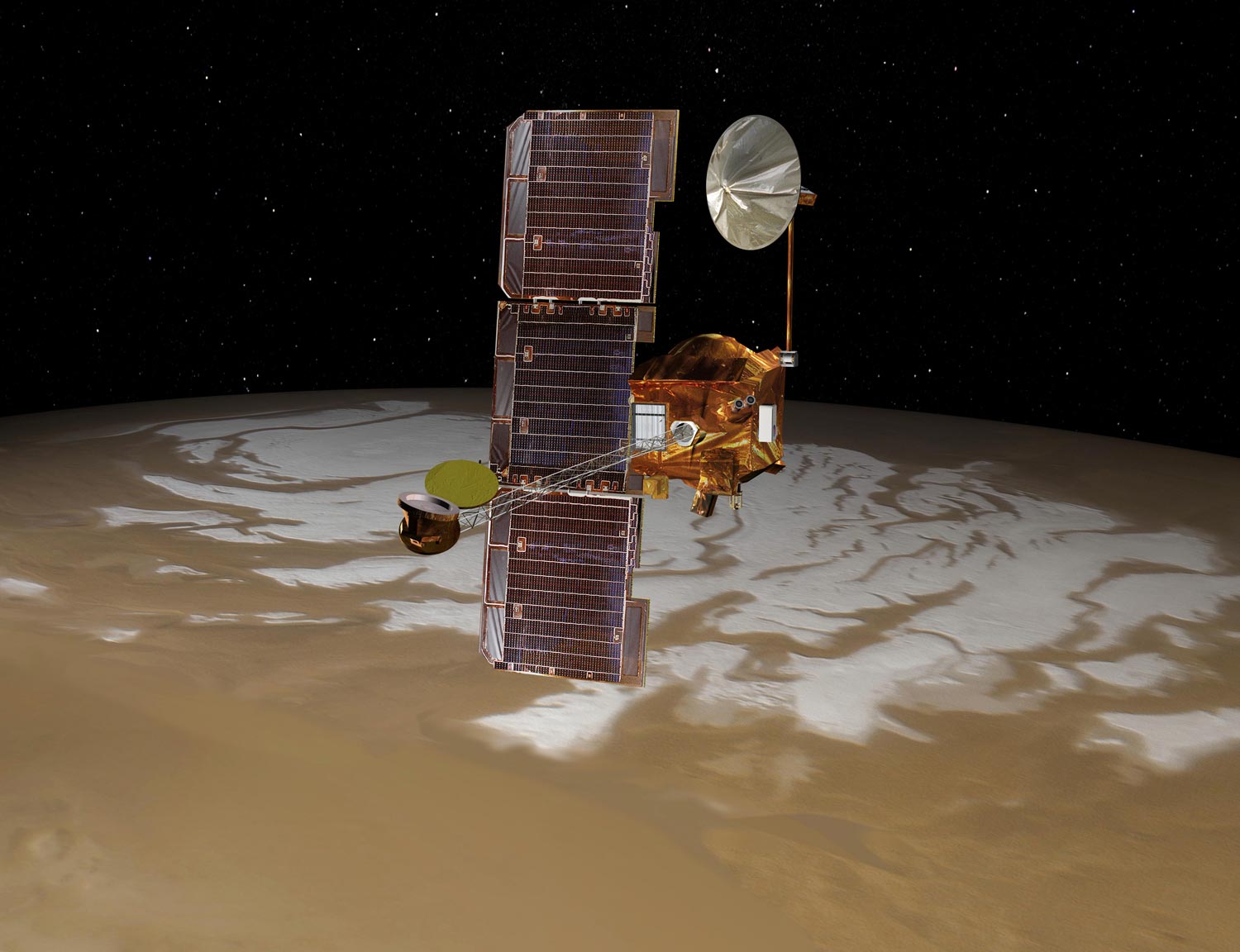
Launched in 2001, Mars Odyssey holds the record as the longest-running spacecraft orbiting another planet. In 2023, the mission began capturing high-altitude shots of the Martian horizon. To take these unique images, Odyssey rotates its camera, normally used to scan the surface, so it can look sideways and capture the edge of the planet.
This new approach is opening a window into Mars’ upper atmosphere, providing insights that surface-focused images simply can’t reveal.

Tracking Martian Weather and Cloud Evolution
This angled perspective allows scientists to study layers of dust and water ice clouds high above the Martian surface. By comparing images taken at different times of year, researchers can now observe how these cloud layers change with the seasons.
“We’re seeing some really significant seasonal differences in these horizon images,” said planetary scientist Michael D. Smith of NASA’s Goddard Space Flight Center in Greenbelt, Maryland. “It’s giving us new clues to how Mars’ atmosphere evolves over time.”
Understanding Mars’ clouds is particularly important for understanding the planet’s weather and how phenomena like dust storms occur. That information, in turn, can benefit future missions, including entry, descent, and landing operations.
Volcanic Giants of Mars
While these images focus on the upper atmosphere, the Odyssey team has tried to include interesting surface features in them, as well. In Odyssey’s latest horizon image, captured on May 2, Arsia Mons stands 12 miles (20 kilometers) high, roughly twice as tall as Earth’s largest volcano, Mauna Loa, which rises 6 miles (9 kilometers) above the seafloor.
The southernmost of the Tharsis volcanoes, Arsia Mons is the cloudiest of the three. The clouds form when air expands as it blows up the sides of the mountain and then rapidly cools. They are especially thick when Mars is farthest from the Sun, a period called aphelion. The band of clouds that forms across the planet’s equator at this time of year is called the aphelion cloud belt, and it’s on proud display in Odyssey’s new panorama.
“We picked Arsia Mons hoping we would see the summit poke above the early morning clouds. And it didn’t disappoint,” said Jonathon Hill of Arizona State University in Tempe, operations lead for Odyssey’s camera, called the Thermal Emission Imaging System, or THEMIS.
The THEMIS camera can view Mars in both visible and infrared light. The latter allows scientists to identify areas of the subsurface that contain water ice, which could be used by the first astronauts to land on Mars. The camera can also image Mars’ tiny moons, Phobos and Deimos, allowing scientists to analyze their surface composition.
More About Odyssey
Mars Odyssey is NASA’s longest-operating spacecraft at the Red Planet, orbiting Mars since 2001. Managed by NASA’s Jet Propulsion Laboratory (JPL)—a division of Caltech in Pasadena, California—Odyssey is a vital part of the Mars Exploration Program, overseen by NASA’s Science Mission Directorate in Washington.
The spacecraft was built by Lockheed Martin Space in Denver, which continues to work closely with JPL on mission operations. One of Odyssey’s key instruments is THEMIS (Thermal Emission Imaging System), designed and operated by Arizona State University in Tempe. THEMIS captures both visible and infrared imagery, enabling detailed studies of Mars’ surface composition, atmosphere, and seasonal changes.
Now over two decades into its mission, Mars Odyssey continues to provide groundbreaking science, from mapping subsurface water ice to capturing dramatic views of Martian volcanoes and clouds, offering crucial insights for both current exploration and future human missions.
Never miss a breakthrough: Join the SciTechDaily newsletter.
Follow us on Google and Google News.
1 Comment
I wonder why Mars would have the biggest volcano in the solar system.