
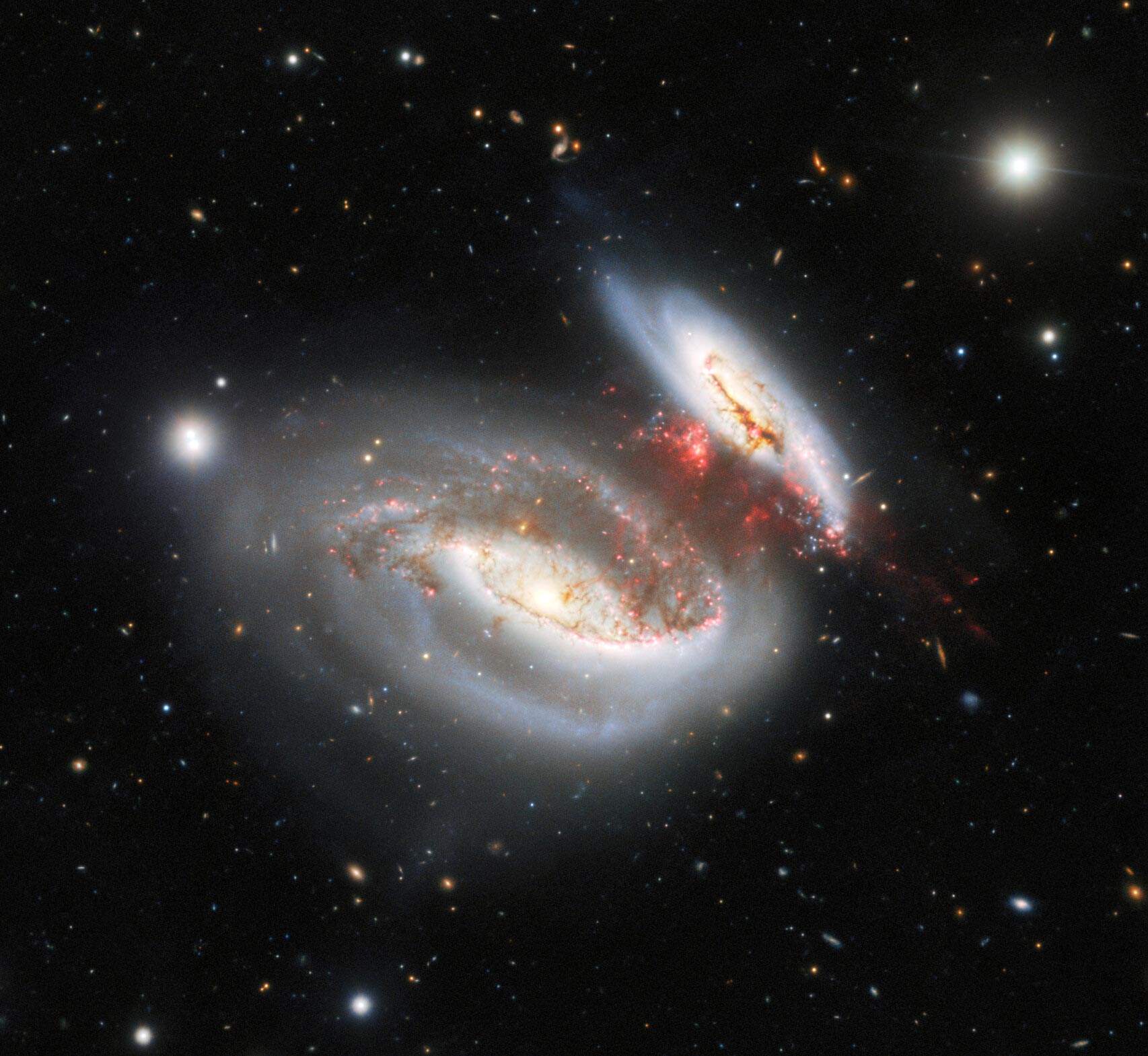
Credit: International Gemini Observatory/NOIRLab/NSF/AURA, Image Processing: M. Rodriguez (NSF’s NOIRLab), T.A. Rector (University of Alaska Anchorage/NSF’s NOIRLab), J. Miller (Gemini Observatory/NSF’s NOIRLab), M. Zamani (NSF’s NOIRLab) & D. de Martin (NSF’s NOIRLab), Acknowledgment: PI: A. S. Castelli (Universidad Nacional de la Plata)
Gemini North captures sprawling aftermath of head-on collision between a pair of galaxies.
The Gemini North telescope, one half of the International Gemini Observatory, operated by NSF’s NOIRLab, captured this dazzling image of UGC 12914 and UGC 12915, which are nicknamed the Taffy Galaxies. Their twisted shape is the result of a head-on collision that occurred about 25 million years prior to their appearance in this image. A bridge of highly turbulent gas devoid of significant star formation spans the gap between the two galaxies.
Galaxy collisions are transformative events, largely responsible for driving the evolution of the Universe. The mixing and mingling of stellar material is an incredibly dynamic process that can lead to the formation of molecular clouds populated with newly forming stars. But, a head-on collision between the two galaxies UGC 12914 (left) and UGC 12915 (right) 25–30 million years ago appears to have resulted in a different kind of structure — a bridge of highly turbulent material spanning the two galaxies. Though this intergalactic bridge is teeming with star-forming material, its turbulent nature is suppressing star formation.
This pair of galaxies, nicknamed the Taffy Galaxies, is located about 180 million light-years away in the direction of the constellation Pegasus.
This new image, captured with Gemini North, one half of the International Gemini Observatory, operated by NSF’s NOIRLab, showcases the fascinating feature that gave them their name. A tenuous bridge composed of narrow molecular filaments, shown in brown, and clumps of hydrogen gas, shown in red, can be seen between the two galaxies. Its complex web structure resembles taffy being stretched as the pair slowly separates.
Galaxy collisions can happen out of a variety of different scenarios, often involving a larger galaxy and a smaller satellite galaxy. As they drift near one another, the satellite galaxy can attract one of the larger galaxy’s primary spiral arms, pulling it out of its orbit. Or the satellite galaxy can actually intersect with the larger galaxy, causing significant distortions to its own structure. In other cases, a collision can lead to a merger if neither member has enough momentum to continue on after colliding. In all these scenarios, stellar material from both galaxies mixes through a gradual combining and redistribution of gas, like two puddles of liquid that are slowly bleeding into each other. The resulting collecting and compression of the gas can then trigger star formation.
Zoom-in to UGC 12914 and UGC 12915, which are nicknamed the Taffy Galaxies. Their twisted shape is the result of a head-on collision that occurred about 25 million years prior to their appearance in this image. A bridge of highly turbulent gas devoid of significant star formation spans the gap between the two galaxies.
A head-on collision, however, would be more like pouring liquid from two separate cups into a shared bowl. When the Taffy Galaxies’ collided, their galactic disks and gaseous components smashed right into each other. This resulted in a massive injection of energy into the gas, causing it to become highly turbulent. As the pair emerged from their collision, high-velocity gas was pulled from each galaxy, creating a massive gas bridge between them. The turbulence of the stellar material throughout the bridge is now prohibiting the collection and compression of gas that are required to form new stars.
The Gemini North observations of this object were led by Analía Smith Castelli, an astronomer with the Instituto de Astrofísica de La Plata in Argentina. Argentina is one of the partners in the International Gemini Observatory.
Never miss a breakthrough: Join the SciTechDaily newsletter.
Follow us on Google and Google News.