

A student-led experiment has shown that the search for dark matter doesn’t always require massive infrastructure.
Modern cosmology is often associated with large observatories, complex instruments, global collaborations, and major funding. Even so, progress remains possible through smaller, flexible efforts led by young researchers and supported by institutional resources and creative problem solving, including in the ongoing search for dark matter.
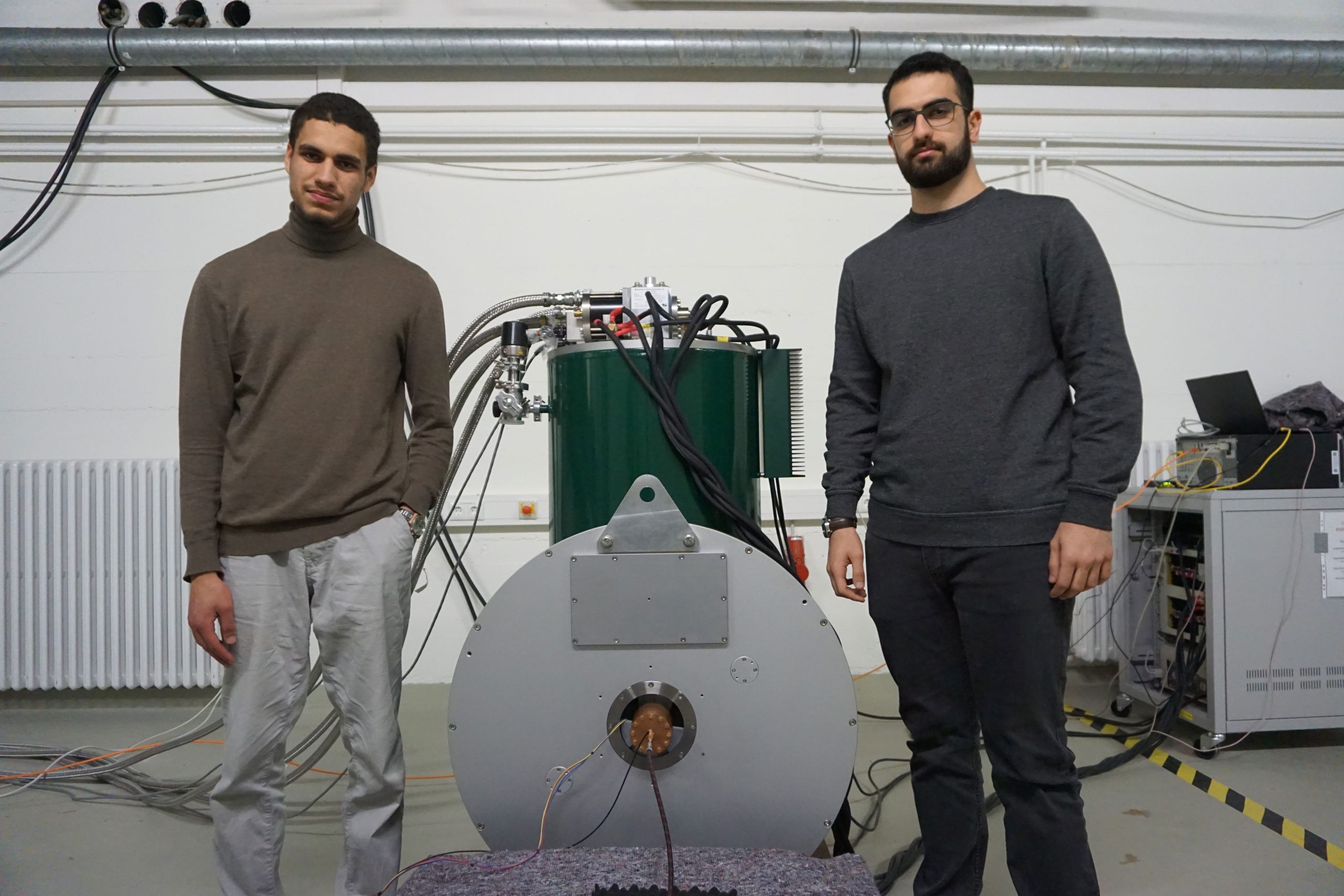
In a recent study published in the Journal of Cosmology and Astroparticle Physics (JCAP), a team of undergraduate students at the University of Hamburg designed and built a cavity detector to look for axions, a leading dark matter candidate. Despite limited resources, they established new experimental constraints on axion properties, demonstrating that compact experiments can still contribute to one of physics’ biggest unanswered questions.
Funding for students
The work was supported by a student research grant from the University of Hamburg through the Hub for Crossdisciplinary Learning, which encourages independent research projects.
“We were kind of embedded in the research group of the MADMAX dark matter experiment,” explains Nabil Salama, one of the authors of the study, currently pursuing an M.Sc. in Physics at the University of Hamburg. “MADMAX carries out a similar experiment on a much larger and more complex scale, and we benefited from their expertise and support.”
“We are very grateful for this help,” he adds, “and also to the University of Hamburg and the Quantum Universe Cluster of Excellence, which provided funding, access to key equipment such as the magnet, and invaluable support from researchers.”
Searching for dark matter
“The benefit of working with dark matter, or axions, is that we expect it to be present everywhere in our galaxy,” says Agit Akgümüs, first author of the study with Salama, currently pursuing an M.Sc. in Mathematical Physics at the University of Hamburg. “So essentially, no matter where you perform the experiment, you have some dark matter on your hand you can do experiments with.”
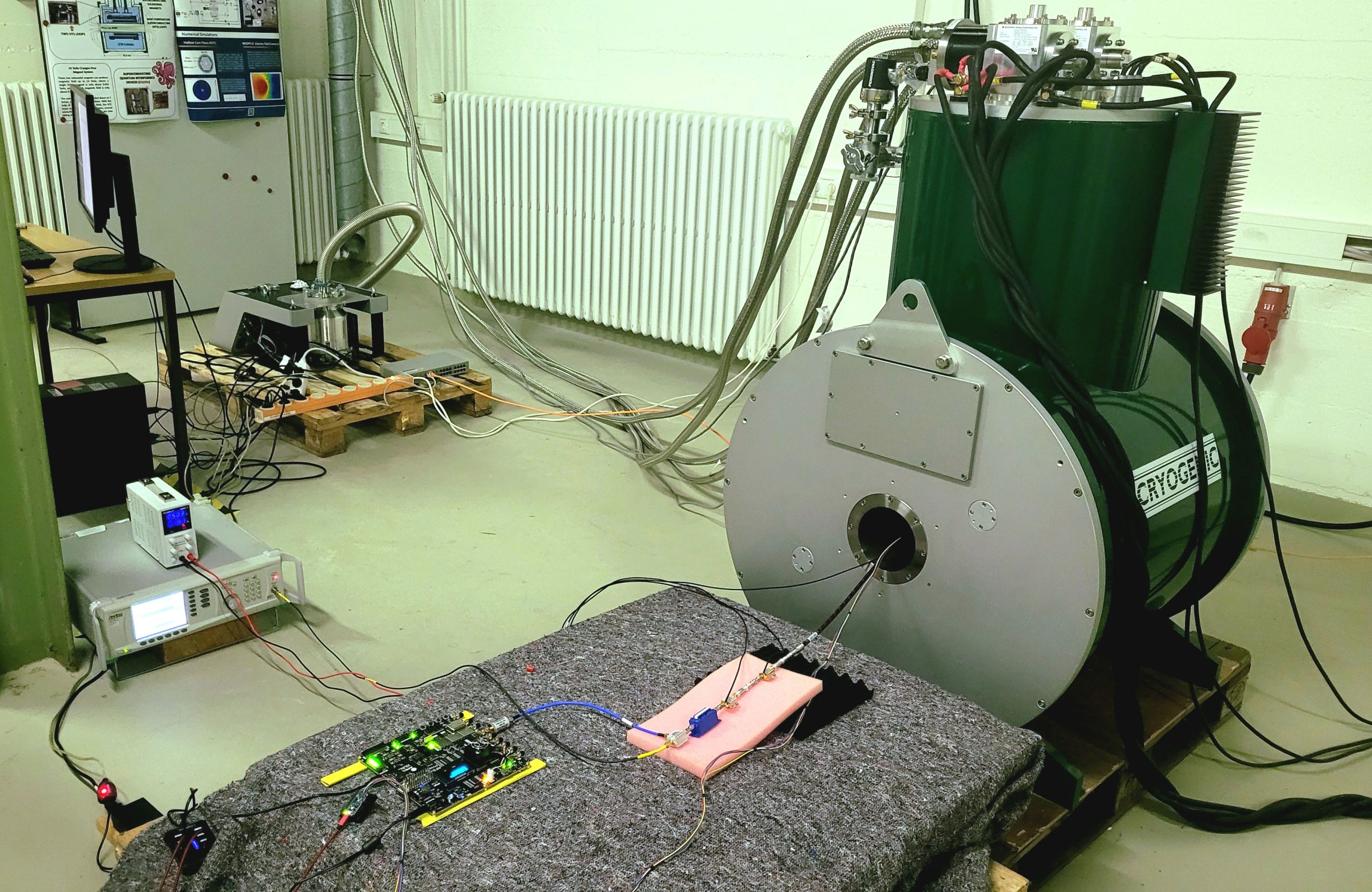
The team used their funding to assemble the experimental setup, beginning with a resonant cavity made from highly conductive materials, along with electronics, cabling, supports, and measurement devices. “The detector we built is essentially the simplest version of a cavity detector for dark matter,” says Salama.
They also relied on existing infrastructure and equipment provided by the university and collaborating groups rather than building everything from scratch. The system was then tested, calibrated, and operated to collect data.
“We reduced very complex experiments to their essential components,” says Salama. “The result is a less sensitive setup, limited to a small search window, but still capable of producing new scientific data.”
No signal found, new limits set
“The search for axions involves exploring a wide range of possible parameters,” Akgümüs explains. “Our experiment covers only a small region, with limited sensitivity, but it still helps narrow down the possibilities. To actually find the particle, we need either much larger experiments or many different ones, each probing a specific region.”
After completing data collection, the team did not detect any signal linked to axions. Rather than a negative outcome, this result provides valuable constraints. It allows scientists to rule out axions with certain properties within the tested mass range, especially those that interact more strongly with photons. This helps refine the search and informs future experiments.
“I think the point of our experiment is that things can be done on a smaller scale,” says Salama. Akgümüs adds: “Our results are naturally more limited than those of larger experiments. Performance scales with resources and complexity. However, we have shown that it is possible to reduce these setups to a much smaller scale — even to projects developed almost independently by students — while still producing real scientific data.”
During peer review, a referee highlighted an intriguing possibility, Salama notes. Once axions are discovered and their properties, especially their mass, are known, similar experiments could become far more accessible and even suitable for teaching labs. “We were told that setups like ours could one day become standard student lab experiments,” says Salama. “In a way, we may have anticipated that future, showing that it is already possible to build and operate such an experiment on a small scale.”
Reference: “A new limit for axion dark matter with SPACE” by M.A. Akgümüs, N. Salama, J. Egge, E. Garutti, M. Maroudas, L.H. Nguyen and D. Leppla-Weber, 17 April 2026, Journal of Cosmology and Astroparticle Physics.
DOI: 10.1088/1475-7516/2026/04/054
Never miss a breakthrough: Join the SciTechDaily newsletter.
Follow us on Google and Google News.
3 Comments
So they set up all that equipment in collaboration with some better resources, then ran their experiment, and found nothing. i.e. no axions showed up, but what they proved is that micro-experiments can still find nothing just like macro-experiments, and that their experiment can be repeated in the classroom, for possible teaching hands-on sessions! HMMMMM?
They found nothing because there is nothing 😉
Dark matter does not exist.
There is no such thing as dark matter.
The notion is herd mentality.
There is another explanation for the observations.