
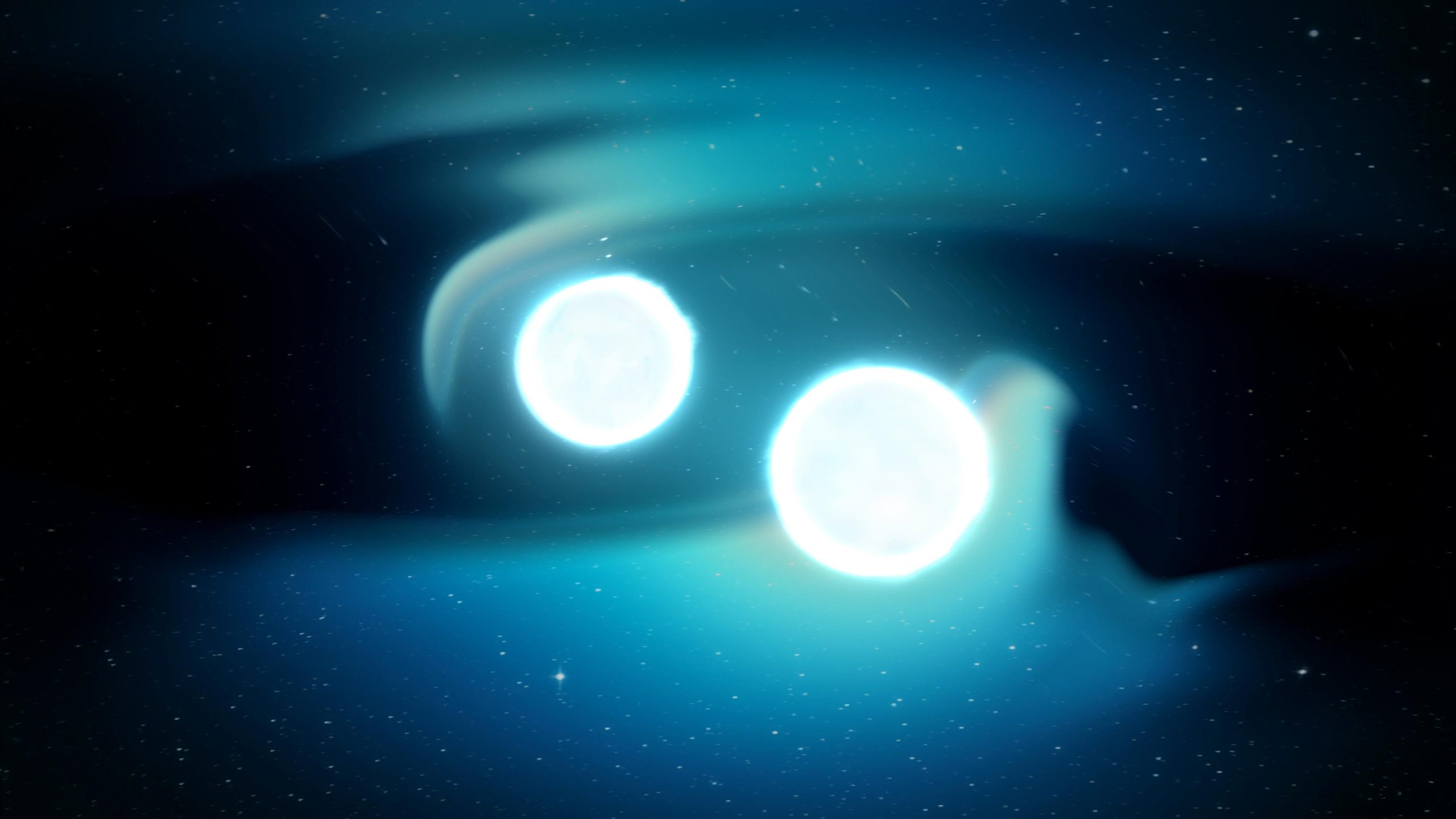
Gravitational waves could reveal whether the quark soup that existed in the early Universe is created in neutron-star mergers.
RIKEN researchers suggest that gravitational-wave signals from merging neutron stars could reveal the existence of ultra-dense quark-gluon matter. By simulating these mergers and analyzing the resultant gravitational waves, they propose that next-gen detectors, due within the next decade, could confirm this theory.
Telltale signatures in gravitational-wave signals from merging neutron stars should reveal what happens to matter at the extreme pressures generated during such mergers, calculations by RIKEN researchers predict.
If you took some water and compressed it with a piston, it would shrink as the molecules get pushed closer together.
If you continued ramping up the pressure, you’d reach a point where the atoms collapse and form an ultra-dense soup of neutrons and protons. The only place in the Universe where this happens is neutron stars, the collapsed remnants of burned-out stars, and it produces mind-boggling densities—one teaspoon of such material weighs several hundred billion kilograms.
But what would happen if you continued to increase the pressure still further? Not even astrophysicists know the answer to that.
The Mystery of Quark-Gluon Phases
The density at the heart of neutron stars is three to five times higher than that of an atomic nucleus; it’s the highest density achievable before a black hole forms. Nobody knows what happens to matter at such extreme densities.
One theory posits that the ultra-dense soup of neutrons and protons will decompose into a soup of quarks and gluons—the most fundamental building blocks of matter.
“Some researchers believe that quark phases will appear in the center of neutron stars,” says Shigehiro Nagataki of the RIKEN Astrophysical Big Bang Laboratory. “But it’s a conjecture.”
Gravitational Waves: A Window into the Unknown
A promising way to discover whether this strange form of matter exists is by observing mergers of two neutron stars using gravitational-wave detectors.
If it does exist, there are two possibilities for how protons and neutrons would disintegrate into their constituent quarks during mergers. They could go through a sharp transition, much like liquid water turns into vapor at its boiling point at normal pressures. Or there could be a fuzzy transition, analogous to how water becomes vapor at pressures above its critical point.
Now, Nagataki and co-workers have stimulated mergers between two neutron stars and calculated the gravitational waves that would be produced by them to explore the second possibility.
The frequency of the gravitational waves from neutron-star mergers typically depends on how fast the neutron star rotates. Larger neutron stars typically rotate slower, and vice-versa.
The team found that it should be possible to probe whether the quark phase exists in a neutron star by analyzing the frequency of its gravitational waves. If it does exist, the gravitational waves can also reveal how the quark phase appears.
While current gravitational-wave detectors can’t detect this, the next generation of detectors, which will be coming online in the next decade or so, should be able to.
“It’s amazing to think we should be able to detect the type of transition by detecting gravitational waves,” says Nagataki.
Reference: “Merger and Postmerger of Binary Neutron Stars with a Quark-Hadron Crossover Equation of State” by Yong-Jia Huang, Luca Baiotti, Toru Kojo, Kentaro Takami, Hajime Sotani, Hajime Togashi, Tetsuo Hatsuda, Shigehiro Nagataki and Yi-Zhong Fan, 26 October 2022, Physical Review Letters.
DOI: 10.1103/PhysRevLett.129.181101
Never miss a breakthrough: Join the SciTechDaily newsletter.
Follow us on Google and Google News.
1 Comment
This mysterious to me