
Close Menu
    Facebook X (Twitter) Instagram
    SciTechDaily
    • Biology
    • Chemistry
    • Earth
    • Health
    • Physics
    • Science
    • Space
    • Technology
    Facebook X (Twitter) Pinterest YouTube RSS
    SciTechDaily
    Home»Physics»Astral Alchemy: Researchers Synthesize Mysterious Exotic Baryon
    Physics

    Astral Alchemy: Researchers Synthesize Mysterious Exotic Baryon

    By Osaka UniversityFebruary 26, 20231 Comment5 Mins Read
    Facebook Twitter Pinterest Telegram LinkedIn WhatsApp Email Reddit
    Share
    Facebook Twitter LinkedIn Pinterest Telegram Email Reddit
    Abstract Energy Particle Physics Astrophysics Concept
    Researchers have successfully synthesized an exotic, but very short-lived, Lambda resonance known as Λ(1405) for the first time.

    Scientists at Osaka University were part of a particle accelerator experiment that produced an exotic and highly unstable particle, and determined its mass. This could contribute to a better understanding of the inner workings of ultra-dense neutron stars.

    The Standard Model of particle physics explains that most particles are made of combinations of just six types of basic entities called quarks. However, there are still many unsolved mysteries, one of which is Λ(1405), an exotic but fleeting Lambda resonance. It was previously believed to be a specific combination of three quarks – up, down, and strange – and gaining insight into its composition could assist in uncovering information about the extremely dense matter in neutron stars.

    Now, investigators from Osaka University were part of a team that succeeded in synthesizing Λ(1405) for the first time by combining a K– meson and a proton and determining its complex mass (mass and width). The K– meson is a negatively charged particle containing a strange quark and an up antiquark.
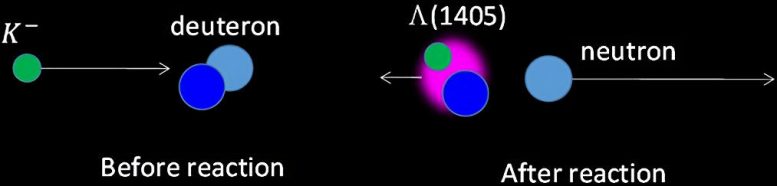
    Schematic Illustration of the Reaction Used To Synthesize Λ(1405)
    Schematic illustration of the reaction used to synthesize Λ(1405) by fusing a K- (green circle) with a proton (dark blue circle), which takes place inside a deuteron nucleus. Credit: Hiroyuki Noumi

    The much more familiar proton that makes up the matter that we are used to has two up quarks and a down quark. The researchers showed that Λ(1405) is best thought of as a temporary bound state of the K– meson and the proton, as opposed to a three-quark excited state.

    In a study published recently in Physics Letters B, the group describes the experiment they carried out at the J-PARC accelerator. K– mesons were shot at a deuterium target, each of which had one proton and one neutron. In a successful reaction, a K– meson kicked out the neutron, and then merged with the proton to produce the desired Λ(1405). “The formation of a bound state of a K– meson and a proton was only possible because the neutron carried away some of the energy,” says an author of the study, Kentaro Inoue.
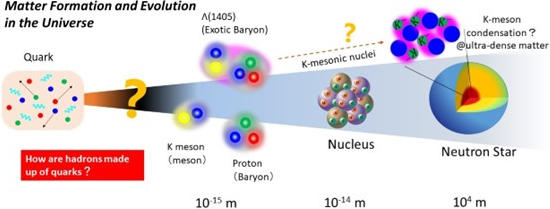
    Exotic Baryon Called Λ(1405)
    The exotic baryon called Λ(1405) and a schematic illustration of the evolution of matter. Credit: Hiroyuki Noumi

    One of the aspects that had been perplexing scientists about Λ(1405) was its very light overall mass, even though it contains a strange quark, which is nearly 40 times as heavy as an up quark. During the experiment, the team of researchers was able to successfully measure the complex mass of Λ(1405) by observing the behavior of the decay products.
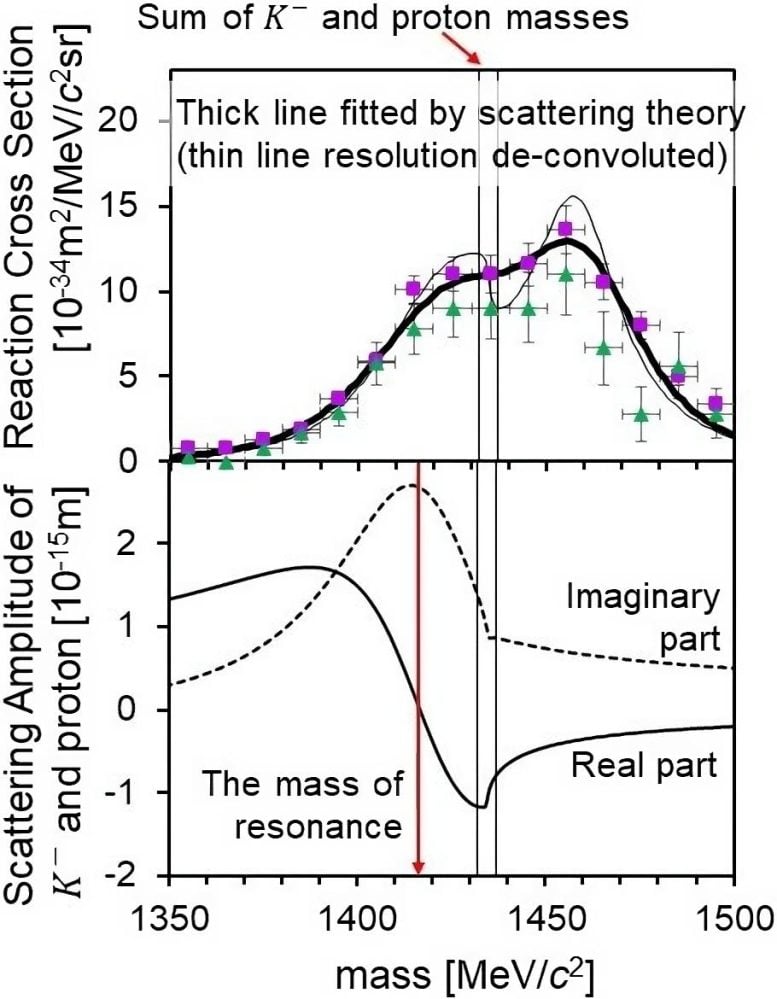
    Astral Alchemy Study Graph
    (Top) Measured reaction cross-section. The horizontal axis is the K- and proton collision recoil energy converted into a mass value. Large reaction events occur at mass values lower than the sum of the K- and proton masses, which itself suggests the existence of Λ(1405). The measured data were reproduced by scattering theory (solid lines). (Bottom) Distribution of K– and proton scattering amplitudes. When squared, these correspond to the reaction cross-section and are generally complex numbers. The calculated values match with the measured data. When the real part (solid line) crosses 0, the value of the imaginary part reaches its maximum value. This is a typical distribution for a resonance state, and determines the complex mass. The arrows indicate the real part. Credit: 2023, Hiroyuki Noumi, Pole position of Λ(1405) measured in d(K–,n)πΣ reactions, Physics Letters B

    “We expect that progress in this type of research can lead to a more accurate description of ultra-high-density matter that exists in the core of a neutron star,” says Shingo Kawasaki, another study author. This work implies that Λ(1405) is an unusual state consisting of four quarks and one antiquark, making a total of 5 quarks, and does not fit the conventional classification in which particles have either three quarks or one quark and one antiquark.

    This research may lead to a better understanding of the early formation of the Universe, shortly after the Big Bang, as well as what happens when matter is subject to pressures and densities well beyond what we see under normal conditions.

    Reference: “Pole position of Λ(1405) measured in d(K−,n)πΣ reactions” by S. Aikawa, S. Ajimura, T. Akaishi, H. Asano, G. Beer, C. Berucci, M. Bragadireanu, P. Buehler, L. Busso, M. Cargnelli, S. Choi, C. Curceanu, S. Enomoto, H. Fujioka, Y. Fujiwara, T. Fukuda, C. Guaraldo, T. Hashimoto, R.S. Hayano, T. Hiraiwa, M. Iio, M. Iliescu, K. Inoue, Y. Ishiguro, S. Ishimoto, T. Ishikawa, K. Itahashi, M. Iwai, M. Iwasaki, K. Kanno, K. Kato, Y. Kato, S. Kawasaki, P. Kienle, Y. Komatsu, H. Kou, Y. Ma, J. Marton, Y. Matsuda, Y. Mizoi, O. Morra, R. Murayama, T. Nagae, H. Noumi, H. Ohnishi, S. Okada, Z. Omar, H. Outa, K. Piscicchia, Y. Sada, A. Sakaguchi, F. Sakuma, M. Sato, A. Scordo, M. Sekimoto, H. Shi, K. Shirotori, D. Sirghi, F. Sirghi, K. Suzuki, S. Suzuki, T. Suzuki, K. Tanida, H. Tatsuno, A.O. Tokiyasu, M. Tokuda, D. Tomono, A. Toyoda, K. Tsukada, O. Vazquez-Doce, E. Widmann, T. Yamaga, T. Yamazaki, H. Yim, Q. Zhang and J. Zmeskal, 20 December 2022, Physics Letters B.
    DOI: 10.1016/j.physletb.2022.137637

    The study was funded by the Japan Society for the Promotion of Science, Ministry of Education, Culture, Sports, Science and Technology.

    Never miss a breakthrough: Join the SciTechDaily newsletter.
    Follow us on Google and Google News.

    Hadron Neutron Star Neutrons Particle Physics Popular Protons University of Osaka
    Share. Facebook Twitter Pinterest LinkedIn Email Reddit

    Related Articles

    Completing Einstein’s Theories – A Particle Physics Breakthrough

    Physics Surprise: Protons Are Probably Actually Smaller Than Long Thought

    Large Hadron Collider: New Insight Into the Internal Structure of the Proton

    Tetra-Neutron Experiment: Understanding of Nuclear Forces Might Have To Be Significantly Changed

    Unexpected Substructures in the Fundamental Components of All Matter

    Incredible Cosmic Conditions: Bringing Neutron Stars Down to Earth

    Physicists May Have Found Dark Matter: X-rays Surrounding “Magnificent 7” May Be Traces of Theorized Particle

    Generating Megatesla Magnetic Fields on Earth Using Intense-Laser-Driven Microtube Implosions

    Tracking Down the Mystery of the Origin of Matter: Complex Experiment Runs for 2 Years in Search for “New Physics”

    1 Comment

    1. AĚŌ on March 5, 2023 8:53 am

      Particles have nothing to do with physics and measured equations. Educational government terrorism

      Reply
    Leave A Reply Cancel Reply

    • Facebook
    • Twitter
    • Pinterest
    • YouTube

    Don't Miss a Discovery

    Subscribe for the Latest in Science & Tech!

    Trending News

    Bone-Strengthening Discovery Could Reverse Osteoporosis

    Scientists Uncover Hidden Trigger Behind Stem Cell Aging

    Scientists Find Way to Reverse Fatty Liver Disease Without Changing Diet

    Could Humans Regrow Limbs? New Study Reveals Promising Genetic Pathway

    Scientists Reveal Eating Fruits and Vegetables May Increase Your Risk of Lung Cancer

    Scientists Reverse Brain Aging With Simple Nasal Spray

    Scientists Uncover Potential Brain Risks of Popular Fish Oil Supplements

    Scientists Discover a Surprising Way To Make Bread Healthier and More Nutritious

    Follow SciTechDaily
    • Facebook
    • Twitter
    • YouTube
    • Pinterest
    • Newsletter
    • RSS
    SciTech News
    • Biology News
    • Chemistry News
    • Earth News
    • Health News
    • Physics News
    • Science News
    • Space News
    • Technology News
    Recent Posts
    • Alzheimer’s Symptoms May Start Outside the Brain, Study Finds
    • Cancer’s Secret Weapon? Scientists Reveal How Tumors “Learn” To Survive Treatment
    • Millions Take This Popular Supplement – Scientists Discover a Concerning Link to Heart Failure
    • What Makes Rubber So Strong? Scientists Finally Solve 100-Year-Old Mystery
    • Scientists Decode Mysterious Magnetic “Maze Domains” To Boost EV Efficiency
    Copyright © 1998 - 2026 SciTechDaily. All Rights Reserved.
    • Science News
    • About
    • Contact
    • Editorial Board
    • Privacy Policy
    • Terms of Use

    Type above and press Enter to search. Press Esc to cancel.