

Close Menu
    Facebook X (Twitter) Instagram
    SciTechDaily
    • Biology
    • Chemistry
    • Earth
    • Health
    • Physics
    • Science
    • Space
    • Technology
    Facebook X (Twitter) Pinterest YouTube RSS
    SciTechDaily
    Home»Biology»Daylong Gene Activity Disruption: Unveiling the Effects of Obstructive Sleep Apnea
    Biology

    Daylong Gene Activity Disruption: Unveiling the Effects of Obstructive Sleep Apnea

    By PLOSJune 27, 2023No Comments4 Mins Read
    Facebook Twitter Pinterest Telegram LinkedIn WhatsApp Email Reddit
    Share
    Facebook Twitter LinkedIn Pinterest Telegram Email Reddit
    Very Tired Man
    Obstructive Sleep Apnea (OSA) leads to significant changes in gene activity throughout the day due to intermittent low blood oxygen, reveals a study by Cincinnati Children’s Hospital Medical Center. The research, which involved mice exposed to hypoxic conditions, found the largest transcriptional changes in lung genes. The findings offer insights into organ damage in OSA patients and could aid in identifying diagnostic or therapeutic targets.

    Tracking time-dependent changes may lead to better diagnosis and understanding of health risks.

    The low blood oxygen levels of obstructive sleep apnea cause widespread changes in gene activity throughout the day, according to a new study in the open-access journal PLOS Biology by David Smith of Cincinnati Children’s Hospital Medical Center, US, and colleagues. The finding may lead to tools for earlier diagnosis and tracking of the disorder.

    Obstructive sleep apnea (OSA) occurs when the airway becomes blocked (usually by soft tissue, associated with snoring and interrupted breathing during the night), resulting in intermittent hypoxia (low blood oxygen) and disrupted sleep. It affects over one billion people worldwide and costs $150 billion per year in direct medical costs in the United States alone. OSA increases the risk for cardiovascular, respiratory, metabolic, and neurologic complications.
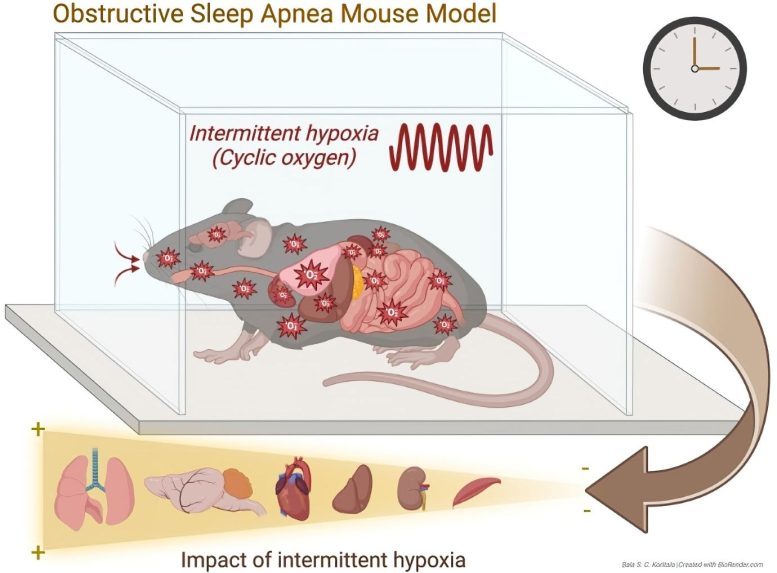
    Obstructive Sleep Apnea Disrupts Gene Activity
    Obstructive sleep apnea disrupts gene activity throughout the day in mice. Created with biorender.com. Credit: Bala S. C. Koritala (CC-BY 4.0)

    The activity of many genes varies naturally throughout the day, partially in response to activity of circadian clock genes, whose regular oscillations drive circadian variation in up to half the genome. Gene activity also varies in response to external factors, including decreases in oxygen levels, which causes production of “hypoxia-inducible factors,” which influence activity of many genes, including clock genes. To better understand how OSA may affect gene activity throughout the day, the authors exposed mice to intermittent hypoxic conditions and examined whole-genome transcription in six tissues—lung, liver, kidney, muscle, heart, and cerebellum—throughout the day. The authors then evaluated variation in the circadian timing of gene expression in these same tissues.

    The Disruption of Circadian Rhythms in Key Tissues

    The largest changes were found in the lung, where intermittent hypoxia affected transcription of almost 16% of all genes, most of which were upregulated. Just under 5% of genes were affected in heart, liver, and cerebellum. The subset of genes that normally exhibit circadian rhythmicity were even more strongly affected by intermittent hypoxia, with significant changes seen in 74% of such genes in the lung and 66.9% of such genes in the heart. Among the genes affected in each tissue were known clock genes, an effect that likely contributed to the large changes in circadian activity of other genes seen in these tissues.

    “Our findings provide novel insight into the pathophysiological mechanisms that could be associated with end-organ damage in patients with chronic exposure to intermittent hypoxia,” Smith said, “and may be useful to identify targets for future mechanistic studies evaluating diagnostic or therapeutic approaches;” for instance, through a blood test tracking one of the dysregulated gene products to detect early OSA.

    Bala S. C. Koritala adds, “Our study using an animal model of Obstructive Sleep Apnea unveils time- and tissue-specific variations of the whole genome transcriptome and associated hallmark pathways. These unique findings uncover early biological changes linked to this disorder, occurring across multiple organ systems.”

    Reference: “Obstructive sleep apnea in a mouse model is associated with tissue-specific transcriptomic changes in circadian rhythmicity and mean 24-hour gene expression” by Bala S. C. Koritala, Yin Yeng Lee, Laetitia S. Gaspar, Shweta S. Bhadri, Wen Su, Gang Wu, Lauren J. Francey, Marc D. Ruben, Ming C. Gong, John B. Hogenesch and David F. Smith, 30 May 2023, PLOS Biology.
    DOI: 10.1371/journal.pbio.3002139

    Never miss a breakthrough: Join the SciTechDaily newsletter.
    Follow us on Google and Google News.

    Genetics PLOS Sleep Apnea Sleep Science
    Share. Facebook Twitter Pinterest LinkedIn Email Reddit

    Related Articles

    Temperature-Dependent Sex Reversals in Bearded Dragon Embryos

    Circadian Rhythm Research Could Turn Early Birds Into Night Owls – Or Vice Versa

    Toxic Masculinity: DNA Repeats on Y Chromosome Contribute to a Shorter Lifespan in Male Flies

    Genetic Mutations Add Up to Very High Blood Cancer Risk in Three Popular Dog Breeds

    Key Factor Identified That Makes Worms Feel Full – Similar Factor May Control Feelings of Fullness in Humans

    How an Infectious Tumor in Endangered Tasmanian Devils Evolved As It Spread

    New Type of Multi-Tasking Taste Cells Discovered in Taste Buds

    Shocking Research Finds DNA From an Ancient, Unidentified Ancestor Was Passed Down to Humans Living Today

    Fighting Fish Synchronize Their Combat Moves and Gene Expression Leading to Tightly Meshed Battles

    Leave A Reply Cancel Reply

    • Facebook
    • Twitter
    • Pinterest
    • YouTube

    Don't Miss a Discovery

    Subscribe for the Latest in Science & Tech!

    Trending News

    Monster Storms on Jupiter Unleash Lightning Beyond Anything on Earth

    Scientists Create “Liquid Gears” That Spin Without Touching

    The Simple Habit That Could Help Prevent Cancer

    Millions Take These IBS Drugs, But a New Study Finds Serious Risks

    Scientists Unlock Hidden Secrets of 2,300-Year-Old Mummies Using Cutting-Edge CT Scanner

    Bread Might Be Making You Gain Weight Even Without Eating More Calories

    Scientists Discover Massive Magma Reservoir Beneath Tuscany

    Europe’s Most Active Volcano Just Got Stranger – Here’s Why Scientists Are Rethinking It

    Follow SciTechDaily
    • Facebook
    • Twitter
    • YouTube
    • Pinterest
    • Newsletter
    • RSS
    SciTech News
    • Biology News
    • Chemistry News
    • Earth News
    • Health News
    • Physics News
    • Science News
    • Space News
    • Technology News
    Recent Posts
    • Scientists Discover a New Meteor Shower From a Mysterious Crumbling Asteroid
    • This Simple Fruit Wash Could Make Produce Safer and Last Days Longer
    • These Tiny Robots 50x Smaller Than a Hair Can Hunt and Move Bacteria
    • Simple Blood Test May Predict Alzheimer’s Years Before Brain Scans Show Signs
    • Scientists Say Adding This Unusual Seafood to Your Diet Could Reverse Signs of Aging
    Copyright © 1998 - 2026 SciTechDaily. All Rights Reserved.
    • Science News
    • About
    • Contact
    • Editorial Board
    • Privacy Policy
    • Terms of Use

    Type above and press Enter to search. Press Esc to cancel.