
Close Menu
    Facebook X (Twitter) Instagram
    SciTechDaily
    • Biology
    • Chemistry
    • Earth
    • Health
    • Physics
    • Science
    • Space
    • Technology
    Facebook X (Twitter) Pinterest YouTube RSS
    SciTechDaily
    Home»Biology»Key Factor Identified That Makes Worms Feel Full – Similar Factor May Control Feelings of Fullness in Humans
    Biology

    Key Factor Identified That Makes Worms Feel Full – Similar Factor May Control Feelings of Fullness in Humans

    By PLOSMarch 4, 2021No Comments3 Mins Read
    Facebook Twitter Pinterest Telegram LinkedIn WhatsApp Email Reddit
    Share
    Facebook Twitter LinkedIn Pinterest Telegram Email Reddit
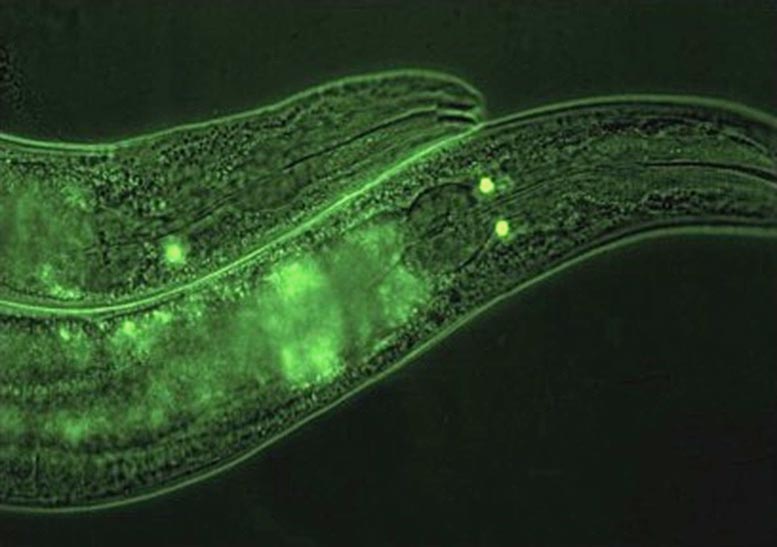
    SKN-1B Tagged With GFP
    SKN-1B tagged with GFP can be seen in two chemosensory head neurons. SKN-1B acts in these neurons to sense food and elicit appropriate behavioral changes. Credit: Tataridas-Pallas N, et al., 2021, PLOS Genetics

    Study finds that in nematodes, SKN-1B controls behaviors like foraging, eating, and resting.

    In nematode worms, a key controller allows the worm to sense when it needs food and when it feels full, and then changes its behavior accordingly. Jennifer Tullet of the University of Kent and colleagues report these new findings in a paper published March 4th in PLOS Genetics. They propose that a similar factor may control feelings of fullness in humans.

    Deciding when and how much to eat is crucial for maintaining health and preventing overeating. Our bodies take in complex molecular signals from our nervous, physiological, and metabolic systems, which tell us when we’re hungry and when to stop eating, but how these signals work is not yet well understood. Tullet and her colleagues used the nematode worm C. elegans, to investigate how the worm’s nervous system senses its food status and communicates fullness to the rest of the animal.

    SKN-1B: The Fullness Regulator

    They identified a new master controller of this system, SKN-1B, which appears to be deeply involved in food-detection and food-related behaviors. SKN-1B is a transcription factor, meaning that it can regulate when other genes are turned on or off. The researchers discovered that it functions by changing hormonal signaling in the worm and activating the network of mitochondria that provides power in each cell. Based on the worm’s nutritional needs, SKN-1B can tell the animal to switch between behaviors, such as searching for food, eating, and taking a post-meal nap.

    Future Drug Potential for Appetite Control

    The new study suggests the possibility that a similar transcription factor in humans regulates food-sensing and the feeling of being full. Instead of SKN-1B, mammals have NF-E2 related transcription factors, or Nrfs, which scientists think function in metabolism and the process of converting food nutrients into energy. Nrfs also play a role in the phenomenon where animals live longer when they restrict their calories. If future research confirms the role of Nrfs in signaling fullness, then Nrfs may be a new target for developing drugs that control overeating.

    The authors add, “We are really excited about this work, understanding the neuroendocrinology of eating and sleeping is so important to lifelong health and wellbeing.”

    Reference: “Neuronal SKN-1B modulates nutritional signalling pathways and mitochondrial networks to control satiety” by Nikolaos Tataridas-Pallas, Maximillian A. Thompson, Alexander Howard, Ian Brown, Marina Ezcurra, Ziyun Wu, Isabel Goncalves Silva, Christopher D. Saunter, Timo Kuerten, David Weinkove, T. Keith Blackwell and Jennifer M. A. Tullet, 4 March 2021, PLoS Genetics.
    DOI: 10.1371/journal.pgen.1009358

    Funding: This work was funded by awards from UKRI | Biotechnology and Biological Sciences Research Council (BBSRC) to JMAT BB/R003629/1; and HHS | National Institutes of Health (NIH) AG054215; GM122610; and DK036836 to TKB. The funders had no role in study design, data collection and analysis, decision to publish, or preparation of the manuscript.

    Never miss a breakthrough: Join the SciTechDaily newsletter.
    Follow us on Google and Google News.

    Genetics Metabolism Neuroscience PLOS Weight Loss
    Share. Facebook Twitter Pinterest LinkedIn Email Reddit

    Related Articles

    Scientists Identify Gene Linked to Thinness – Unique to People That Can Eat Anything and Not Gain Weight

    Hereditary Form of Autism May Be Treatable With Nutritional Supplements

    Extra Gaits in Horses Traced to Single Mutation

    De Novo Somatic Mutations Likely Cause Hemimegalencephaly

    Mysterious Gene Mutation Provides Window into the Biology of Language Cognition

    Imbalance Between Neuronal Excitation and Inhibition May Account for Seizure Susceptibility in Angelman Syndrome

    Evolutionary Changes Surrounding the NOS1 Gene

    Secreted Peptide Dilp8 Essential to Insect Growth Rate

    “Area X” of Zebra Finch May Provide Insights to Human Speech Disorders

    Leave A Reply Cancel Reply

    • Facebook
    • Twitter
    • Pinterest
    • YouTube

    Don't Miss a Discovery

    Subscribe for the Latest in Science & Tech!

    Trending News

    Largest-Ever Study Finds Medicinal Cannabis Ineffective for Anxiety, Depression, PTSD

    250-Million-Year-Old Egg Solves One of Evolution’s Biggest Mysteries

    Living With Roommates Might Be Changing Your Gut Microbiome Without You Knowing

    Century-Old Cleaning Chemical Linked to 500% Increased Risk of Parkinson’s Disease

    What if Your Memories Never Happened? Physicists Take a New Look at the Boltzmann Brain Paradox

    One of the Universe’s Largest Stars May Be Getting Ready To Explode

    Scientists Discover Enzyme That Could Supercharge Ozempic-Like Weight Loss Drugs

    Popular Sweetener Linked to DNA Damage – “It’s Something You Should Not Be Eating”

    Follow SciTechDaily
    • Facebook
    • Twitter
    • YouTube
    • Pinterest
    • Newsletter
    • RSS
    SciTech News
    • Biology News
    • Chemistry News
    • Earth News
    • Health News
    • Physics News
    • Science News
    • Space News
    • Technology News
    Recent Posts
    • Want Less Stress? Landmark Study Points to a Simple Habit
    • Scientists Reveal Eating Fruits and Vegetables May Increase Your Risk of Lung Cancer
    • AI Reveals Explosive Growth of Floating Algae Across the World’s Oceans
    • 5.5 Million Bees Discovered Living Beneath a New York Cemetery
    • Scientists Reverse Brain Aging With Simple Nasal Spray
    Copyright © 1998 - 2026 SciTechDaily. All Rights Reserved.
    • Science News
    • About
    • Contact
    • Editorial Board
    • Privacy Policy
    • Terms of Use

    Type above and press Enter to search. Press Esc to cancel.