
Close Menu
    Facebook X (Twitter) Instagram
    SciTechDaily
    • Biology
    • Chemistry
    • Earth
    • Health
    • Physics
    • Science
    • Space
    • Technology
    Facebook X (Twitter) Pinterest YouTube RSS
    SciTechDaily
    Home»Space»Hubble Image of the Day: The Sharpest View of the Orion Nebula
    Space

    Hubble Image of the Day: The Sharpest View of the Orion Nebula

    By Hubble Space TelescopeMay 7, 2014No Comments3 Mins Read
    Facebook Twitter Pinterest Telegram LinkedIn WhatsApp Email Reddit
    Share
    Facebook Twitter LinkedIn Pinterest Telegram Email Reddit
    Hubbles Sharpest Image of the Orion Nebula
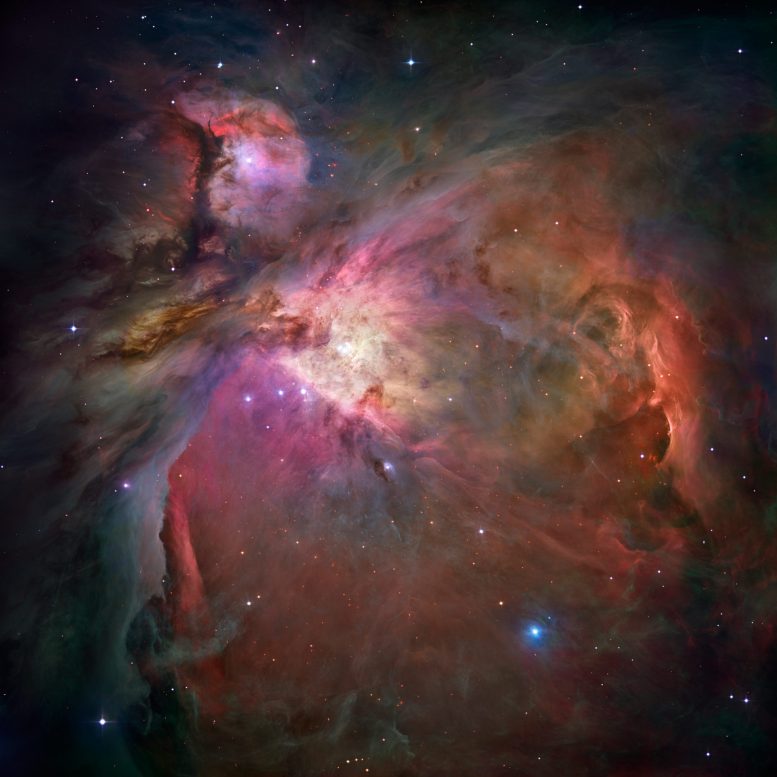
    Captured by the Hubble Space Telescope’s Advanced Camera for Surveys, this image provides the sharpest view of the Orion Nebula to date. Over 3,000 stars, including some never before seen in visible light, are showcased.  Credit: NASA, ESA, M. Robberto (Space Telescope Science Institute/ESA) and the Hubble Space Telescope Orion Treasury Project Team

    This Hubble image of the day represents the sharpest view ever taken of the Orion Nebula.

    This dramatic image offers a peek inside a cavern of roiling dust and gas where thousands of stars are forming. The image, taken by the Advanced Camera for Surveys (ACS) aboard NASA/ESA Hubble Space Telescope, represents the sharpest view ever taken of this region, called the Orion Nebula. More than 3,000 stars of various sizes appear in this image. Some of them have never been seen in visible light. These stars reside in a dramatic dust-and-gas landscape of plateaus, mountains, and valleys that are reminiscent of the Grand Canyon.

    The Orion Nebula is a picture book of star formation, from the massive, young stars that are shaping the nebula to the pillars of dense gas that may be the homes of budding stars. The bright central region is the home of the four heftiest stars in the nebula. The stars are called the Trapezium because they are arranged in a trapezoid pattern. Ultraviolet light unleashed by these stars is carving a cavity in the nebula and disrupting the growth of hundreds of smaller stars. Located near the Trapezium stars are stars still young enough to have disks of material encircling them. These disks are called protoplanetary disks or “proplyds” and are too small to see clearly in this image. The disks are the building blocks of solar systems.

    The bright glow at upper left is from M43, a small region being shaped by a massive, young star’s ultraviolet light. Astronomers call the region a miniature Orion Nebula because only one star is sculpting the landscape. The Orion Nebula has four such stars. Next to M43 are dense, dark pillars of dust and gas that point toward the Trapezium. These pillars are resisting erosion from the Trapezium’s intense ultraviolet light. The glowing region on the right reveals arcs and bubbles formed when stellar winds – streams of charged particles ejected from the Trapezium stars — collide with material.

    The faint red stars near the bottom are the myriad brown dwarfs that Hubble spied for the first time in the nebula in visible light. Sometimes called “failed stars,” brown dwarfs are cool objects that are too small to be ordinary stars because they cannot sustain nuclear fusion in their cores the way our Sun does. The dark red column, below, left, shows an illuminated edge of the cavity wall.

    The Orion Nebula is 1,500 light-years away, the nearest star-forming region to Earth. Astronomers used 520 Hubble images, taken in five colors, to make this picture. They also added ground-based photos to fill out the nebula. The ACS mosaic covers approximately the apparent angular size of the full moon.

    The Orion observations were taken between 2004 and 2005.

    Never miss a breakthrough: Join the SciTechDaily newsletter.
    Follow us on Google and Google News.

    Astronomy Hubble Space Telescope Nebula Star Formation
    Share. Facebook Twitter Pinterest LinkedIn Email Reddit

    Related Articles

    Hubble Video Gives 3D Perspective of Gum 29 and Westerlund 2

    Astronomers Discover Water-Building Molecule in Planetary Nebulas

    Hubble Views Star Formation within the Chamaeleon Cloud

    Astronomers Find Bizarre Alignment of Planetary Nebulae in the Milky Way

    Hubble Views Planetary Nebula IC 289

    A Closer Look at Planetary Nebula NGC 2392

    Images of the Necklace Nebula

    Hubble’s Close-Up View of the Tarantula Nebula

    In McNeil’s Nebula, Protostar V1647 Ori Flaunts its X-ray Spots

    Leave A Reply Cancel Reply

    • Facebook
    • Twitter
    • Pinterest
    • YouTube

    Don't Miss a Discovery

    Subscribe for the Latest in Science & Tech!

    Trending News

    Scientists May Have Discovered How To Heal Damaged Kidneys

    Interstellar Visitor 3I/ATLAS Is Bursting With an Unexpected Chemical

    Scientists Just Found All 5 Genetic “Letters” of DNA and RNA on an Asteroid

    The 4,000-Year-Old City That Defied History’s Rules on Wealth and Power

    The World’s Biggest Population Fear Has Flipped – and It Could Change Everything

    This “Fake” Pill Improved Memory and Physical Performance in Just 3 Weeks

    Scientists Say Frequent Ejaculation May Improve Sperm Quality and Fertility

    Scientists Have Found “The Heaven Sword” After Years of Looking

    Follow SciTechDaily
    • Facebook
    • Twitter
    • YouTube
    • Pinterest
    • Newsletter
    • RSS
    SciTech News
    • Biology News
    • Chemistry News
    • Earth News
    • Health News
    • Physics News
    • Science News
    • Space News
    • Technology News
    Recent Posts
    • Scientists Challenge a Fundamental Assumption About Consciousness
    • Scientists Say the “Backrooms” Have Become a New Kind of Tourist Destination
    • A Giant Scorpion the Size of a Coffee Table Is Forcing Scientists To Rethink Evolution
    • Science Debunks a Common Belief About Pets and Stress
    • The Surprising Reason Sugary Gum Helped Lower Blood Pressure
    Copyright © 1998 - 2026 SciTechDaily. All Rights Reserved.
    • Science News
    • About
    • Contact
    • Editorial Board
    • Privacy Policy
    • Terms of Use

    Type above and press Enter to search. Press Esc to cancel.