
Close Menu
    Facebook X (Twitter) Instagram
    SciTechDaily
    • Biology
    • Chemistry
    • Earth
    • Health
    • Physics
    • Science
    • Space
    • Technology
    Facebook X (Twitter) Pinterest YouTube RSS
    SciTechDaily
    Home»Space»Historic Voyager 2 Image of Neptune
    Space

    Historic Voyager 2 Image of Neptune

    By NASAAugust 25, 2014No Comments2 Mins Read
    Facebook Twitter Pinterest Telegram LinkedIn WhatsApp Email Reddit
    Share
    Facebook Twitter LinkedIn Pinterest Telegram Email Reddit
    Voyager 2 Image of Neptune
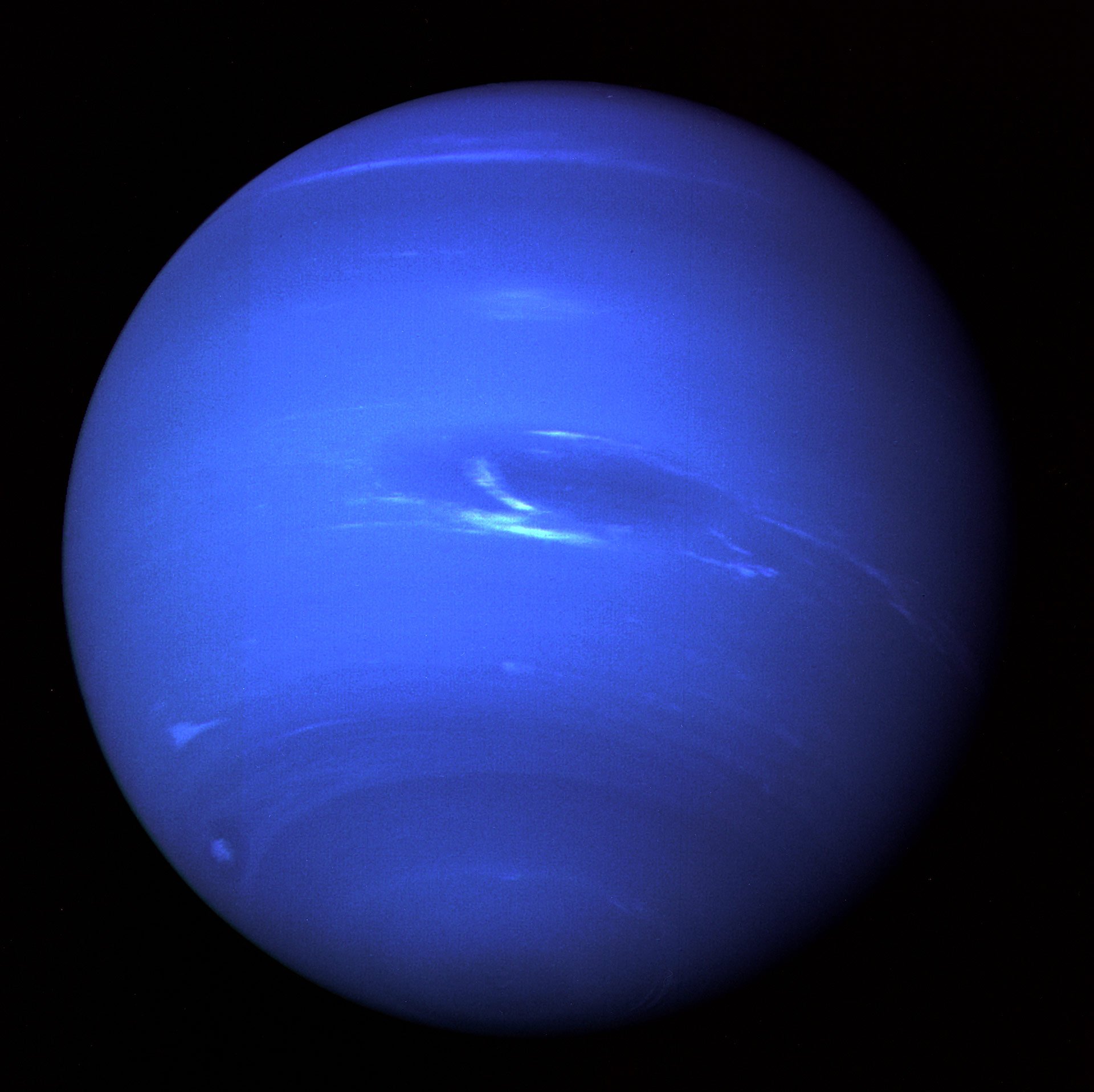
    This image of Neptune reveals the Great Dark Spot and its adjacent bright smudge. On the western edge, you can see the swiftly moving bright feature known as “Scooter,” along with a small dark spot. Credit: NASA

    This image of Neptune reveals the Great Dark Spot and its adjacent bright smudge. On the western edge, you can see the swiftly moving bright feature known as “Scooter,” along with a small dark spot. Credit: NASA

    This historic image of Neptune was taken twenty-five years ago by NASA’s Voyager 2 Spacecraft.

    NASA’s Voyager 2 spacecraft gave humanity its first glimpse of Neptune and its moon Triton in the summer of 1989. This picture of Neptune was produced from the last whole planet images taken through the green and orange filters on the Voyager 2 narrow angle camera. The images were taken on August 20, 1989, at a range of 4.4 million miles (7.1 million kilometers) from the planet, 4 days and 20 hours before the closest approach on August 25. The picture shows the Great Dark Spot and its companion bright smudge; on the west limb the fast-moving bright feature called “Scooter” and the little dark spot are visible. These clouds were seen to persist for as long as Voyager’s cameras could resolve them. North of these, a bright cloud band similar to the south polar streak may be seen.

    In the summer of 2015, another NASA mission to the farthest zone of the solar system, New Horizons, will make a historic first close-up study of Pluto. Although a fast flyby, New Horizons’ Pluto encounter on July 14, 2015, will not be a replay of Voyager but more of a sequel and a reboot, with a new and more technologically advanced spacecraft and, more importantly, a new cast of characters. Those characters are Pluto and its family of five known moons, all of which will be seen up close for the first time next summer.


    Never miss a breakthrough: Join the SciTechDaily newsletter.

    Astronomy NASA Neptune Voyager
    Share. Facebook Twitter Pinterest LinkedIn Email Reddit

    Related Articles

    A Tale of Four Worlds: Hubble’s Ten-Year Hunt for Secrets in the Outer Solar System

    New Color Map of Neptune’s Moon Triton

    Voyager 1 Presents the “Sounds” of Interstellar Space

    Hubble Data Reveals a New Neptune Moon

    NASA’s Voyager 1 Explores the Outer Limits of Our Heliosphere

    Fly Along With the Voyager Spacecraft As They Head Towards Interstellar Space

    Voyager Spacecraft Poised to Make New Discoveries

    Voyager 1 Reports a Rapid Increase in High-Energy Cosmic Ray Particles

    NASA’s Voyager 1 at the Final Frontier

    Leave A Reply Cancel Reply

    • Facebook
    • Twitter
    • Pinterest
    • YouTube

    Don't Miss a Discovery

    Subscribe for the Latest in Science & Tech!

    Trending News

    It’s Snowing Salt. The Strange Phenomenon Happening Deep in the Dead Sea

    Stanford Scientists Successfully Reverse Autism Symptoms in Mice

    Scientists Finally Solve the Mystery of the Sun’s Fastest Particles

    Don’t Throw Away Those Cannabis Leaves – They’re Packed With Rare Compounds

    Why Cancer Spreads: Scientists Uncover a New Clue Inside the Cell’s Power Plant

    These Glow-in-the-Dark Succulents Could Replace Your Night Light

    Mezcal Worm in a Bottle Yields Surprising DNA Results

    The Math Says Life Shouldn’t Exist: New Study Challenges Origins Theories

    Follow SciTechDaily
    • Facebook
    • Twitter
    • YouTube
    • Pinterest
    • Newsletter
    • RSS
    SciTech News
    • Biology News
    • Chemistry News
    • Earth News
    • Health News
    • Physics News
    • Science News
    • Space News
    • Technology News
    Recent Posts
    • If Aliens Are Looking for Us, This Is How They’d Find Us
    • “Alien Aurora” – Scientists Spot Never-Before-Seen Plasma Waves in Jupiter’s Polar Lights
    • 50-Million-Year-Old Sea Turtle Unearthed in Syria Stuns Paleontologists
    • 41,000 Years Ago, Something Weird in Space Changed How Humans Lived on Earth
    • $1 Billion Saved Each Year? Scientists Question Adult Booster Shots
    Copyright © 1998 - 2025 SciTechDaily. All Rights Reserved.
    • Science News
    • About
    • Contact
    • Editorial Board
    • Privacy Policy
    • Terms of Use

    Type above and press Enter to search. Press Esc to cancel.