
Close Menu
    Facebook X (Twitter) Instagram
    SciTechDaily
    • Biology
    • Chemistry
    • Earth
    • Health
    • Physics
    • Science
    • Space
    • Technology
    Facebook X (Twitter) Pinterest YouTube RSS
    SciTechDaily
    Home»Space»Chandra Confirms Active Galactic Nuclei Downsizing
    Space

    Chandra Confirms Active Galactic Nuclei Downsizing

    By Harvard-Smithsonian Center for AstrophysicsOctober 27, 20142 Comments3 Mins Read
    Facebook Twitter Pinterest Telegram LinkedIn WhatsApp Email Reddit
    Share
    Facebook Twitter LinkedIn Pinterest Telegram Email Reddit
    Modest AGN Tend to Peak Later in Cosmic History
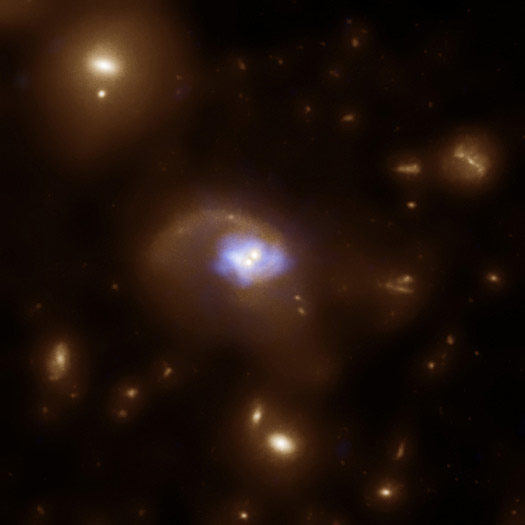
    A multicolor image of galaxies in the field of the Chandra Cosmic Evolution Survey. Credit: X-ray: NASA/CXC/SAO/F.Civano et al. Optical: NASA/STScI

    A new study of 209 galaxies in the early universe with X-ray bright supermassive black holes reveals that more modest active galactic nuclei (AGN) tend to peak later in cosmic history, and that obscured and unobscured AGN evolve in similar ways.

    Supermassive black holes containing millions or even billions of solar masses of material are found at the nuclei of galaxies. Our Milky Way, for example, has a nucleus with a black hole with about four million solar masses of material. Around the black hole, according to theories, is a torus of dust and gas, and when material falls toward the black hole (a process called accretion) the inner edge of the disk can be heated to millions of degrees. Such accretion heating can power dramatic phenomena like bipolar jets of rapidly moving charged particles. Such actively accreting supermassive black holes in galaxies are called active galactic nuclei (AGN).

    The evolution of AGN in cosmic time provides a picture of their role in the formation and co-evolution of galaxies. Recently, for example, there has been some evidence that AGN with more modest luminosities and accretion rates (compared to the most dramatic cases) developed later in cosmic history (dubbed “downsizing”), although the reasons for and implications of this effect are debated. CfA astronomers Eleni Kalfontzou, Francesca Civano, Martin Elvis, and Paul Green and a colleague have just published the largest study of X-ray selected AGN in the universe from the time when it was only 2.5 billion years old, with the most distant AGN in their sample dating from when the universe was about 1.2 billion years old.

    The astronomers studied 209 AGN detected with the Chandra X-ray Observatory. They note that the X-ray observations are less contaminated by host galaxy emission than optical surveys, and consequently that they span a wider, more representative range of physical conditions. The team’s analysis confirms the proposed trend towards downsizing, while it also can effectively rule out some alternative proposals. The scientists also find, among other things, that this sample of AGN represents nuclei with a wide range of molecular gas and dust extinction. Combined with the range of AGN dates, this result enables them to conclude that obscured and unobscured phases of AGN evolve in similar ways.

    Reference: “The largest X-ray-selected sample of z>3 AGNs: C-COSMOS and ChaMP” by E. Kalfountzou, F. Civano, M. Elvis, M. Trichas and P. Green, 9 October 2014, MNRAS.
    DOI: 10.1093/mnras/stu1745
    arXiv: 1408.6280


    Never miss a breakthrough: Join the SciTechDaily newsletter.
    Follow us on Google and Google News.

    Astronomy Astrophysics Chandra X-ray Observatory Galaxy Harvard-Smithsonian Center for Astrophysics
    Share. Facebook Twitter Pinterest LinkedIn Email Reddit

    Related Articles

    Chandra Reveals Extended Hard X-ray Emission from a Galactic Nucleus

    Examining the Dust Absorption of Active Galactic Nuclei

    Astronomers Detect X-rays From the Remains of Supernova SN 1957D

    Calculations Show the Ideal Time to Study the Cosmos

    Using Infrared Images from Hubble & Spitzer, Scientists Discover 25 Distant Galaxies

    Supernova Shock Wave Breaks Through a Cocoon of Gas

    Origins of Type Ia Supernovae

    Study of X-Shaped Radio Galaxy NGC 326 Shows Outburst History and Active Galactic Nucleus Feedback

    Hubble Observes Rare Blue Stars in Andromeda’s Core

    2 Comments

    1. s. keeling on October 27, 2014 3:12 pm

      “CfA astronomers Eleni Kalfontzou, Francesca Civano, Martin Elvis and Paul Green and a colleague”

      Alright, fess up. Who is this “a colleague” person?

      Reply
    2. Steve Johnson on October 28, 2014 1:18 pm

      check-out St JEROME PICTURE ‘WIKI HERMIT; for emergent life in the picture!
      if light travels at the speed of light and the camera shutter opens for ONE half of a second how much time will it take to see the picture emerge
      for us to focus and view IN OUR DAILY LIVES !

      Reply
    Leave A Reply Cancel Reply

    • Facebook
    • Twitter
    • Pinterest
    • YouTube

    Don't Miss a Discovery

    Subscribe for the Latest in Science & Tech!

    Trending News

    Magnetic Bacterium Extends Lifespan by 43% in Surprising Anti-Aging Study

    Archaeologists Discover Evidence of “Brands” 3,200 Years Before Modern Capitalism

    The Rare Vision Side Effect of Ozempic and Wegovy You Should Know About

    Hidden Deep Beneath Mars, Scientists Find Evidence of a Vast Magmatic System

    Your Gut Microbiome May Be Contagious, Scientists Discover

    Scientists Find a Troubling Effect of Sitting That Exercise Couldn’t Prevent

    125-Million-Year-Old Crocodile Fossil Reveals Astonishing New Secrets

    Scientists Discover an “Impossible” Way Muscle Filaments Can Grow

    Follow SciTechDaily
    • Facebook
    • Twitter
    • YouTube
    • Pinterest
    • Newsletter
    • RSS
    SciTech News
    • Biology News
    • Chemistry News
    • Earth News
    • Health News
    • Physics News
    • Science News
    • Space News
    • Technology News
    Recent Posts
    • Dead Sea Scrolls May Solve a Decades-Old Mystery About the Qumran Calendar
    • Study Challenges a Decades-Old Belief About Why Children Struggle To Read
    • Scientists Discover a “Loose Cannon” Virus Enzyme That Rewires Nearly Every Protein in a Bacterial Cell
    • Scientists Tracked Galápagos Sea Turtles for Years – What They Found Was Unexpected
    • Scientists Discover a “New” Frog That Was Hiding in Plain Sight for 100 Years
    Copyright © 1998 - 2026 SciTechDaily. All Rights Reserved.
    • Science News
    • About
    • Contact
    • Editorial Board
    • Privacy Policy
    • Terms of Use

    Type above and press Enter to search. Press Esc to cancel.