
Close Menu
    Facebook X (Twitter) Instagram
    SciTechDaily
    • Biology
    • Chemistry
    • Earth
    • Health
    • Physics
    • Science
    • Space
    • Technology
    Facebook X (Twitter) Pinterest YouTube RSS
    SciTechDaily
    Home»Space»Scientists Use Meteorite to Measure Ancient Solar Nebula Magnetic Fields
    Space

    Scientists Use Meteorite to Measure Ancient Solar Nebula Magnetic Fields

    By Harvard-Smithsonian Center for AstrophysicsNovember 21, 2014No Comments3 Mins Read
    Facebook Twitter Pinterest Telegram LinkedIn WhatsApp Email Reddit
    Share
    Facebook Twitter LinkedIn Pinterest Telegram Email Reddit
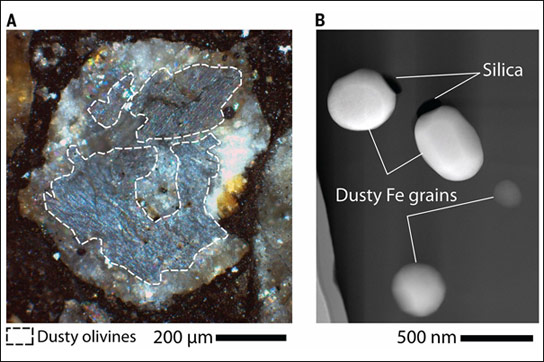
    Solar Nebula Magnetic Fields Recorded in the Semarkona Meteorite
    Dusty olivine-bearing chondrules from the Semarkona meteorite. Optical photomicrograph of chondrule DOC4 showing the location of dusty olivine grains. Image taken in reflected light with crossed polarizers. Credit: Roger R. Fu, et al.,

    Scientists from the Harvard-Smithsonian Center for Astrophysics have succeeded in determining ancient solar nebula magnetic field strength by measuring the field recorded in chondrules from the Semarkona meteorite.

    Astronomical observations of young protostars indicate that early planetary systems evolved from the dust in a protoplanetary disk very quickly – in under five million years. Such short timescales require very efficient mechanism(s) to transport material inward towards the central star, but the mechanism(s) that do this are uncertain. Several have been invoked, however, in which magnetic fields play a key role, either in the stellar wind or in the disk itself.

    Astronomers cannot currently directly measure magnetic field strengths in planet-forming regions, but experiments on meteoritic materials in our own Solar system can potentially constrain the strength of early Solar nebular magnetic fields. Chondrules are millimeter-sized constituents of primitive meteorites that formed in brief heating events in the young solar nebula. They probably constitute a significant fraction of the mass of asteroids and even of terrestrial planet precursors. The formation of chondrules, therefore, very likely occurred during a key stage in the evolution of the early solar system. If a stable field was present during their cooling off phase, they should themselves have become slightly magnetized. Determining their magnetic fields should therefore not only constrain models of their formation, but of the disk’s evolution as well.

    Among the most pristine known meteorites is one called Semarkona. It contains chondrules of crystalline olivine which, due to their unique compositional and magnetic properties, can retain their primitive magnetization even over the eons since they formed and despite their subsequent histories in the solar system.

    Harvard-Smithsonian Center for Astrophysics (CfA) astrophysicists Xue-Ning Bai and Ron Walsworth, and their collaborators, isolated eight olivine chondrules from the Semarkona meteorite; they are tiny, less than a millimeter in size. Using newly perfected techniques that take advantage of cryogenic quantum measurements developed in Walsworth’s laboratory, the team was able to detect magnetic fields in these minuscule crystal samples, and to conclude that the primitive nebula in which these chondrules formed had a field strength corresponding to about double the Earth’s current magnetic field (at its surface).

    The scientists conclude that the evidence supports the model of chondrules forming in shocks or collisions between larger bodies, rather than any of the stellar wind formation theories. They also conclude that the nebular magnetic fields were large enough to account for the measured rates of mass transport in the early evolutionary stages. Not least, the result is an impressive application of newly perfected quantum measuring techniques.

    Reference: “Solar Nebula Magnetic Fields Recorded in the Semarkona Meteorite” by Roger R. Fu, Benjamin P. Weiss, Eduardo A. Lima, Richard J. Harrison, Xue-Ning Bai, Steven J. Desch, Denton S. Ebel, Clément Suavet, Huapei Wang, David Glenn, David Le Sage, Takeshi Kasama, Ronald L. Walsworth and Aaron T. Kuan, 13 November 2014, Science.
    DOI: 10.1126/science.1258022

    Never miss a breakthrough: Join the SciTechDaily newsletter.
    Follow us on Google and Google News.

    Astronomy Astrophysics Harvard-Smithsonian Center for Astrophysics Meteorites
    Share. Facebook Twitter Pinterest LinkedIn Email Reddit

    Related Articles

    X-Ray Emission From Mysterious Dark Matter

    Analyzing Dust Storm Sequences on Mars

    Intriguing Remains of a Rare Stellar Explosion Discovered in Milky Way Center

    Puzzling Astrophysics of Quasars in the Early Universe

    Four Exoplanets – Including a Super-Earth Planet – Discovered by High School Students

    Massive Rotating Stars in the Pleiades Cluster

    Astronomers Discover First Cloudless, Jupiter-Like Planet – “Smoking Gun Evidence”

    Chandra X-ray Observatory Studies Extraordinary Magnetar [Video]

    Chandra Studies Extraordinary Magnetar: Fastest Spinning and Possibly the Youngest Magnetar Known

    Leave A Reply Cancel Reply

    • Facebook
    • Twitter
    • Pinterest
    • YouTube

    Don't Miss a Discovery

    Subscribe for the Latest in Science & Tech!

    Trending News

    Scientists Discover How Coffee Impacts Memory, Mood, and Gut Health

    Why Did the Neanderthals Disappear? Scientists Reveal Humans Had a Hidden Advantage

    Physicists Propose Strange Experiment Where Time Goes Quantum

    Magnesium Magic: New Drug Melts Fat Even on a High-Fat, High-Sugar Diet

    Weight-Loss Drugs Like Ozempic May Come With an Unexpected Cost

    Mezcal “Worm” in a Bottle Mystery: DNA Testing Reveals a Surprise

    New Research Reveals That Your Morning Coffee Activates an Ancient Longevity Switch

    This Is What Makes You Irresistible to Mosquitoes

    Follow SciTechDaily
    • Facebook
    • Twitter
    • YouTube
    • Pinterest
    • Newsletter
    • RSS
    SciTech News
    • Biology News
    • Chemistry News
    • Earth News
    • Health News
    • Physics News
    • Science News
    • Space News
    • Technology News
    Recent Posts
    • Harvard Scientists Reveal Secret Structure Behind How You Smell
    • Scientists Just Discovered the Hidden Trick That Keeps Your Cells Alive
    • This Simple Movement Could Be Secretly Cleaning Your Brain
    • Male Birth Control Breakthrough: Scientists Find Way To Turn Sperm Production Off and Back On
    • A Common Vitamin Could Hold the Key to Treating Fatty Liver Disease
    Copyright © 1998 - 2026 SciTechDaily. All Rights Reserved.
    • Science News
    • About
    • Contact
    • Editorial Board
    • Privacy Policy
    • Terms of Use

    Type above and press Enter to search. Press Esc to cancel.