
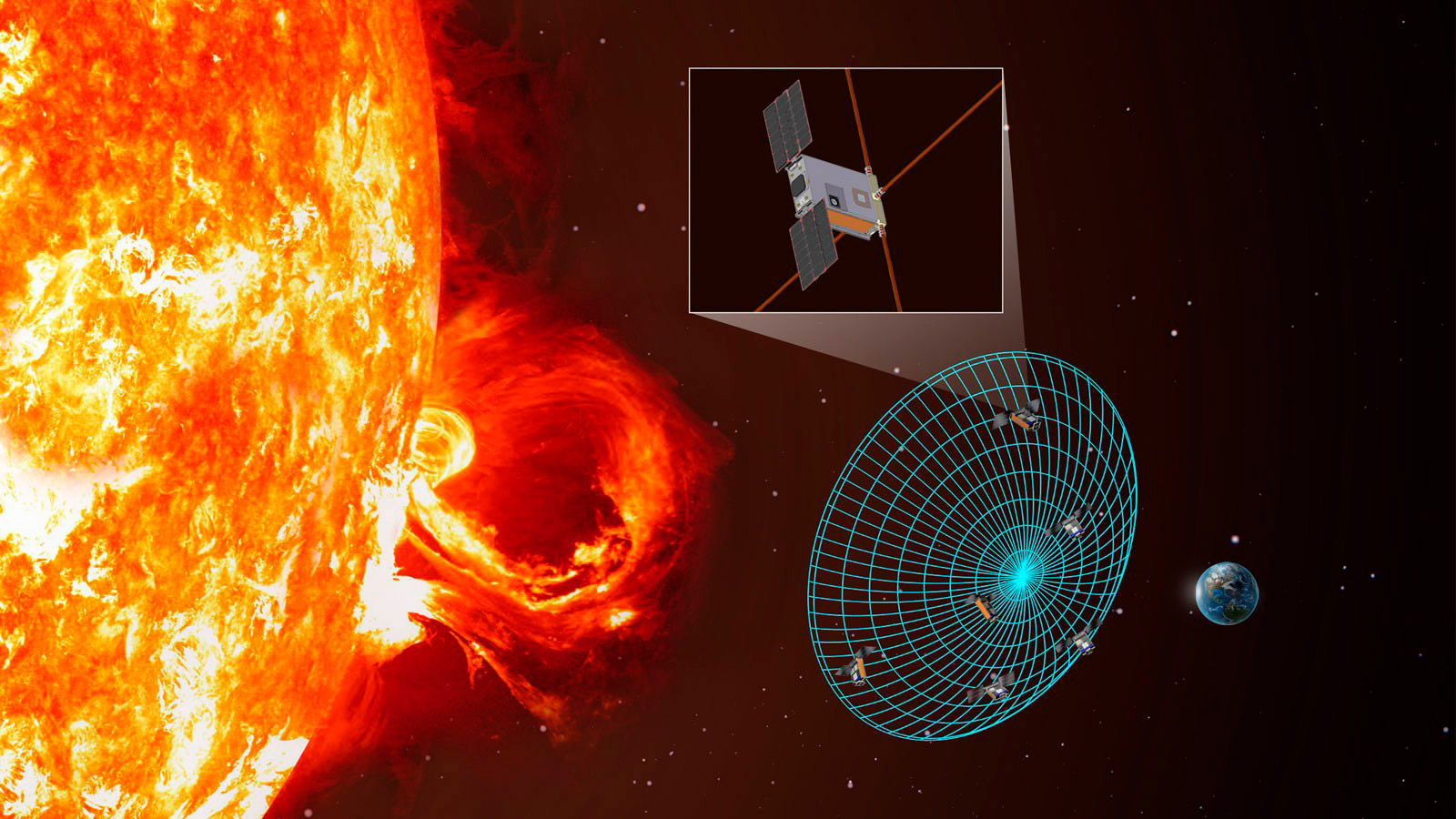
The satellites are part of the agency’s SunRISE mission, which will study the physics behind explosions that the Sun generates.
Most NASA missions feature one spacecraft or, occasionally, a few. The agency’s Sun Radio Interferometer Space Experiment (SunRISE) is using half a dozen. This month, mission members completed construction of the six identical cereal box-size satellites, which will now go into storage and await their final testing and ride to space. SunRISE will launch as a rideshare aboard a United Launch Alliance Vulcan rocket, sponsored by the United States Space Force (USSF)’s Space Systems Command (SSC).
SunRISE’s Role in Solar Research
Once launched, these six small satellites, or SmallSats, will work together to act like one giant radio antenna in space. The mission will study the physics of explosions in the Sun’s atmosphere in order to gain insights that could someday help protect astronauts and space hardware from showers of accelerated particles.
“This is a big moment for everyone who has worked on SunRISE,” said Jim Lux, the SunRISE project manager at NASA’s Jet Propulsion Laboratory in Southern California, which manages the mission for the agency. “Challenges are expected when you’re doing something for the first time, and especially when the space vehicles are small and compact. But we have a small team that works well together, across multiple institutions and companies. I’m looking forward to the day when we receive the first images of the Sun in these radio wavelengths.”
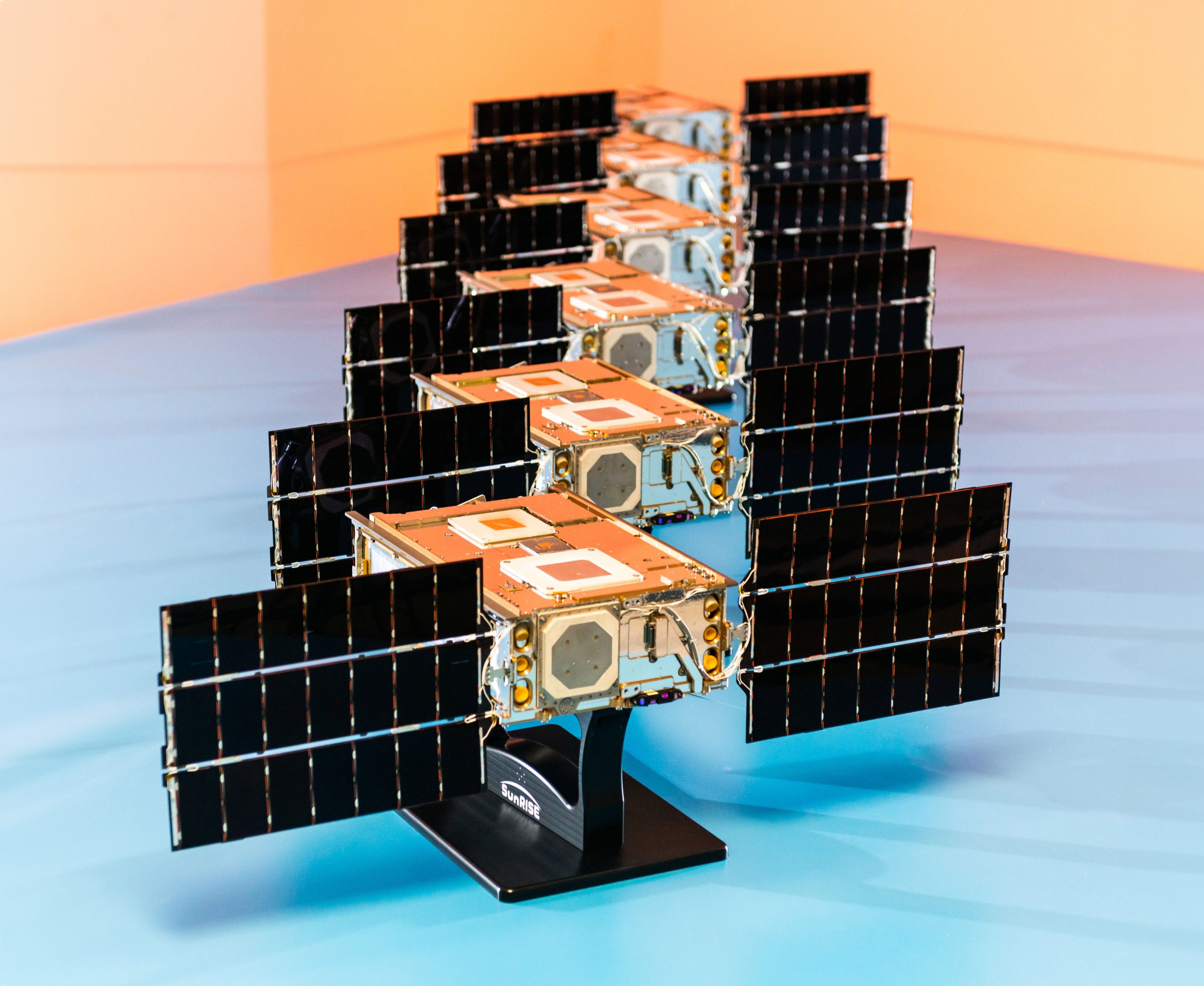
Monitoring Solar Radio Bursts
They may be small, but the six satellites have a big job ahead of them studying solar radio bursts, or the generation of radio waves in the outer atmosphere of the Sun. These bursts result from electrons accelerated in the Sun’s atmosphere during energetic events known as coronal mass ejections and solar flares.
Particles accelerated by these events can damage spacecraft electronics – including on communications satellites in Earth orbit – and pose a health threat to astronauts. Scientists still have big questions about how solar radio bursts, coronal mass ejections, and solar flares are created and how they are linked. SunRISE may shed light on this complex question. Someday, tracking solar radio bursts and pinpointing their location could help warn humans when the energetic particles from coronal mass ejections and solar flares are likely to hit Earth.
This type of monitoring isn’t possible from the ground. Earth’s atmosphere blocks the range of radio wavelengths primarily emitted by solar radio bursts. For a space-based monitoring system, scientists need a radio telescope bigger than any previously flown in space. This is where SunRISE comes in.
Technical Aspects of SunRISE
To look out for solar radio events, the SmallSats will fly about 6 miles (10 kilometers) apart and each deploy four radio antennas that extend 10 feet (2.5 meters). Mission scientists and engineers will track where the satellites are relative to one another and measure with precise timing when each one observes a particular event. Then they will combine the information collected by the satellites into a single data stream from which images of the Sun will be produced for scientists to study – a technique called interferometry.
“Some missions put multiple scientific instruments on a single spacecraft, whereas we use multiple small satellites to act as a single instrument,” said JPL’s Andrew Romero-Wolf, the deputy project scientist for SunRISE.
More About the SunRISE Mission
SunRISE is a Mission of Opportunity under the Heliophysics Division of NASA’s Science Mission Directorate (SMD). Missions of Opportunity are part of the Explorers Program, managed by NASA’s Goddard Space Flight Center in Greenbelt, Maryland. SunRISE is led by Justin Kasper at the University of Michigan in Ann Arbor and managed by NASA’s Jet Propulsion Laboratory in Southern California, a division of Caltech in Pasadena, California. Utah State University’s Space Dynamics Laboratory built the SunRISE spacecraft. JPL, a division of Caltech in Pasadena, California, provides the mission operations center and manages the mission for NASA.
Never miss a breakthrough: Join the SciTechDaily newsletter.
Follow us on Google and Google News.