
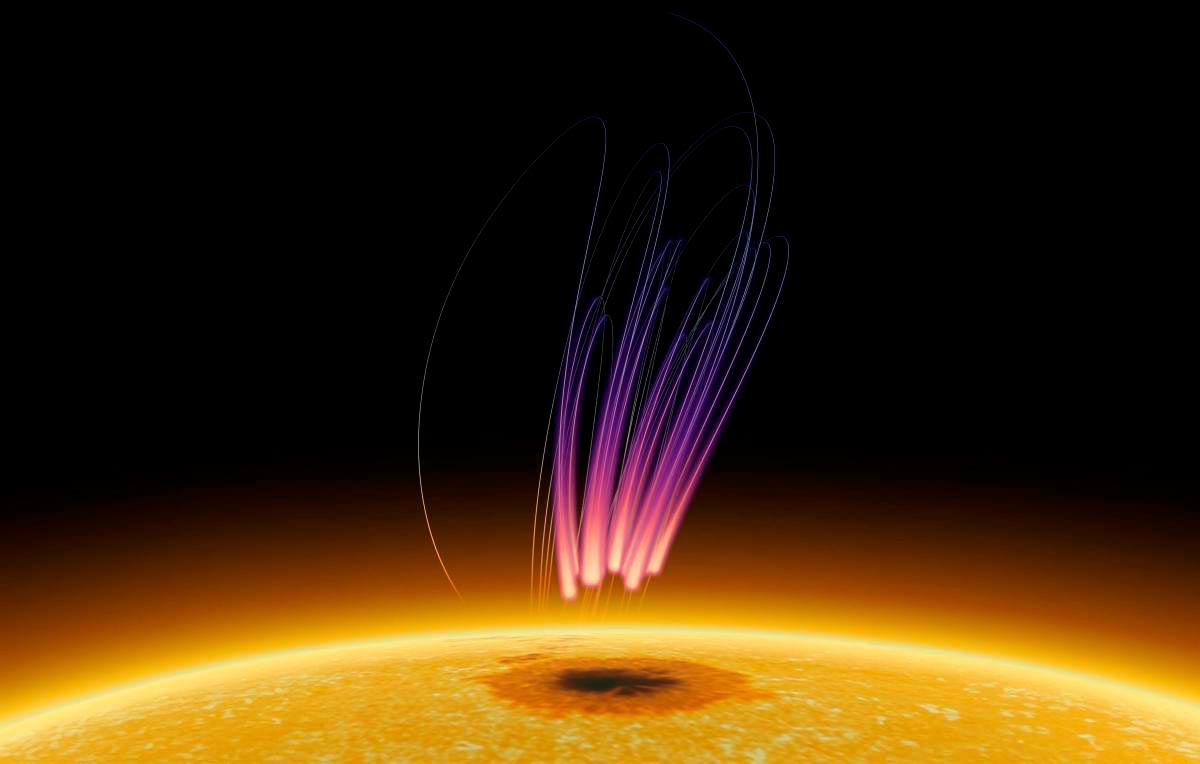
Scientists have identified persistent radio bursts from the Sun similar to Earth’s auroras, opening new research avenues in solar and stellar phenomena.
A NASA-funded team of scientists has discovered long-lasting radio signals emanating from the Sun that are similar to those associated with auroras – northern and southern lights – on Earth.
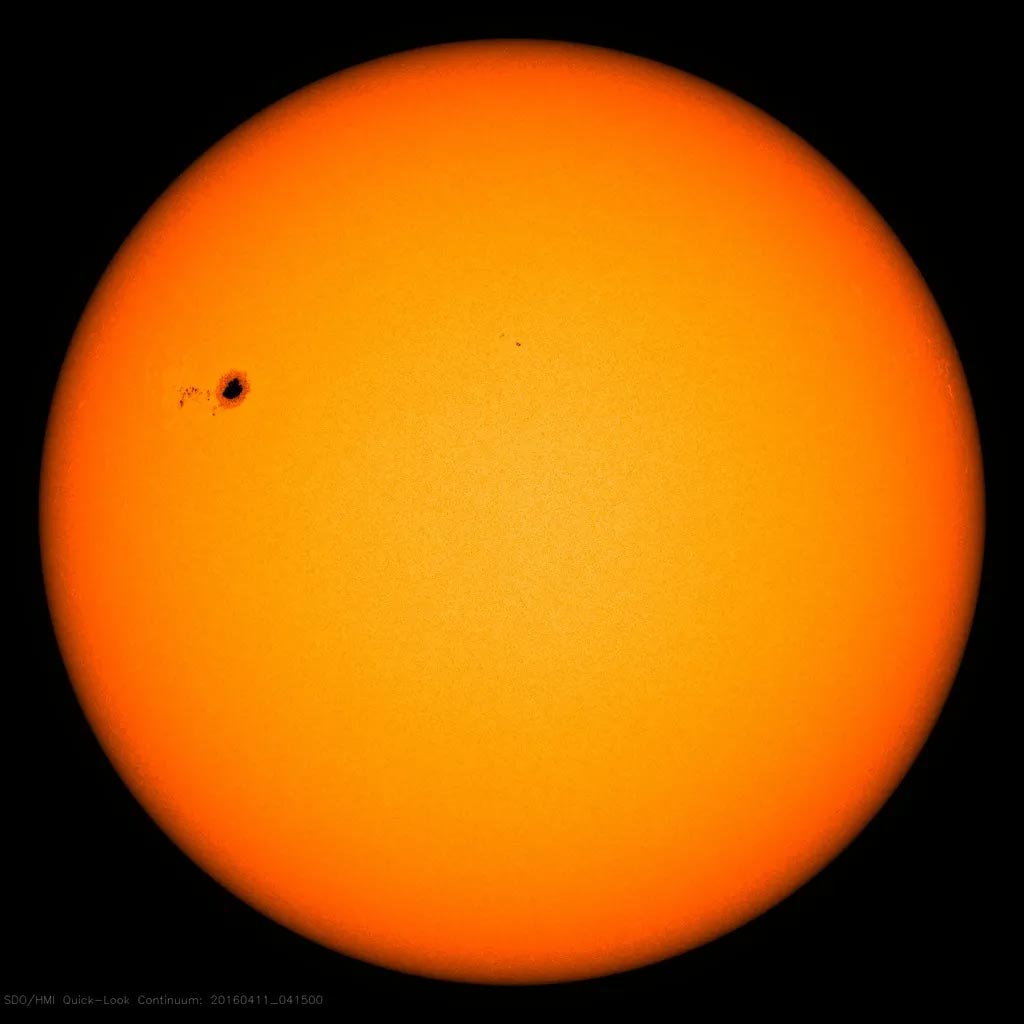
Detected about 25,000 miles (40,000 km) above a sunspot – a relatively cool, dark, and magnetically active region on the Sun – such radio bursts had previously been observed only on planets and other stars.
“This sunspot radio emission represents the first detection of its kind,” said Sijie Yu of the New Jersey Institute of Technology, Newark, who is the lead author of a paper reporting the discovery in the January 2024 issue of Nature Astronomy. The research was first published online in November 2023.
The discovery could help us better understand our own star as well as the behavior of distant stars that produce similar radio emissions.
Insights Into Solar and Stellar Phenomena
The Sun often emits short radio bursts that last for minutes or hours. But the radio bursts Yu’s team detected, using the Karl G. Jansky Very Large Array in New Mexico, persisted for over a week.
These sunspot radio bursts also have other characteristics – such as their spectra (or intensity at different wavelengths) and their polarization (the angle or direction of the radio waves) – that are much more like radio emissions produced in the polar regions of Earth and other planets with auroras.
On Earth (and other planets such as Jupiter and Saturn), auroras shimmer in the night sky when solar particles are caught up in the planet’s magnetic field and get pulled toward the poles, where magnetic field lines converge. As they accelerate poleward, the particles generate intense radio emissions at frequencies around a few hundred kilohertz and then smash into atoms in the atmosphere, causing them to emit light as auroras.
The analysis by Yu’s team suggests the radio bursts above the sunspot are likely produced in a comparable way – when energetic electrons get trapped and accelerated by converging magnetic fields above a sunspot. Unlike Earth’s auroras, though, the radio bursts from sunspots occur at much higher frequencies – hundreds of thousands of kilohertz to roughly 1 million kilohertz. “That’s a direct result of the sunspot’s magnetic field being thousands of times stronger than Earth’s,” Yu said.
Expanding Understanding of Stellar Activities
Similar radio emissions have previously been observed from some types of low-mass stars as well. This discovery introduces the possibility that aurora-like radio emissions may originate from large spots on those stars (called “starspots”) in addition to the previously proposed auroras in their polar regions.
“The discovery excites us as it challenges existing notions of solar radio phenomena and opens new avenues for exploring magnetic activities both in our Sun and in distant stellar systems,” Yu said.
“NASA’s growing heliophysics fleet is well suited to continue to investigate the source regions of these radio bursts,” said Natchimuthuk Gopalswamy, a heliophysicist and solar radio researcher at NASA’s Goddard Space Flight Center. “For example, the Solar Dynamics Observatory continually monitors the Sun’s active regions, which likely give rise to this phenomenon.”
In the meantime, Yu’s team plans to reexamine other solar radio bursts to see whether any appear to be similar to the aurora-like radio bursts they found. “We aim to determine if some of the previously recorded solar bursts could be instances of this newly identified emission,” Yu said.
For more on this research, see Mysterious Aurora-Like Radio Emissions Discovered Above a Sunspot.
Reference: “Detection of long-lasting aurora-like radio emission above a sunspot” by Sijie Yu, Bin Chen, Rohit Sharma, Timothy S. Bastian, Surajit Mondal, Dale E. Gary, Yingjie Luo and Marina Battaglia, 13 November 2023, Nature Astronomy.
DOI: 10.1038/s41550-023-02122-6
The research by Yu’s team has been supported in part by a NASA Early Career Investigator Program (ECIP) grant awarded to the New Jersey Institute of Technology.
Never miss a breakthrough: Join the SciTechDaily newsletter.
Follow us on Google and Google News.