
Close Menu
    Facebook X (Twitter) Instagram
    SciTechDaily
    • Biology
    • Chemistry
    • Earth
    • Health
    • Physics
    • Science
    • Space
    • Technology
    Facebook X (Twitter) Pinterest YouTube RSS
    SciTechDaily
    Home»Space»NASA’s Parker Solar Probe Shatters Records: The Closest & Fastest Sun Flyby Ever
    Space

    NASA’s Parker Solar Probe Shatters Records: The Closest & Fastest Sun Flyby Ever

    By Michael Buckley, Johns Hopkins Applied Physics LaboratoryOctober 3, 2023No Comments3 Mins Read
    Facebook Twitter Pinterest Telegram LinkedIn WhatsApp Email Reddit
    Share
    Facebook Twitter LinkedIn Pinterest Telegram Email Reddit
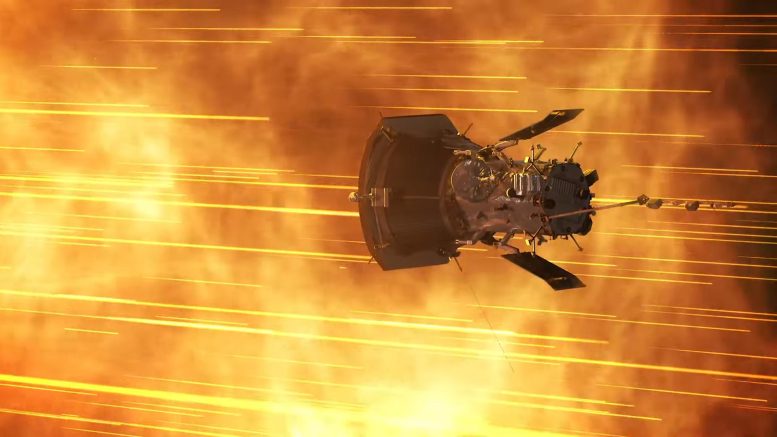
    Parker Solar Probe Close to Sun
    On September 27, 2023, NASA’s Parker Solar Probe made its 17th close approach to the Sun, breaking its own record by coming within 4.51 million miles of the solar surface. Assisted by a gravity-aided flyby of Venus, the probe achieved a speed of 394,736 mph, marking another record. Credit: NASA GSFC/CIL/Brian Monroe

    NASA’s Parker Solar Probe broke its own record by approaching within 4.51 million miles of the Sun on September 27, 2023, also achieving a record speed during its approach.

    NASA’s Parker Solar Probe completed its 17th close approach to the Sun on September 27, 2023, breaking its own distance record by skimming just 4.51 million miles (7.26 million kilometers) from the solar surface.

    Set up by a gravity-assist flyby of Venus on August 21, the close approach (known as perihelion) occurred at 7:28 p.m. EDT, with Parker Solar Probe moving 394,736 miles per hour (635,266 kilometers per hour) around the Sun – another record. The milestone also marked the midway point in the mission’s 17th solar encounter, which began September 22 and continues through October 3.
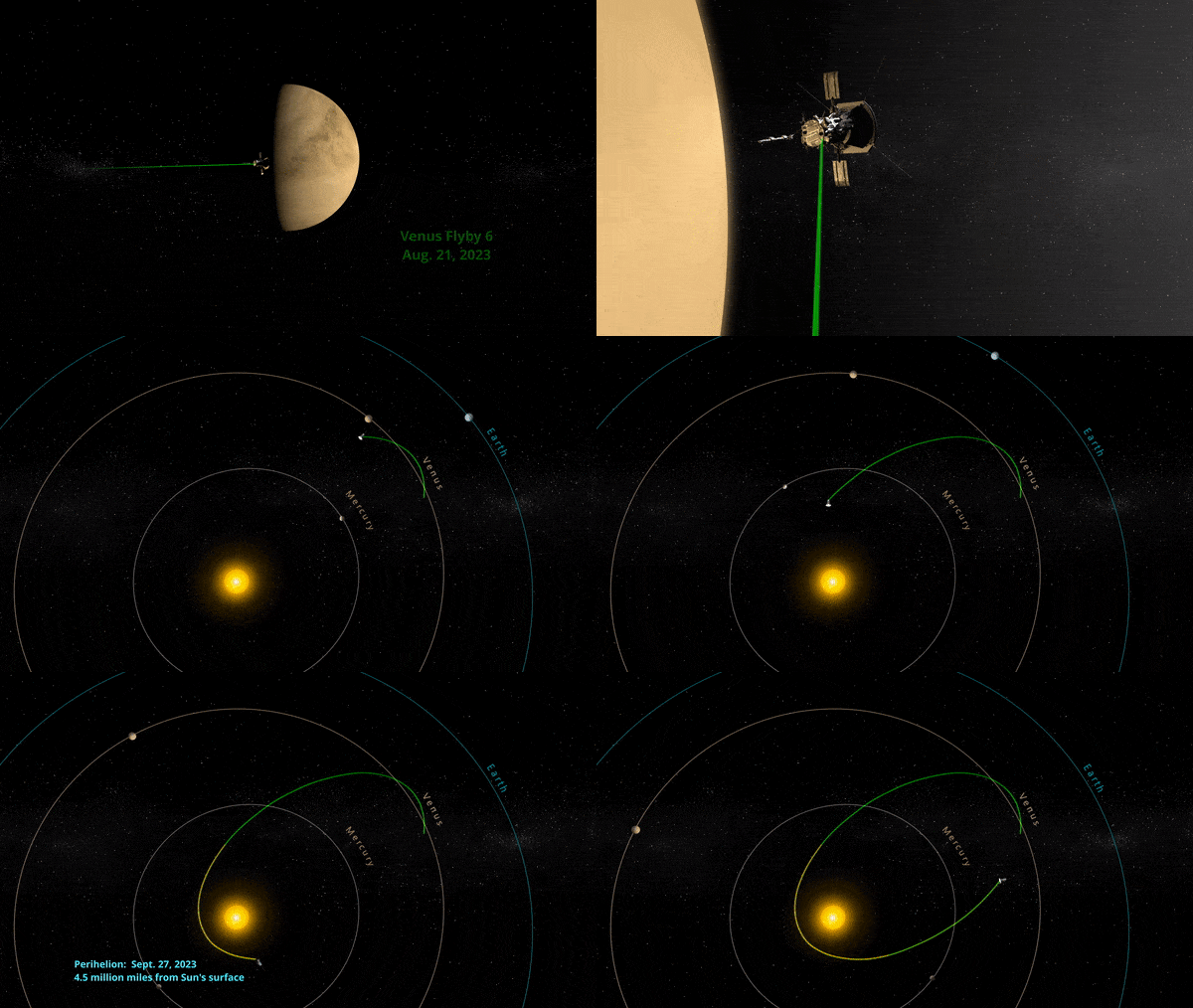
    Parker Solar Probe Orbit 17
    Parker Solar Probe’s 17th orbit included a perihelion that brought the spacecraft within 4.51 million miles of the Sun. Credit: NASA/Johns Hopkins APL/Steve Gribben

    The spacecraft entered the encounter in good health, with all systems operating normally. Parker Solar Probe is scheduled to check back in with mission operators at the Johns Hopkins Applied Physics Laboratory in Laurel, Maryland – where the spacecraft was also designed and built – by sending a stream of telemetry (status data) on October 1.

    The spacecraft will transmit science data from the encounter – largely covering the properties, structure, and behavior of the solar wind as it launches off the Sun – back to Earth from October 4 – 19.
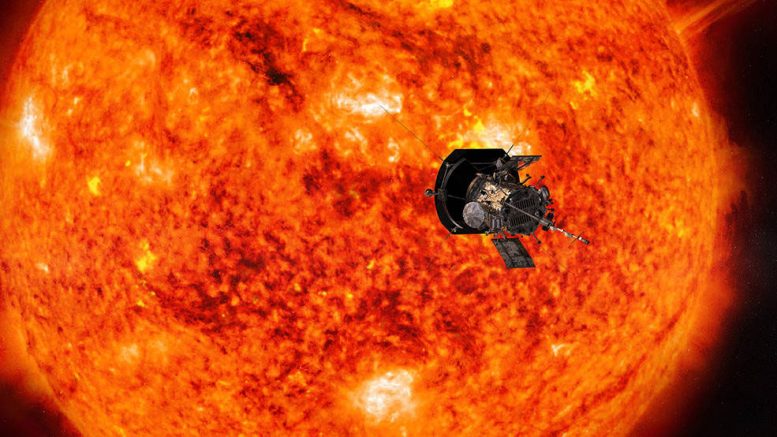
    Parker Solar Probe
    Artist’s concept of NASA’s Parker Solar Probe spacecraft flying through the Sun’s corona to trace how energy and heat move through the star’s atmosphere. Credits: NASA/Johns Hopkins APL

    Launched in 2018, NASA’s Parker Solar Probe is on an unparalleled journey to study the Sun’s outer atmosphere. Designed to brave extreme heat and radiation, the probe will come within 3.83 million miles of the Sun’s surface, closer than any previous spacecraft.

    Over seven years and 24 orbits, with the aid of Venus for gravitational assists, the probe will examine the Sun’s corona, the solar wind, and solar energetic particles. Its findings aim to enhance our understanding of solar phenomena and their effects on Earth.

    Never miss a breakthrough: Join the SciTechDaily newsletter.
    Follow us on Google and Google News.

    Astronomy Astrophysics Johns Hopkins APL NASA Parker Solar Probe Popular Sun
    Share. Facebook Twitter Pinterest LinkedIn Email Reddit

    Related Articles

    Eclipsing Theories: Parker Soars Through Powerful Coronal Mass Ejection “Vacuuming Up” Interplanetary Dust

    Gravity Assist: Venus Flyby Sends Parker Solar Probe Toward Record-Setting Flights Around the Sun

    5 Years, 430,000 MPH, and Counting: How NASA’s Parker Solar Probe Is Making History

    Spacecraft Enters the Sun’s Blistering Hot Corona for the First Time in History

    Parker Solar Probe: For the First Time in History, a Spacecraft Has Touched the Sun

    Celestial Geometry Posed a Special Opportunity During Parker Solar Probe’s 7th Solar Encounter

    Magnetic Explosions Observed on Sun – Unlike Anything Seen Before [Video]

    5 Astonishing New Discoveries From NASA’s Parker Solar Probe [Video]

    NASA’s Van Allen Probes Made Major Discoveries That Revolutionized Understanding of Near-Earth Environment

    Leave A Reply Cancel Reply

    • Facebook
    • Twitter
    • Pinterest
    • YouTube

    Don't Miss a Discovery

    Subscribe for the Latest in Science & Tech!

    Trending News

    The Universe Is Expanding Too Fast and Scientists Can’t Explain Why

    “Like Liquid Metal”: Scientists Create Strange Shape-Shifting Material

    Early Warning Signals of Esophageal Cancer May Be Hiding in Plain Sight

    Common Blood Pressure Drug Shows Surprising Power Against Deadly Antibiotic-Resistant Superbug

    Scientists Uncover Dangerous Connection Between Serotonin and Heart Valve Disease

    Scientists Discover a “Protector” Protein That Could Help Reverse Hair Loss

    Bone-Strengthening Discovery Could Reverse Osteoporosis

    Scientists Uncover Hidden Trigger Behind Stem Cell Aging

    Follow SciTechDaily
    • Facebook
    • Twitter
    • YouTube
    • Pinterest
    • Newsletter
    • RSS
    SciTech News
    • Biology News
    • Chemistry News
    • Earth News
    • Health News
    • Physics News
    • Science News
    • Space News
    • Technology News
    Recent Posts
    • Scientists Overcome Major Quantum Bottleneck, Potentially Transforming Teleportation and Computing
    • Quantum Physics’ Strangest Problem May Hold the Key to Time Itself
    • Scientists Create “Liquid Gears” That Spin Without Touching
    • The Simple Habit That Could Help Prevent Cancer
    • Forgotten Medicinal Plant Shows Promise in Fighting Dangerous Superbugs
    Copyright © 1998 - 2026 SciTechDaily. All Rights Reserved.
    • Science News
    • About
    • Contact
    • Editorial Board
    • Privacy Policy
    • Terms of Use

    Type above and press Enter to search. Press Esc to cancel.