
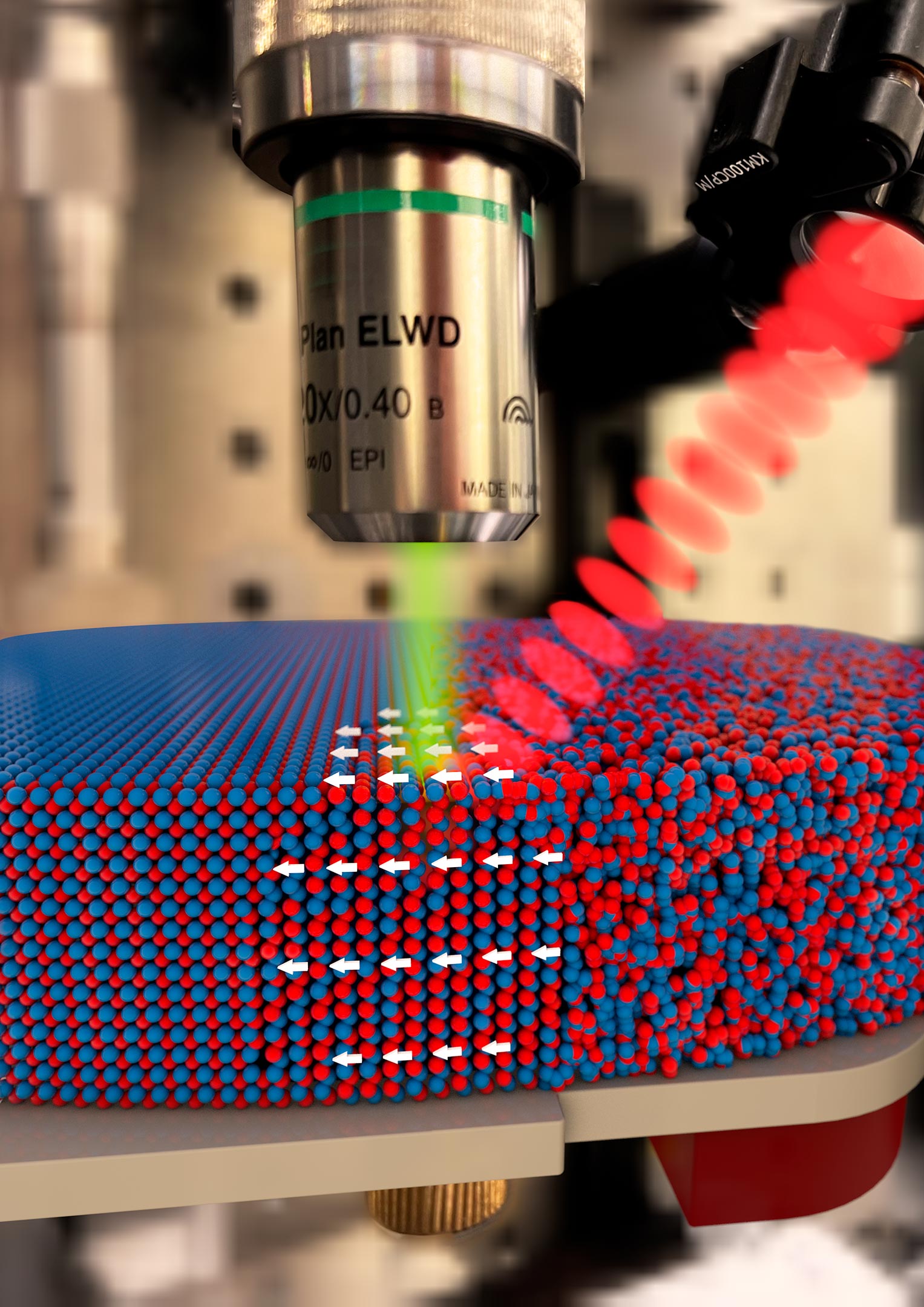
A research team has revealed that ultrashort laser pulses can magnetize iron alloys, a discovery with significant potential for applications in magnetic sensor technology, data storage, and spintronics.
To magnetize an iron nail, one simply has to stroke its surface several times with a bar magnet. Yet, there is a much more unusual method: A team led by the Helmholtz-Zentrum Dresden-Rossendorf (HZDR) discovered some time ago that a certain iron alloy can be magnetized with ultrashort laser pulses. The researchers have now teamed up with the Laserinstitut Hochschule Mittweida (LHM) to investigate this process further. They discovered that the phenomenon also occurs with a different class of materials – which significantly broadens potential application prospects. The working group presents its findings in the scientific journal Advanced Functional Materials.
Breakthrough Discovery in Magnetization
The unexpected discovery was made back in 2018. When the HZDR team irradiated a thin layer of an iron-aluminum alloy with ultrashort laser pulses, the non-magnetic material suddenly became magnetic. The explanation: The laser pulses rearrange the atoms in the crystal in such a way that the iron atoms move closer together, and thus forming a magnet. The researchers were then able to demagnetize the layer again with a series of weaker laser pulses. This enabled them to discover a way of creating and erasing tiny “magnetic spots” on a surface.
However, the pilot experiment still left some questions unanswered. “It was unclear whether the effect only occurs in the iron-aluminum alloy or also in other materials,” explains HZDR physicist Dr. Rantej Bali. “We also wanted to try tracking the time progression of the process.” For further investigation, he teamed up with Dr. Theo Pflug from the LHM and colleagues from the University of Zaragoza in Spain.
Flip Book With Laser Pulses
The experts focused specifically on an iron-vanadium alloy. Unlike the iron-aluminum alloy with its regular crystal lattice, the atoms in the iron-vanadium alloy are arranged more chaotically, forming an amorphous, glass-like structure. In order to observe what happens upon laser irradiation, the physicists used a special method: The pump-probe method.
“First, we irradiate the alloy with a strong laser pulse, which magnetizes the material,” explains Theo Pflug. “Simultaneously, we use a second, weaker pulse that is reflected on the material surface.”
The analysis of the reflected laser pulse provides an indication of the material’s physical properties. This process is repeated several times, whereby the time interval between the first “pump” pulse and the subsequent “probe” pulse is continually extended.
As a result, a time series of reflection data is obtained, which allows to characterize the processes being triggered by the laser excitation. “The whole procedure is similar to generating a flip book,” says Pflug. “Likewise, a series of individual images that animate when viewed in quick succession.”
Rapid Melting
The result: Although it has a different atomic structure than the iron-aluminum compound, the iron-vanadium alloy can also be magnetized via laser. “In both cases, the material melts briefly at the irradiation point,” explains Rantej Bali. “This causes the laser to erase the previous structure so that a small magnetic area is generated in both alloys.”
An encouraging result: Apparently, the phenomenon is not limited to a specific material structure but can be observed in diverse atomic arrangements.
The team is also keeping track of the temporal dynamics of the process: “At least we now know in which time scales something happens,” explains Theo Pflug. “Within femtoseconds, the laser pulse excites the electrons in the material. Several picoseconds later, the excited electrons transfer their energy to the atomic nuclei.”
Consequently, this energy transfer causes the rearrangement into a magnetic structure, which is stabilized by the subsequent rapid cooling. In follow-up experiments, the researchers aim to observe exactly how the atoms rearrange themselves by examining the magnetization process with intense X-rays.
Sights Set on Applications
Although still in the early stages, this work already provides initial ideas for possible applications: For example, placing tiny magnets on a chip surface via laser is conceivable. “This could be useful for the production of sensitive magnetic sensors, such as those used in vehicles,” speculates Rantej Bali. “It could also find possible applications in magnetic data storage.”
Additionally, the phenomenon appears relevant for a new type of electronics, namely spintronics. Here, magnetic signals should be used for digital computing processes instead of electrons passing through transistors as usual – offering a possible approach to computer technology of the future.
Reference: “Laser-Induced Positional and Chemical Lattice Reordering Generating Ferromagnetism” by Theo Pflug, Javier Pablo-Navarro, Md. Shabad Anwar, Markus Olbrich, César Magén, Manuel Ricardo Ibarra, Kay Potzger, Jürgen Faßbender, Jürgen Lindner, Alexander Horn and Rantej Bali, 21 November 2023, Advanced Functional Materials.
DOI: 10.1002/adfm.202311951
Never miss a breakthrough: Join the SciTechDaily newsletter.
Follow us on Google and Google News.