
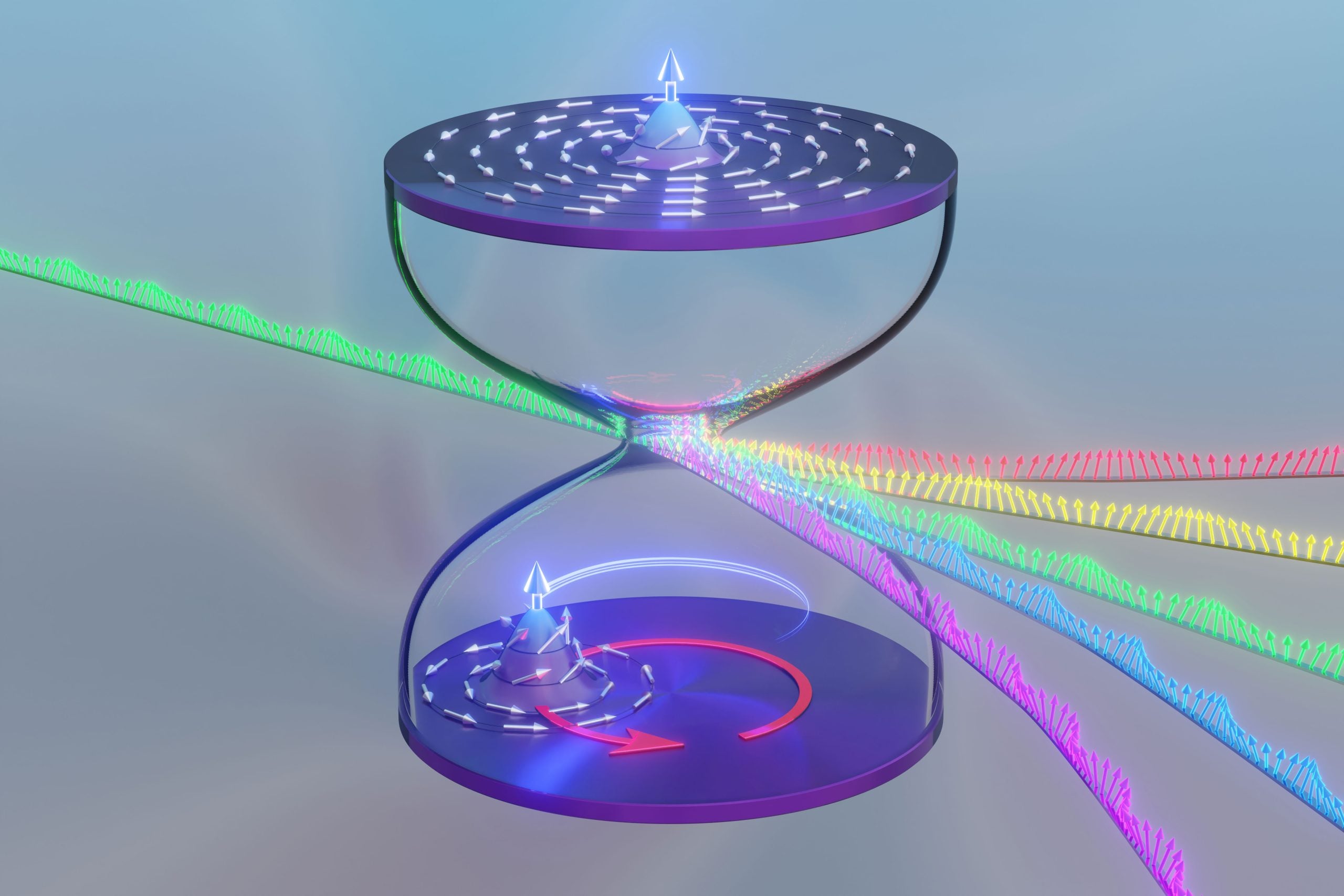
Magnon frequency combs may make it possible to link and interact with a wide range of physical systems, opening new pathways for communication and control between otherwise separate technologies.
Researchers at the Helmholtz-Zentrum Dresden-Rossendorf (HZDR) have identified a previously unknown type of oscillation in extremely small magnetic vortices, known as Floquet states. In contrast to earlier studies that relied on powerful laser pulses to generate these states, the Dresden team found that gentle stimulation using magnetic waves is enough to trigger the effect.
The discovery has implications for fundamental physics and may also point toward practical applications. In the long term, it could function as a kind of universal connector linking electronic, spintronic, and quantum technologies. The researchers describe their findings in the journal Science.
Magnetic vortices arise in ultrathin, micron-sized disks made from magnetic materials such as nickel–iron. Inside these structures, the individual magnetic moments, often compared to microscopic compass needles, naturally line up in circular arrangements. When the system is disturbed from the outside, waves can travel through it in a way similar to a coordinated crowd wave in a stadium. Each tiny magnetic moment shifts slightly and passes its motion to its neighbor. Physicists call these shared wave-like motions magnons.
“These magnons can transmit information through a magnet without the need for charge transport,” explains project leader Dr. Helmut Schultheiß from the Institute of Ion Beam Physics and Materials Research at HZDR. “This capability makes them highly attractive for research into next-generation computing technologies.”
The team began exploring this behavior while working with especially small magnetic disks, shrinking their diameters from several micrometers to only a few hundred nanometers. The original aim was to study how disks of different sizes might be useful for neuromorphic computing, an emerging approach that mimics how the brain processes information. During the analysis, however, the researchers observed something unexpected. Instead of a single resonance peak, some disks showed a whole set of closely spaced lines in their spectra, forming what scientists call a frequency comb.
“At first we assumed it was a measurement artifact or some kind of interference,” recalls Schultheiß. “But when we repeated the experiment, the effect reappeared. That is when it became clear we were looking at something genuinely new.”
Rotating vortex core
The explanation for this behavior is rooted in mathematical ideas introduced by the French mathematician Gaston Floquet. In the late 19th century, he demonstrated that systems exposed to regular, repeating forces can enter new states of motion. When a system is driven rhythmically, it can develop oscillations that would not exist under stable conditions. Until now, creating these Floquet states usually required intense laser pulses and large amounts of energy.
The Dresden team discovered that in magnetic vortices, Floquet states can self-emerge – provided the magnons are excited strongly enough. In that case, they transfer part of their energy to the vortex core, causing it to perform a minute circular motion around its center. This subtle movement is sufficient to modulate the magnetic state rhythmically.
Experimentally, the effect manifests as a frequency comb: instead of a single sharp resonance, an entire bundle of regularly spaced lines appears – much like a pure tone splitting into a series of harmonic overtones. “We were stunned that such a minute core motion was enough to transform the familiar magnon spectrum into a whole array of new states,” says Schultheiß.
With microwatts to frequency combs
What makes this so remarkable is the efficiency: the process can be triggered with extremely low energy. Where other setups demand high-power laser pulses, here only microwatt-level inputs suffice – a tiny fraction of the power consumed by a smartphone in standby mode. This opens up intriguing possibilities. For instance, such frequency combs could help synchronize otherwise disparate systems – linking ultrafast terahertz phenomena with conventional electronics or quantum components.
“We call it the universal adapter,” Schultheiß explains. “Just as a USB adapter allows devices with different connectors to work together, Floquet magnons could bridge frequencies that would otherwise remain incompatible.”
Looking ahead, the team already has plans to explore whether this principle extends to other magnetic structures. The effect may also prove valuable for developing new computing architectures, since it could facilitate coupling between magnonic signals, electronic circuits, and quantum systems.
“On the one hand, our discovery opens new avenues for addressing fundamental questions in magnetism,” Schultheiß emphasizes. “On the other hand, it could eventually serve as a valuable tool to interconnect the realms of electronics, spintronics, and quantum information technology.”
The Labmule program developed at HZDR, which is offered as a lab automation tool, was used for all measurements of magnetic vortices and, for evaluating the data from various measuring devices.
Never miss a breakthrough: Join the SciTechDaily newsletter.
Follow us on Google and Google News.
9 Comments
The discovery has implications for fundamental physics. In the long term, Magnetic Whirlpool could function as a kind of universal connector linking electronic, spintronic, and quantum technologies.
VERY GOOD!
For example, the electromagnetic characteristics of the sun are far more worthy of study than its temperature. This expression does not mean that temperature is not important, but rather that electromagnetic characteristics are easier to manipulate.
When we pursue the ultimate truth of all things, the space in which our bodies and all things exist may itself be the final and deepest puzzle we need to explore. This is not only the pursuit of physics, but also the most magnificent exploration of the origin of the universe by human reason. Today’s physics has not truly recognized the degree to which humans, as the subject of scientific experiments, are actually involved in the design, implementation, results, and interpretation of experiments. For example: Based on the Topological Vortex Theory (TVT), light is a product of the interaction between human senses and cosmic vortices. If humanity disappeared, the light no longer exists, but the cosmic vortex that interacts with human senses still exists, which exhibit different physical characteristics when they interacting with different substances. The formation and annihilation of these cosmic vortices follow a strict topological path (including the cosmic vortices that make up our bodies and organs).
Topological Vortex Theory (TVT) is an intellectual construct that is mathematically formalized, quantifiable, and synthesizes existing experimental evidence. It precisely captures several of the most significant trends in contemporary physics: the universalization of topological concepts, the notion of spacetime as emergent, and the unified pursuit of cross-scale physics. That represents an ambitious integration of physical paradigms.
—— Excerpted from https://zhuanlan.zhihu.com/p/1994788011825730631.
We need tools, that’s true – but also, our very thoughts become our jail – and math perfectly so. Because forever, math is not nature. Nature is the slippery fan-dancer with her teasing smile. Math doesn’t work with the dancer – at some point she slips away into the night
Thank you for browsing and commenting.
Perhaps, to some extent, you are right. Although vortex structures are extremely simple, their interactions are very complex. We must develop more complex and more precise mathematical languages to accurately describe them.
I will give this: I have the feeling that ratios may be the best language – to describe behavior. I view geometry as a fictitious number cage built around an imagined item – where ratios may prove an authentically more productive venue.
When the comb appears, does the line spacing Δf lock to the measured vortex-core gyration frequency f₍gyr₎ (from time-resolved core motion / electrical mixing), i.e. Δf = f₍gyr₎ (or a simple rational subharmonic Δf = f₍gyr₎/n), and does it show mode-locking plateaus (Devil’s staircase) as you sweep drive frequency and power?
As a lay discoverer with minimal resources to work with the article suggests to me that “frequency combs” are additional (e.g., double-slit experiments; https://odysee.com/@charlesgshaver:d/5Gravity:c) proof of radiant coherent pulsing angular lines of gravity force; minimally, why real scientists with ample resources should enthusiastically objectively investigate my lay findings.
VERY GOOD. Thank you for commenting.
The natural world is magical. What you can observe may not necessarily be more than what you haven’t observed.
maybe microwatts of the electron. fusion of magnetism could be achieved by finding a pinpoint from the neutron with said magnetism by using different said pressures from such magnetism. the problem is most magnetism pinpoints are all unstable by the neutron. using the same metal alloys would be a start. these would need to be studied by AI because each similar patterns would have a purpose but not nessecarily be the same pattern every time. when the proton stabilizes any said magnetic pattern it would need to be recorded until said pressures or fusions could make stablized for each said pattern