
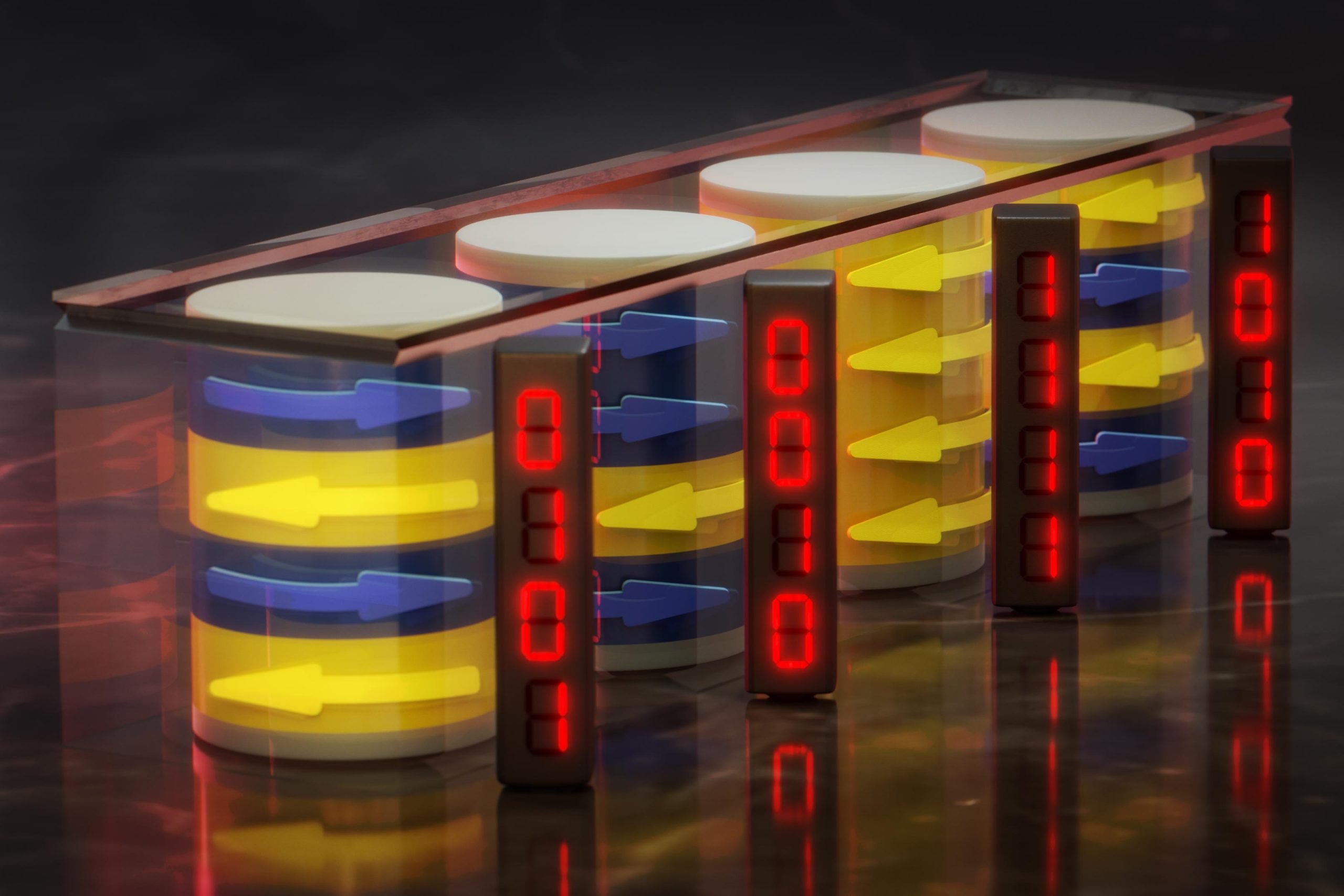
Researchers stored bit sequences in cylindrical magnetic domains, using 3D metamaterials. This innovation could transform data storage and magnetoelectronics.
For the first time, researchers have demonstrated that not just individual bits, but entire bit sequences can be stored in cylindrical domains: tiny, cylindrical areas measuring just around 100 nanometers. As the team reports in the journal Advanced Electronic Materials, these findings could pave the way for novel types of data storage and sensors, including even magnetic variants of neural networks.
Groundbreaking Magnetic Storage
“A cylindrical domain, which we physicists also call a bubble domain, is a tiny, cylindrical area in a thin magnetic layer. Its spins, the electrons’ intrinsic angular momentum that generates the magnetic moment in the material, point in a specific direction. This creates a magnetization that differs from the rest of the environment. Imagine a small, cylinder-shaped magnetic bubble floating in a sea of opposite magnetization,” says Prof. Olav Hellwig from Helmholtz-Zentrum Dresden-Rossendorf’s Institute of Ion Beam Physics and Materials Research, describing the subject of his research. He and his team are confident that such magnetic structures possess a great potential for spintronic applications.
“We are working to overcome [current] data-density limitations by extending storage into the third dimension.” Prof. Olav Hellwig
Domain Walls and Data Density
Domain walls form at the edges of this cylindrical domain, fringe areas in which the direction of magnetization changes. In the magnetic storage technology, which Hellwig’s team is trying to achieve, it will be crucial to precisely control the spin structure in the domain wall, since its clockwise or counterclockwise direction can be used directly to encode bits.
The researchers are also focusing on another aspect: “Our current hard disks, with their track widths of 30 to 40 nanometers and bit lengths of 15 to 20 nanometers, accommodate approximately one terabyte on a surface the size of a postage stamp. We are working to overcome this data-density limitation by extending storage into the third dimension,” Hellwig explains.
The Solution: Metamaterials in 3D
Magnetic multilayer structures are an appealing way of controlling the internal spin structure of domain walls because the magnetic energies involved can be adjusted by combining different materials and layer thicknesses. Hellwig’s team used blocks of alternating layers of cobalt and platinum, separated by layers of ruthenium, and deposited them on silicon wafers.
The resulting metamaterial is a synthetic antiferromagnet. Its special feature is a vertical magnetization structure in which adjacent layer blocks have opposite directions of magnetization, resulting in a net neutral magnetization overall.
Racetrack Memory and Multilayer Structures
“This is where the concept of the ‘racetrack’ memory comes in. The system is like a racetrack, along which the bits are arranged like a string of pearls. The ingenious thing about our system is that we can specifically control the thickness of the layers and thus, their magnetic properties. This allows us to adapt the magnetic behavior of the synthetic antiferromagnet to enable the storage not only of individual bits, but entire bit sequences, in the form of a depth-dependent magnetization direction of the domain walls,” explains Hellwig.
This opens up the prospect of transporting such multi-bit cylinder domains along these magnetic data highways in a controlled, fast, and energy-efficient manner.
Future Applications in Magnetoelectronics
There is also potential for other applications in magnetoelectronics. For instance, they can be used in magnetoresistive sensors or in spintronic components. In addition, such complex magnetic nano-objects have great potential for magnetic implementations in neural networks that could process data in the same way as the human brain.
Reference: “Multilayer Metamaterials with Ferromagnetic Domains Separated by Antiferromagnetic Domain Walls” by Ruslan Salikhov, Fabian Samad, Sebastian Schneider, Darius Pohl, Bernd Rellinghaus, Benny Böhm, Rico Ehrler, Jürgen Lindner, Nikolai S. Kiselev and Olav Hellwig, 13 May 2024, Advanced Electronic Materials.
DOI: 10.1002/aelm.202400251
Never miss a breakthrough: Join the SciTechDaily newsletter.
Follow us on Google and Google News.
1 Comment
Could but won’t, because it’s just another fancy lab gimmick that will never see the market.