
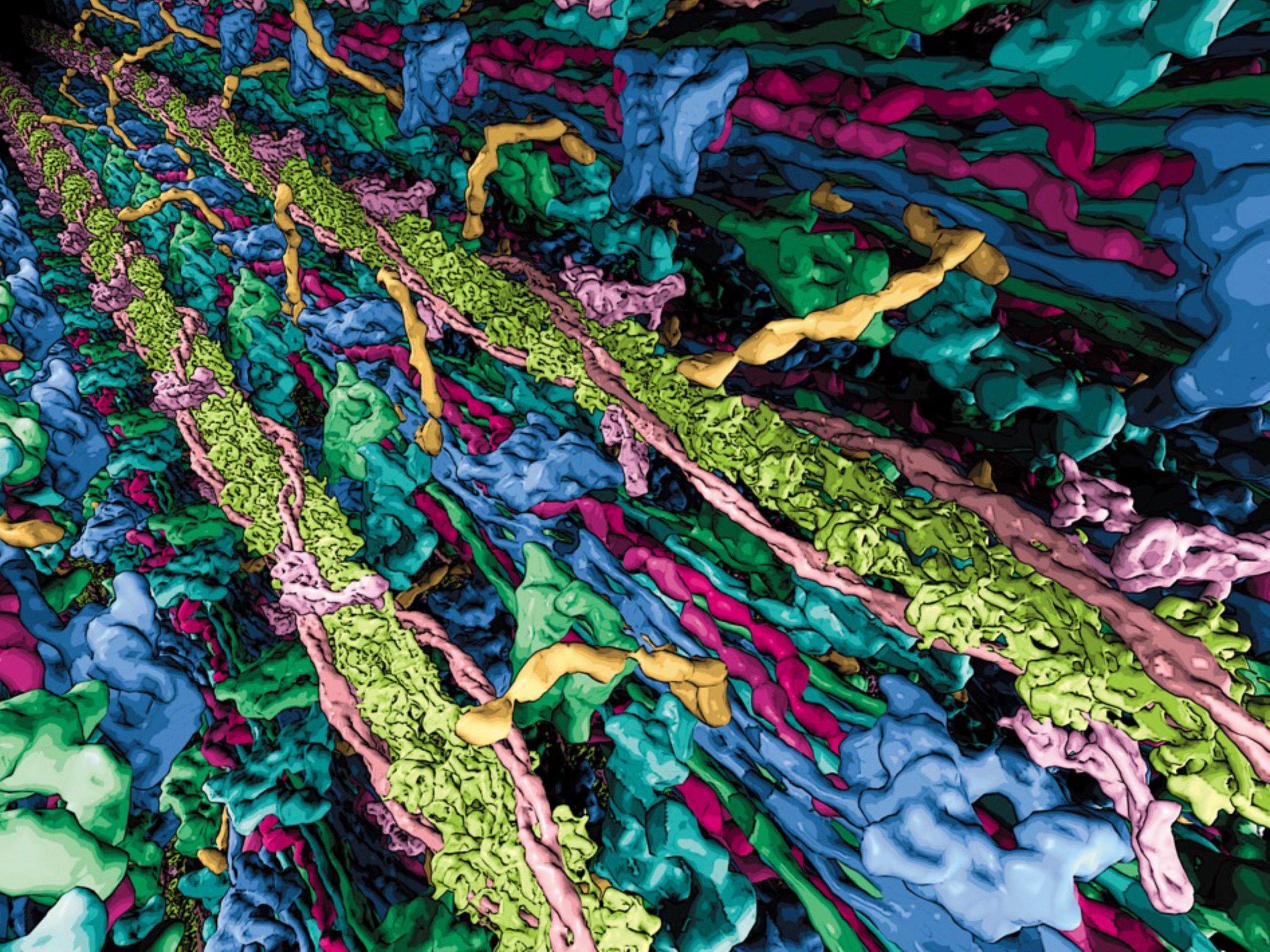
Scientists captured the first true-to-life 3D image of the thick filament in mammalian heart muscle.
Atrial fibrillation, heart failure, and stroke are among the severe health conditions that can stem from hypertrophic cardiomyopathy, a critical factor in sudden cardiac death among individuals under 35 years old.
“The heart muscle is a central engine of the human body. Of course, it is easier to fix a broken engine, if you know how it is built and how it functions,” says Stefan Raunser. “At the beginning of our muscle research, we have successfully visualized the structure of the essential muscle building blocks and how they interact using electron cryo-microscopy.”
“However, these were static images of proteins taken out of the living cell. They only tell us little about how the highly variable, dynamic interplay of muscle components moves the muscle in its native environment,” says Raunser.
Through thick and thin
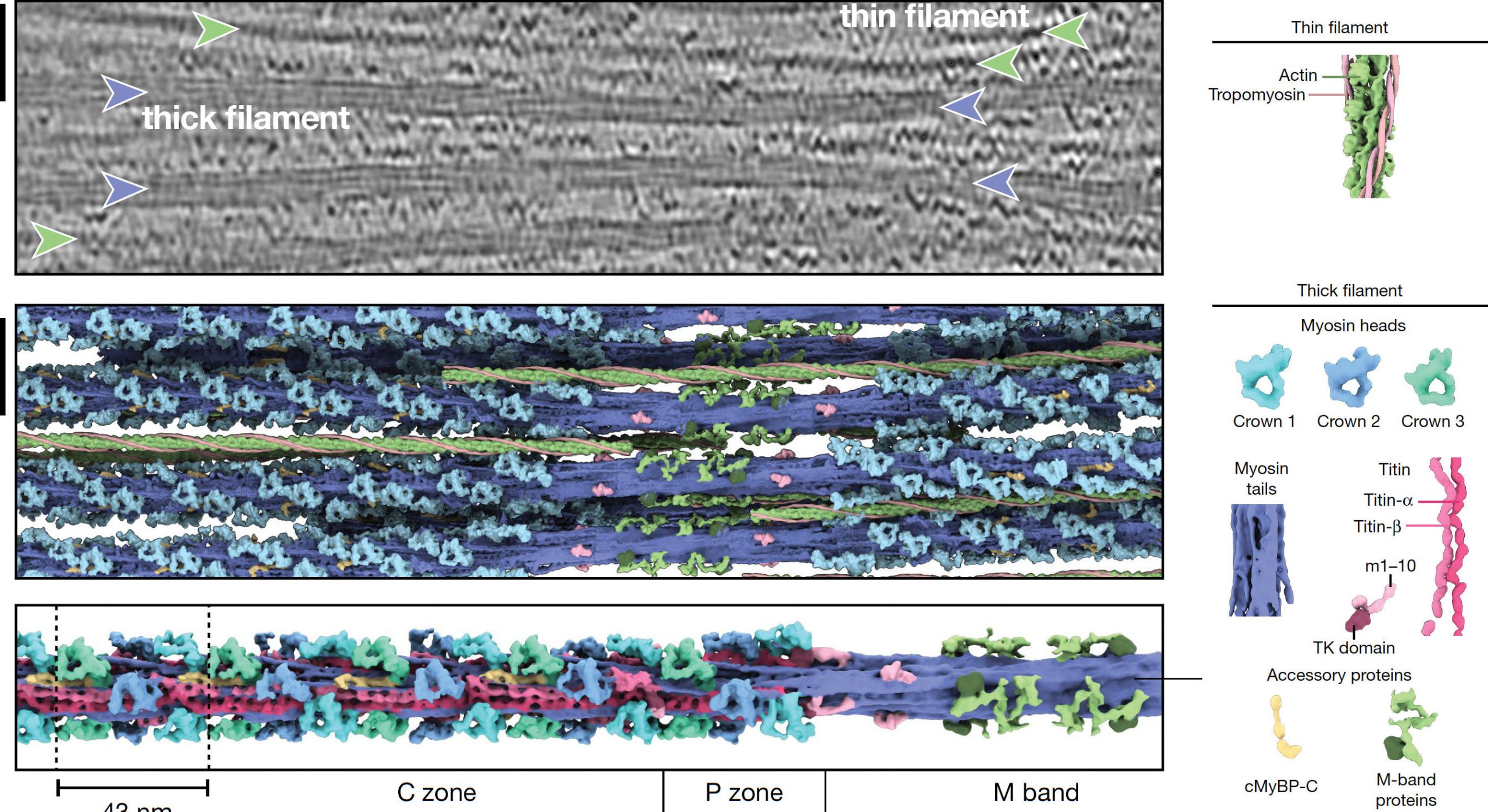
Skeletal and heart muscles contract upon the interaction of two types of parallel protein filaments in the sarcomere: thin and thick. The sarcomere is subdivided in several regions, called zones and bands, in which these filaments are arranged in different ways.
The thin filament consists of F-actin, troponin, tropomyosin, and nebulin. The thick filament is formed of myosin, titin, and myosin-binding protein C (MyBP-C). The latter can form links between the filaments, whereas myosin, the so-called motor protein interacts with the thin filament to generate force and muscle contraction.
MPI of Molecular Physiology
Alterations in the thick filament proteins are associated with muscle diseases. A detailed picture of the thick filament would be of immense importance for developing therapeutical strategies to cure these diseases, but has been missing so far.
Milestones in muscle research
“If you want to fully understand how the muscle works on the molecular level, you need to picture its components in their natural environment – one of the biggest challenges in biological research nowadays that cannot be tackled by traditional experimental approaches,” says Raunser.
To overcome this obstacle his team developed an electron cryo-tomography workflow specifically tailored to the investigation of muscle samples: The scientists flash-freeze mammalian heart muscle samples, produced by the Gautel group in London, at a very low temperature (- 175 °C).
3D structure of the sarcomere showing thick (purple) and thin (green) filaments. Credit: MPI of Molecular Physiology
This preserves their hydration and fine structure and thus their native state. A focused ion beam (FIB milling) is then applied to thin out the samples to an ideal thickness of around 100 nanometers for the transmission electron microscope, which acquires multiple images as the sample is tilted along an axis. Finally, computational methods reconstruct a three-dimensional picture at high resolution.
In recent years, Raunser’s group successfully applied the customized workflow, resulting in two recent groundbreaking publications: They produced the first high-resolution images of the sarcomere and of a so far nebulous muscle protein called nebulin. Both studies provide unprecedented insights into the 3D organization of muscle proteins in the sarcomere, e. g. how myosin binds to actin to control muscle contraction and how nebulin binds to actin to stabilize it and to determine its length.
Completing the painting
In their current study, the scientists produced the first high-resolution image of the cardiac thick filament spanning across several regions in the sarcomere. “With 500 nm length this makes for the longest and biggest structure ever resolved by cryo-ET,” says Davide Tamborrini from the MPI Dortmund, first-author of the study.
Even more impressive are the newly gained insights into the thick filament’s molecular organization and thus into its function. The arrangement of the myosin molecules depends on their position in the filament.
The scientists suspect, that this allows the thick filament to sense and process numerous muscle-regulating signals and thus to regulate the strength of muscle contraction depending on the sarcomere region. They also revealed how titin chains run along the filament. Titin chains intertwine with myosin, acting as a scaffold for its assembly and probably orchestrating a length-depending activation of the sarcomere.
“Our aim is to paint a complete picture of the sarcomere one day. The image of the thick filament in this study is ‘only’ a snapshot in the relaxed state of the muscle. To fully understand how the sarcomere functions and how it is regulated, we want to analyze it in different states e. g. during contraction,” says Raunser.
Comparison with samples from patients with muscle disease will ultimately contribute to a better understanding of diseases like hypertrophic cardiomyopathy and to the development of innovative therapies.
Reference: “Structure of the native myosin filament in the relaxed cardiac sarcomere” by Davide Tamborrini, Zhexin Wang, Thorsten Wagner, Sebastian Tacke, Markus Stabrin, Michael Grange, Ay Lin Kho, Martin Rees, Pauline Bennett, Mathias Gautel and Stefan Raunser, 1 November 2023, Nature.
DOI: 10.1038/s41586-023-06690-5
Never miss a breakthrough: Join the SciTechDaily newsletter.
Follow us on Google and Google News.