
Ultra-intense ultrashort lasers have a wide-ranging scope of applications, encompassing basic physics, national security, industrial service, and health care. In basic physics, such lasers have become a powerful tool for researching strong-field laser physics, especially for laser-driven radiation sources, laser particle acceleration, vacuum quantum electrodynamics, and so on.
Evolution of Laser Power and Technology
A dramatic increase in peak laser power, from the 1996 1-petawatt “Nova” to the 2017 10-petawatt “Shanghai Super-intense Ultrafast Laser Facility” (SULF) and the 2019 10-petawatt “Extreme Light Infrastructure – Nuclear Physics” (ELI-NP), is due to a shift in gain medium for large-aperture lasers (from “neodymium-doped glass” to “titanium:sapphire crystal”). That shift reduced the pulse duration of high-energy lasers from around 500 femtoseconds (fs) to around 25 fs.
Limitations and Innovations in Laser Technology
However, the upper limit for titanium:sapphire ultra-intense ultrashort lasers appears to be 10-petawatt. Presently, for 10-petawatt to 100-petawatt development planning, researchers generally abandon the titanium:sapphire chirped pulse amplification technology, and turn to optical parametric chirped pulse amplification technology, based on deuterated potassium dihydrogen phosphate nonlinear crystals.
That technology, due to its low pump-to-signal conversion efficiency and poor spatiotemporal-spectral-energy stability, will pose a great challenge for the realization and application of the future 10–100 petawatt lasers. On the other hand, the titanium:sapphire chirped pulse amplification technology, as a mature technology that has successfully realized two 10-petawatt lasers in China and Europe, still has great potential for the next-stage development of ultra-intense ultrashort lasers.
Challenges With Titanium:Sapphire Crystals
Titanium:sapphire crystal is an energy-level-type broadband laser gain medium. The pump pulse is absorbed to build up a population inversion between the upper and lower energy levels, which completes the energy storage. When the signal pulse passes through the titanium:sapphire crystal several times, the stored energy is extracted for laser signal amplification. However, in transverse parasitic lasing, an amplified spontaneous emission noise along the crystal diameter consumes the stored energy and reduces the signal laser amplification.
Currently, the maximum aperture of titanium:sapphire crystals can only support 10-petawatt lasers. Even with larger titanium:sapphire crystals, laser amplification is still not possible because strong transverse parasitic lasing increases exponentially as the size of the titanium:sapphire crystals increases.
Innovative Solutions and Future Potential
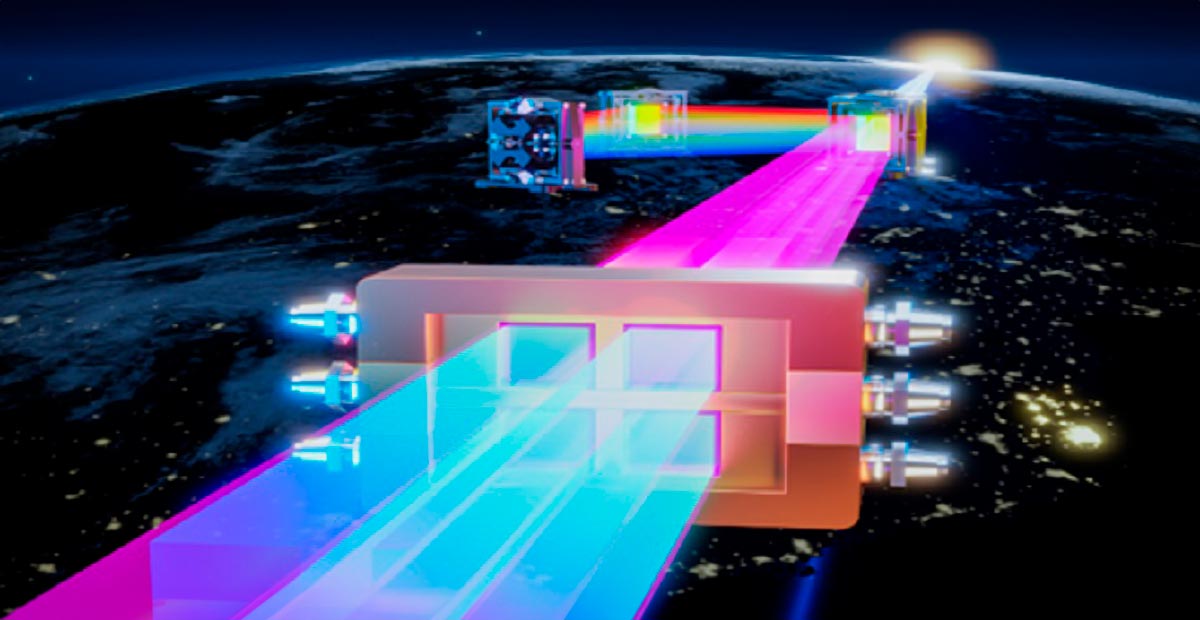
In response to this challenge, researchers have taken an innovative approach that involves coherently tiling multiple titanium:sapphire crystals together. As reported on December 23, 2023, in Advanced Photonics Nexus, this method breaks through the current 10-petawatt limit on the titanium:sapphire ultra-intense ultrashort lasers, effectively increasing the aperture diameter of the entire tiled titanium:sapphire crystal and also truncating the transverse parasitic lasing within each tiling crystal.
Corresponding author Yuxin Leng of the Shanghai Institute of Optics and Fine Mechanics notes, “The tiled titanium:sapphire laser amplification was successfully demonstrated in our 100-terawatt (i.e., 0.1-petawatt) laser system. We achieved near-ideal laser amplification using this technology, including high conversion efficiencies, stable energies, broadband spectra, short pulses, and small focal spots.”
Leng’s team reports that coherently tiled titanium:sapphire laser amplification provides a relatively easy and inexpensive way to surpass the current 10-petawatt limit. “By adding a 2×2 coherently tiled titanium:sapphire high-energy laser amplifier in China’s SULF or EU’s ELI-NP, the current 10-petawatt can be further increased to 40-petawatt and the focused peak intensity can be increased by nearly 10 times or more,” says Leng.
The method promises to enhance the experimental capability of ultra-intense ultrashort lasers for strong-field laser physics.
Reference: “Coherently tiled Ti:sapphire laser amplification: a way to break the 10 petawatt limit on current ultraintense lasers” by Yanqi Liu, Keyang Liu, Zhaoyang Li, Yuxin Leng and Ruxin Li, 23 December 2023, Advanced Photonics Nexus.
DOI: 10.1117/1.APN.2.6.066009
Never miss a breakthrough: Join the SciTechDaily newsletter.
Follow us on Google and Google News.
5 Comments
According to topological vortex gravitational field theory, synchronization and co-direction are important means of increasing energy, and there is no upper limit.
The superposition, deflection, and twisting of topological vortices form the understructures for the evolution and movement of spatiotemporal matter. Temperature change is a manifestation of topological vortices bifurcation. Each temperature change point is the base point of topological vortices bifurcation.
Physics must respect the scientificity of mathematical models in low-dimensional spacetime.
Why do you guys not ban Mr Bao-hua Zhang from continually posting his meaningless GPT generated crap?
It renders your comments section entirely useless. Worth neither the time to read nor the bandwidth to download.
Henceforth, this is another section of your pages that I will block.
More devout believers like you will definitely promote scientific progress.
Wishing you success.