
Computer simulations show how mysterious intermediate-mass black holes could form inside stellar clusters.
An international consortium of astronomers, including staff from the Max Planck Institute for Astronomy, has successfully unraveled the intricate formation mechanisms of the elusive intermediate-mass black holes. They could represent the link between their smaller relatives, the stellar black holes, and the supermassive giants that populate the centers of galaxies. This achievement derives from the DRAGON-II simulation project led by the Gran Sasso Science Institute. The scientists involved in this study computed the complex interactions of stars, stellar black holes, and physical processes inside dense stellar clusters, demonstrating that black holes of up to a few hundred solar masses can emerge in those environments.
The Cradle of Black Holes
The quest to locate and understand the origins of intermediate-mass black holes (IMBHs) remains an ongoing enigma. If they exist, they may serve as the connecting link between two extremes of black holes. At the low-mass end, we observe stellar black holes, remnants of supernova explosions of massive stars at the end of their lifetime. On the other hand, we find black holes in the centers of galaxies, millions or even billions of times more massive than the Sun. The formation and growth of these objects still represent a fascinating mystery to modern astronomy, mainly due to the lack of a definitive smoking gun supporting the existence of such black holes. Astronomers expect to find them in dense and crowded stellar clusters.
The Challenge of Observing IMBHs
“Intermediate-mass black holes are difficult to observe,” explains Manuel Arca Sedda from the Gran Sasso Science Institute (GSSI) in L’Aquila, Italy, and the main author of the underlying research article published in the Monthly Notices of the Royal Astronomical Society. “The current observational limits do not allow us to say anything about the population of intermediate-mass black holes with masses between 1,000 and 10,000 solar masses, and they also represent a headache for scientists regarding the possible mechanisms that lead to their formation.”
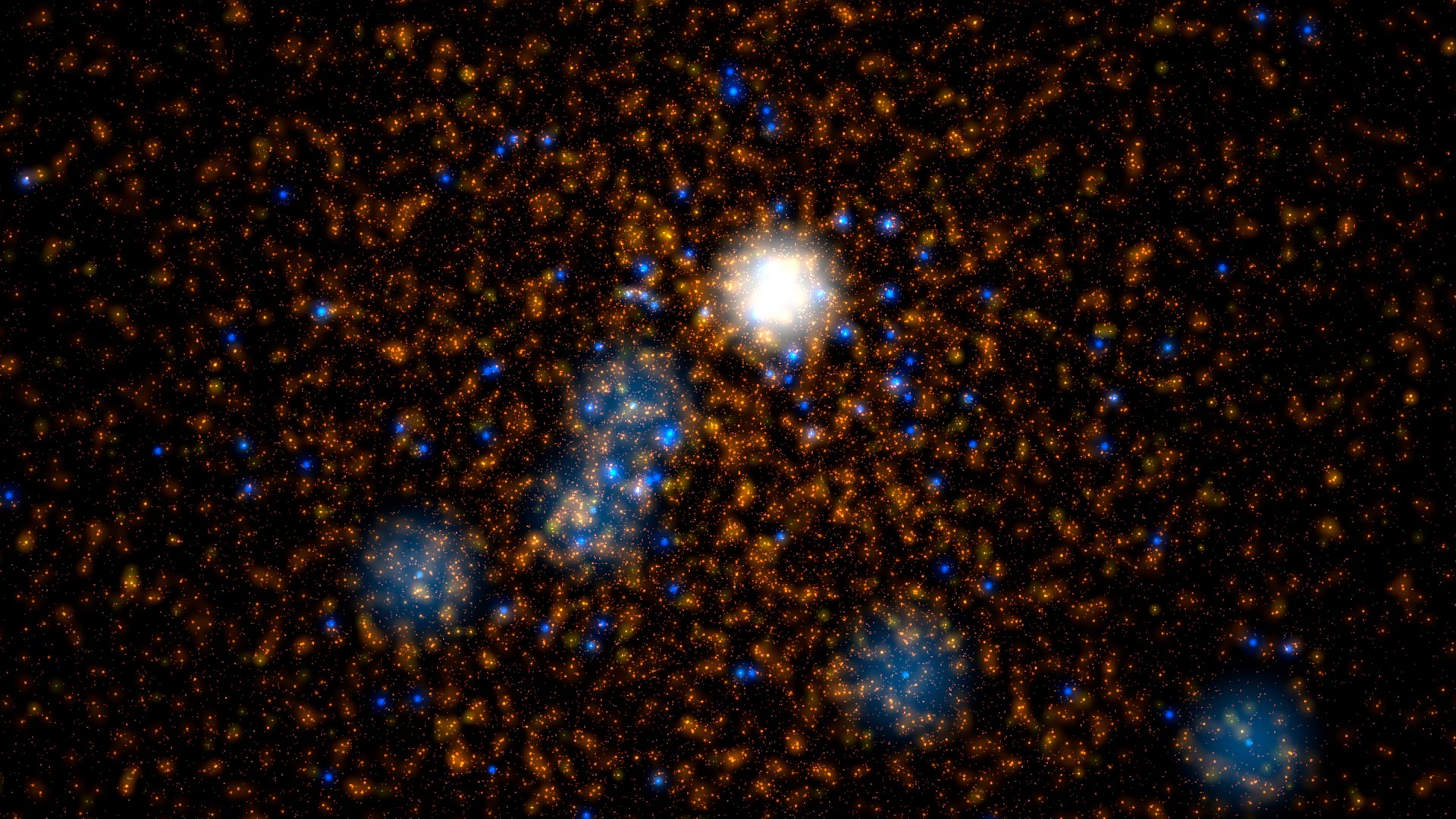
Zoom-in of a snapshot taken from one of the DRAGON-II simulations, modeling dense star clusters with up to 1 million stars. Orange and yellow dots represent sunlike stars, while the blue dots indicate stars with masses of 20 to 300 times that of the Sun. The large white object in the center represents a star with a mass of about 350 solar masses, which will shortly collapse to form an intermediate-mass black hole. Credit: M. Arca Sedda (GSSI)
Discovery Through Simulation
To overcome this disadvantage, an international team led by Arca Sedda and including Albrecht Kamlah of the Max Planck Institute for Astronomy in Heidelberg, Germany (MPIA) have undertaken an innovative series of high-resolution numerical simulations of stellar clusters, known as the DRAGON-II cluster database. In this endeavor, the astronomers uncovered a potential pathway for the formation of black holes of intermediate mass within young, densely populated, and massive star clusters.
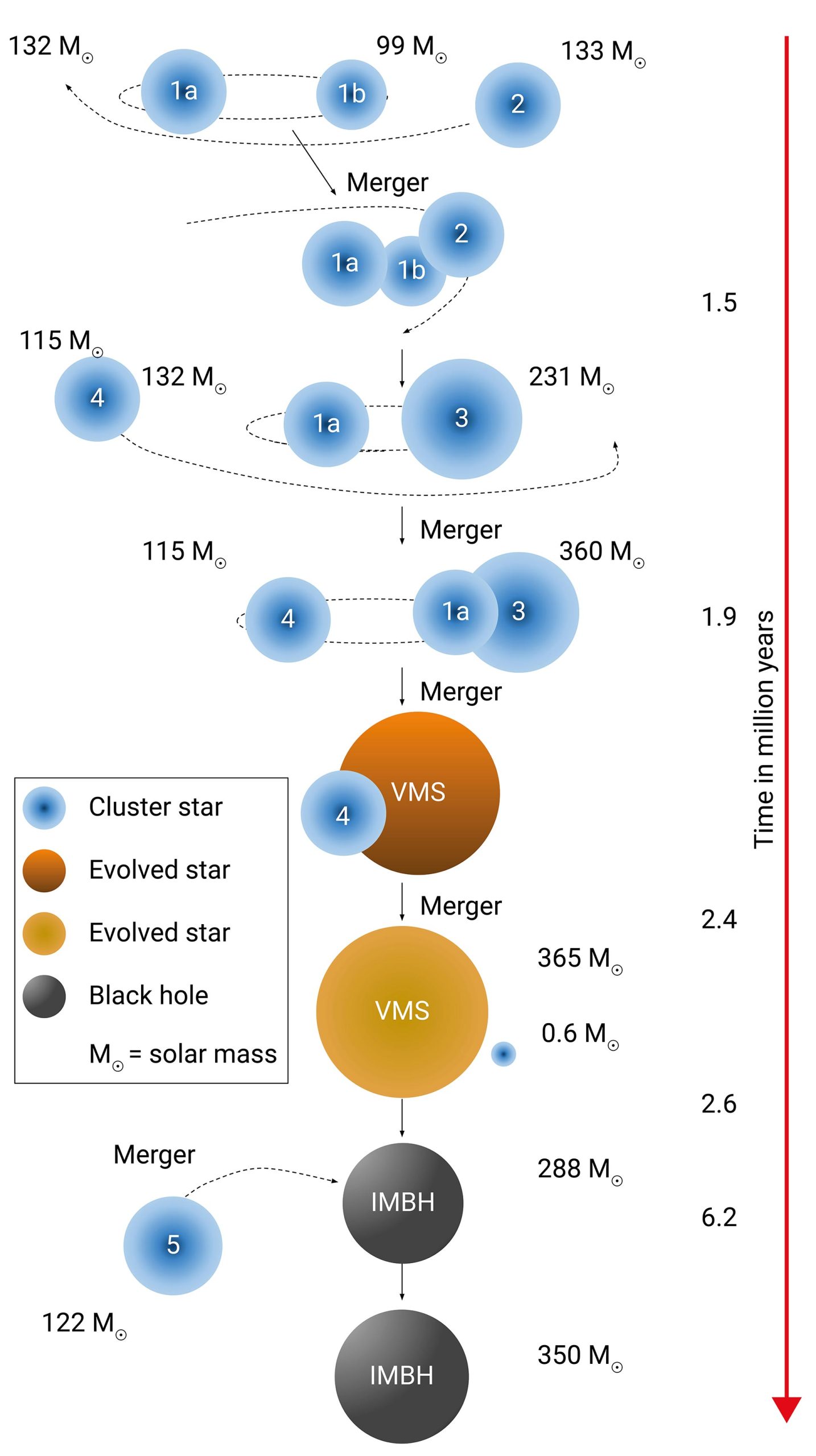
These ground-breaking simulations had to compute a sequence of complex interactions between normal single and binary stars, leading to collisions and forming increasingly massive stars that eventually evolve into IMBHs. At that stage, those black holes may continue incorporating additional massive stars and black holes, leading to a growth to several hundred solar masses. As it turns out, no single pathway leads to an intermediate-mass black hole. Instead, the astronomers find a complex range of interactions and merging events.
Simulating Realistic Star Clusters
Up to one million stars populated the simulated stellar clusters, which exhibit a binary star fraction ranging from 10% to 30%. “The simulated clusters closely mirror real-world counterparts observed in the Milky Way, the Magellanic Clouds, and various galaxies within our local universe,” Kamlah points out.
By tracking the subsequent fate of an intermediate-mass black hole in these simulations, the astronomers identified a turbulent period marked by vigorous interactions with other stars and stellar black holes, which can lead to its rapid expulsion from its parental cluster, typically within a few hundred million years. This ejection effectively limits the further growth of the back hole. The computational models reveal that while IMBH seeds naturally originate from energetic stellar interactions within star clusters, their tendency to attain greater masses exceeding a few hundred solar masses hinges on the environment’s exceptional density or massiveness.
Unresolved Scientific Puzzle
Nevertheless, a pivotal scientific puzzle remains unresolved: whether black holes of intermediate mass serve as the missing link between their smaller stellar counterparts and the colossal supermassive black holes. This question remains unanswered for now, but the study opens the room for informed conjecture.
“We need two ingredients for a better clarification,” Arca Sedda explains, “one or more processes capable of forming black holes of intermediate mass and the possibility of keeping them in the host environment.” The study places stringent constraints on the first ingredient, presenting a clear overview of which processes may contribute to the formation of IMBHs. Considering more massive clusters that contain more binary stars may help obtain the second ingredient in the future, which albeit poses challenging requirements for subsequent simulations.
Future Research Directions
Interestingly, star clusters formed in the early universe may have the suitable qualities to sustain IMBH growth. Future observations of such ancient star clusters, for example, with the aid of the James Webb Space Telescope (JWST) and the development of new theoretical models, may help disentangle the relationship between intermediate-mass and supermassive black holes.
Reference: “The dragon-II simulations – II. Formation mechanisms, mass, and spin of intermediate-mass black holes in star clusters with up to 1 million stars” by Manuel Arca Sedda, Albrecht W H Kamlah, Rainer Spurzem, Francesco Paolo Rizzuto, Thorsten Naab, Mirek Giersz and Peter Berczik, 25 September 2023, Monthly Notices of the Royal Astronomical Society.
DOI: 10.1093/mnras/stad2292
The MPIA scientist involved in this research is Albrecht Kamlah (also Astronomisches Rechen-Institut, Zentrum für Astronomie der Universität Heidelberg).
The publication on the DRAGON-II simulations is part of a three-paper series (with the remaining two in review), which in turn is part of the long-term DRAGON simulation project spearheaded by Rainer Spurzem (Astronomisches Rechen-Institut, Zentrum fur Astronomie der Universität Heidelberg, and Kavli Institute for Astronomy and Astrophysics, Peking University; National Astronomical Observatories, Chinese Academy of Sciences, Beijing) and teams concentrated mainly in Germany, China, Poland, and Italy. This project aims to resolve the dynamical evolution of massive star clusters across cosmic time using the most accurate methods available.
The successful execution of the project requires the extensive deployment of GPU-accelerated massively parallel computing systems, such as the High-Performance Computing (HPC) system Raven and the JUWELS-Booster system of the Jülich Supercomputing Center (JSC). The simulations of the DRAGON-II project featured in the publications were all conducted on the JUWELS-Booster. The extensive utilization of computational resources at Raven, available at the Max Planck Computing and Data Facility (MPCDF), has also been integral in rigorously evaluating and benchmarking the million-body simulations presented throughout the series while providing a testing environment for many of the necessary code updates.
Never miss a breakthrough: Join the SciTechDaily newsletter.
Follow us on Google and Google News.