
Close Menu
    Facebook X (Twitter) Instagram
    SciTechDaily
    • Biology
    • Chemistry
    • Earth
    • Health
    • Physics
    • Science
    • Space
    • Technology
    Facebook X (Twitter) Pinterest YouTube RSS
    SciTechDaily
    Home»Space»Astronomers Use Globular Clusters to Measure Galaxy Evolution
    Space

    Astronomers Use Globular Clusters to Measure Galaxy Evolution

    By Harvard-Smithsonian Center for AstrophysicsMarch 20, 20152 Comments3 Mins Read
    Facebook Twitter Pinterest Telegram LinkedIn WhatsApp Email Reddit
    Share
    Facebook Twitter LinkedIn Pinterest Telegram Email Reddit
    Measuring Galaxy Evolution with Globular Clusters
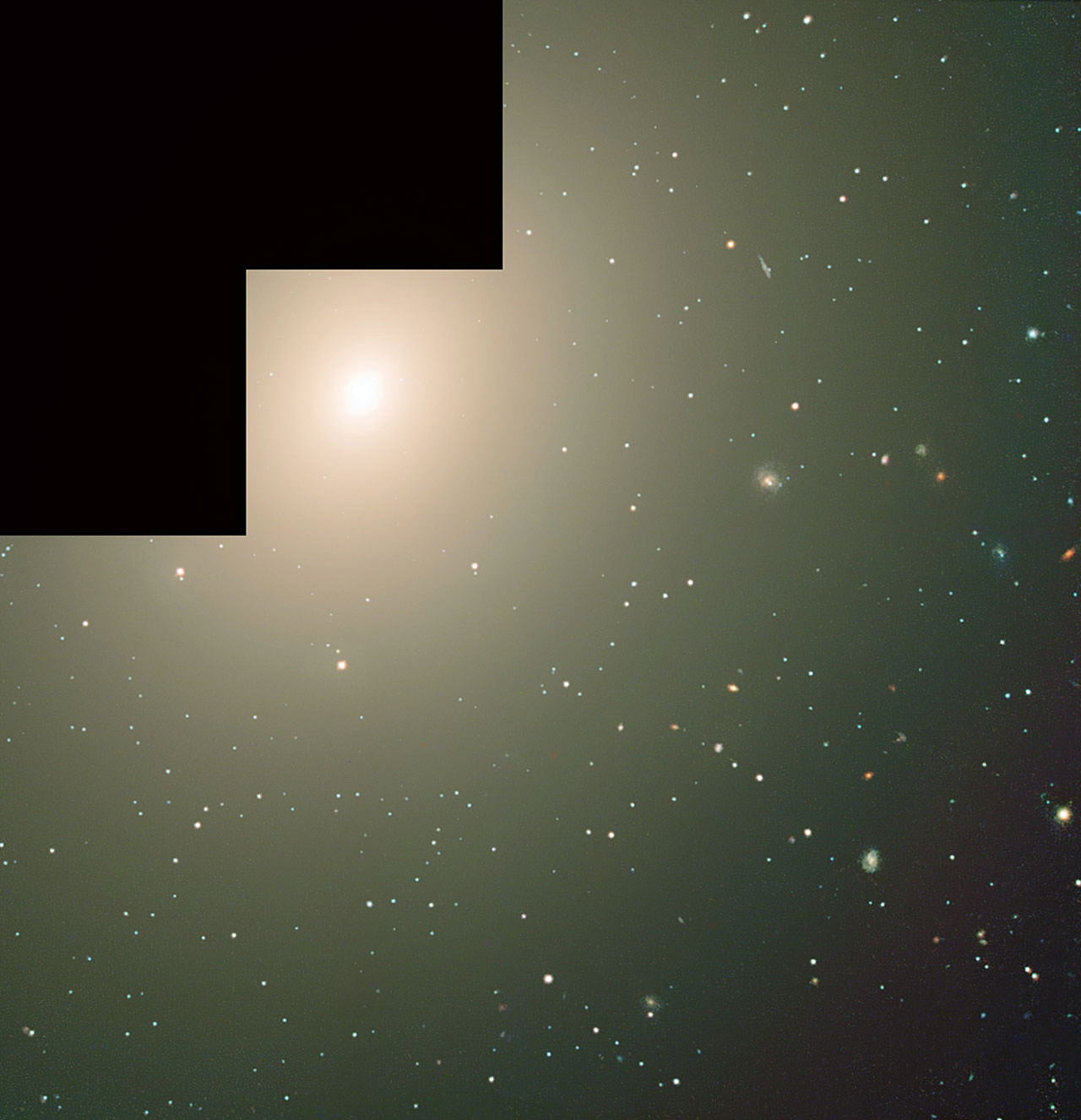
    The galaxy NGC 4365 in the Virgo supercluster of galaxies, showing its many globular clusters (most of the more than one hundred dots in this image are actually globular star clusters). Credit: NASA/HST and ESO VLT

    A new study from the Harvard-Smithsonian Center for Astrophysics reveals that globular clusters are often gathered into distinct groupings whose shapes reflect the formation of the clusters and the histories of the galaxies.

    Globular clusters are gravitationally bound ensembles of stars, as many as a million stars in some cases, grouped in roughly spherical clusters with diameters as small as only tens of light-years. Globular clusters are typically located in the outer regions (the halos) of galaxies; the Milky Way galaxy has about two hundred globular clusters orbiting it. Astronomers are interested in globular clusters in part because they are home to many of the oldest known stars, but also because of their locations in the halos. Collisions between galaxies are commonplace, and globular clusters may provide fossil evidence of these encounters because they are strongly affected by such interactions. During a collision, a galaxy can grow by absorbing or merging with its neighbor, and some models predict that clusters form during these interactions. Moreover, it is possible that in a merger large numbers of globular clusters originally belonging to a smaller galaxy may be captured by the larger galaxy. In any case, the distribution of globular clusters around a galaxy holds clues to their origins and the history of its host galaxy.

    The Virgo Cluster of galaxies, containing between one and two thousand galaxies, is located about fifty-four million light-years away in the direction of the constellation of Virgo. The ten brightest galaxies of the Virgo Cluster alone contain 7053 detected globular clusters. CfA astronomers Raffaele D’Abrusco, Pepi Fabbiano, and Andreas Zezas carefully examined this set of globular clusters looking for information about the history of these galaxies. In a new paper, they report discovering distinctive structures among the globular cluster systems, meaning that the globular clusters around these galaxies are not distributed symmetrically. Their configurations often take shapes ranging from roughly linear to circular, with some more complex shapes as well. The scientists found 229 such structures in this subsample, forty-two of them classified as being medium or large and stretching over as much as seventy-five light-years. The elongated structures tend to be aligned with an axis of the host galaxy, as would be expected if a merger were responsible.

    The scientists argue that these structures are indeed the remnants of galaxies that were accreted in the past, and among other things they estimate limits on the masses of these parent galaxies. Computer simulations provide some rough level of agreement. The authors note that with more detailed computations, these structures offer a powerful new tool to advance the study of galaxy evolution.

    Reference: “Spatial Structures in the Globular Cluster Distribution of the Ten Brightest Virgo Galaxies” by R. D’Abrusco, G. Fabbiano and A. Zezas, 15 May 2015, The Astrophysical Journal.
    DOI: 10.1088/0004-637X/805/1/26
    arXiv: 1503.04819


    Never miss a breakthrough: Join the SciTechDaily newsletter.
    Follow us on Google and Google News.

    Astronomy Astrophysics Galaxy Evolution Globular Cluster Harvard-Smithsonian Center for Astrophysics
    Share. Facebook Twitter Pinterest LinkedIn Email Reddit

    Related Articles

    No Significant Evidence That Distant ULIRGs Are Less Involved in Mergers

    Chandra Reveals Shock Heated Gas in Colliding Galaxies

    12 Billion Year Old Explosion Illuminates a Galaxy from the Dark Ages

    The First Systematic Analysis of the Energy Distribution of Interacting Galaxies

    New Computer Simulations Help Reveal How Spiral Galaxies Get Their Arms

    Researchers Study Early Galaxies and Their Specific Properties

    Centaurus a Hides a Gaseous Spiral at Its Core

    Arepo Software Helps Simulate the Birth and Evolution of Galaxies

    Using Infrared Images from Hubble & Spitzer, Scientists Discover 25 Distant Galaxies

    2 Comments

    1. Alastair Brickell on March 22, 2015 10:59 pm

      Surely the distance to the Virgo Cluster is 54 million light years, not 54 thousand light years!

      Reply
      • Staff on March 23, 2015 8:08 am

        Correct, that was a typo. Thanks-

        Reply
    Leave A Reply Cancel Reply

    • Facebook
    • Twitter
    • Pinterest
    • YouTube

    Don't Miss a Discovery

    Subscribe for the Latest in Science & Tech!

    Trending News

    Two Drinks a Day May Be Riskier Than Many Americans Think

    A Lost Human Lineage May Have Left a Genetic Legacy in People Today

    Study Reveals a Surprising Link Between Birth Control Pills and Binge Eating

    NASA’s HiRISE Captures Perseverance Rover Completing a Marathon on Mars

    Ancient DNA Reveals the Hidden Origins of China’s Mysterious Shimao Civilization

    Scientists Discover a Surprising Link Between Sleep, Genes, and Alzheimer’s

    Popular Childhood Drinks Linked to Higher Blood Pressure Later in Life

    Scientists Just Challenged a 70-Year-Old Myth About the Human Brain

    Follow SciTechDaily
    • Facebook
    • Twitter
    • YouTube
    • Pinterest
    • Newsletter
    • RSS
    SciTech News
    • Biology News
    • Chemistry News
    • Earth News
    • Health News
    • Physics News
    • Science News
    • Space News
    • Technology News
    Recent Posts
    • The Propellantless Spacecraft Technologies That Could Help Us Reach the Stars
    • New Black Hole Theory Solves a 50-Year-Old Problem
    • China’s Tianwen-1 Captures Rare Close-Up Images of Interstellar Comet 3I/ATLAS
    • Second PSMA PET Scan Finds Hidden Prostate Cancer in 56% of Patients
    • Researchers Warn Rising CO₂ May Already Be Changing Human Blood Chemistry
    Copyright © 1998 - 2026 SciTechDaily. All Rights Reserved.
    • Science News
    • About
    • Contact
    • Editorial Board
    • Privacy Policy
    • Terms of Use

    Type above and press Enter to search. Press Esc to cancel.