
Close Menu
    Facebook X (Twitter) Instagram
    SciTechDaily
    • Biology
    • Chemistry
    • Earth
    • Health
    • Physics
    • Science
    • Space
    • Technology
    Facebook X (Twitter) Pinterest YouTube RSS
    SciTechDaily
    Home»Space»Chandra Reveals Shock Heated Gas in Colliding Galaxies
    Space

    Chandra Reveals Shock Heated Gas in Colliding Galaxies

    By Harvard-Smithsonian Center for AstrophysicsJanuary 28, 2014No Comments4 Mins Read
    Facebook Twitter Pinterest Telegram LinkedIn WhatsApp Email Reddit
    Share
    Facebook Twitter LinkedIn Pinterest Telegram Email Reddit
    Chandra Reveals Shock Heated Gas in Colliding Galaxies
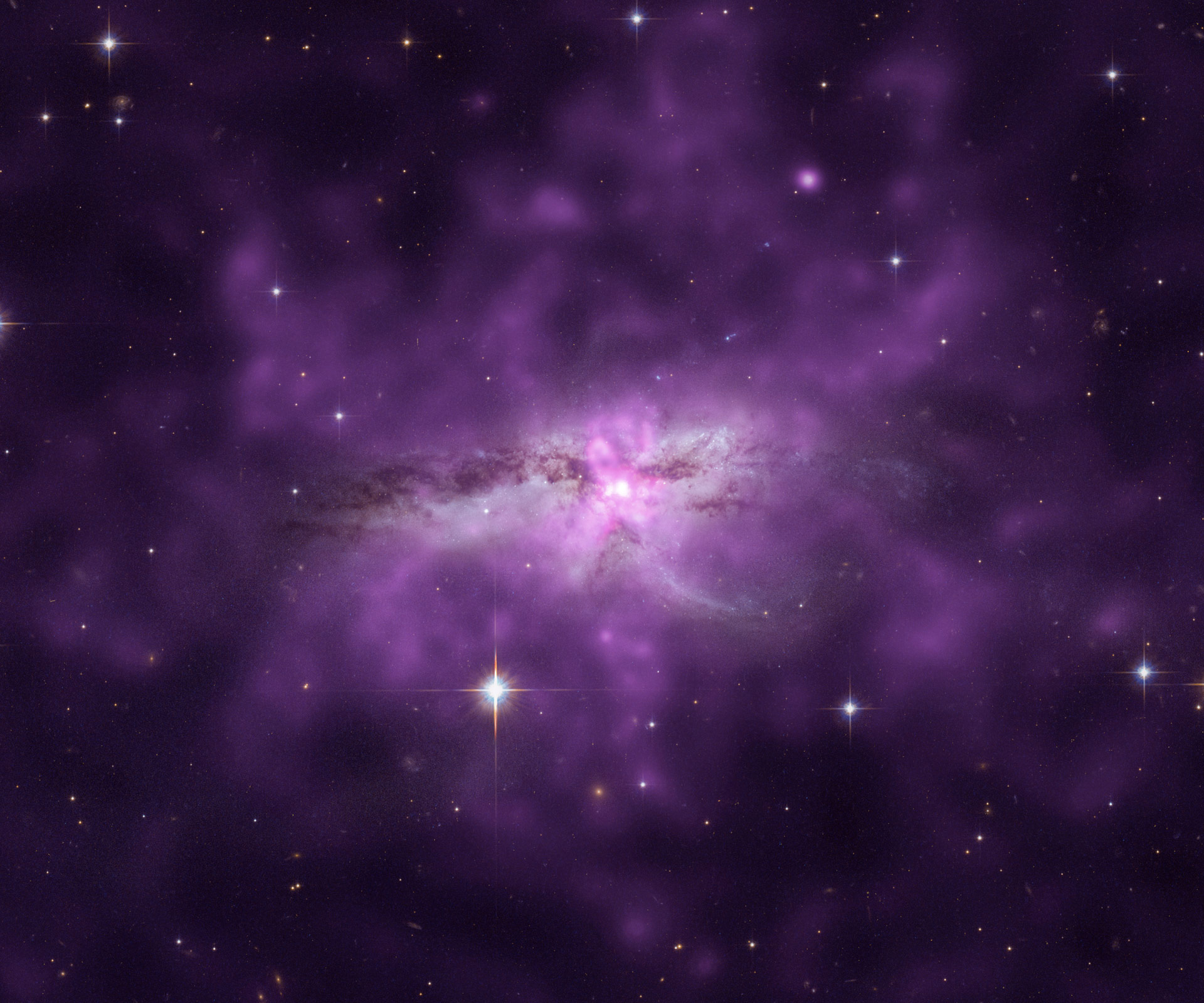
    A composite image of the colliding galaxies NGC6240; X-ray emission is purple and optical emission is white. Astronomers have discovered X-ray evidence for shock-heated gas moving at speeds of about 2200 kilometers per second, presumably associated with ejecta from supernovae. Credit: X-ray – NASA/ CXC/SAO/E.Nardini et al; Optical – NASA/STScI

    Using images and spectra from the Chandra X-ray Observatory, researchers discovered evidence of shock-heated gas moving at speeds of about 2200 kilometers per second in galaxy NGC6240.

    Luminous infrared galaxies shine with the radiative output of tens of Milky Way galaxies, or even more. Their most striking feature, however, is not their tremendous energy output but the fact that nearly all of their radiation is invisible and at infrared wavelengths. The source of the energy is intense star formation that takes place within dust-filled clouds. The ultraviolet and visible light produced by hot young stars is absorbed by the dust grains and is then remitted as infrared radiation. Collisions between galaxies are expected to trigger enhanced star formation, and so luminous galaxies are thought to result from such interactions. These objects may be representative of a phase of stellar growth and enrichment that most galaxies briefly experience, especially during early times in the age of the universe when collisions were more common. The connections between galaxy interactions and star formation, however, are imperfectly understood, in part because the obscuring dust makes it difficult to probe the small nuclei of merging galaxies.

    In the local universe (that is, within a billion light-years or so of us) the galaxy NGC6240 is unusual, being a luminous infrared source in the throes of a major merger of two galaxies, experiencing star formation at an estimated rate of about twenty-five solar masses per year, and radiating about twenty times as much energy as does the Milky Way. It is also known to be a powerful emitter of X-rays. The origin of these X-rays has been uncertain: they could., for example, come from intermediate-sized black holes formed in the star formation process, or perhaps from the supermassive black holes at the center of the nuclei.

    CfA astronomers Junfeng Wang, Emanuele Nardini, Giuseppina Fabbiano, Margarita Karovska, Martin Elvis, Guido Risaliti, and Andreas Zezas, with three colleagues, used images and spectra from the Chandra X-ray Observatory to examine the nuclear region of NGC6240 with high spatial resolution and sensitivity. They were able to identify the two nuclei and study the diffuse very hot gas (about seventy million degrees kelvin) in the inner galaxy out to a distance of nearly twenty thousand light-years. For the first time, they were able to obtain the spatial distribution of the highly ionized, gaseous iron produced in this hot medium. They found that its morphology corresponds closely to that of the shocked molecular hydrogen gas seen in the infrared and that has been known for many years. Based on this correspondence, and incorporating an analysis of the new data, the scientists were able to conclude that there are almost a million solar masses of hot iron in the region, and that both the quantity and energetics are consistent with a series of supernova explosions; the cataclysms produce gas moving at velocities of up to 2,200 kilometers (1,400 miles) per second which shocks the material to the extreme temperatures seen. The results confirm that rapid star formation (supernovae signal the deaths of massive young stars ) is indeed at work, and responsible for both the luminous infrared and the X-ray emission.

    Reference: “Fast and Furious: Shock Heated Gas as the Origin of Spatially Resolved Hard X-ray Emission in the Central 5 kpc of the Galaxy Merger NGC 6240” by Junfeng Wang, Emanuele Nardini, Giuseppina Fabbiano, Margarita Karovska, Martin Elvis, Silvia Pellegrini, Claire Max, Guido Risaliti, Vivian U and Andreas Zezas, 7 January 2014, The Astrophysical Journal.
    DOI: 10.1088/0004-637X/781/1/55
    arXiv:1303.2980

    Never miss a breakthrough: Join the SciTechDaily newsletter.
    Follow us on Google and Google News.

    Astronomy Astrophysics Chandra X-ray Observatory Galaxy Evolution Harvard-Smithsonian Center for Astrophysics
    Share. Facebook Twitter Pinterest LinkedIn Email Reddit

    Related Articles

    Mega-Flares From Stars: 10 Million Times More Energetic Than the Most Powerful Flare Ever Observed on the Sun

    The Give and Take of Stellar Mega-Flares: By Studying Thousands of Young Stars, New Information Has Emerged

    Unprecedented New Panorama of the Center of Our Milky Way – Reveals Magnetized Threads Weaving Spectacular Galactic Tapestry

    How Habitable Are Planets That Orbit Red Dwarfs – The Most Common Type of Stars in the Galaxy?

    Fragments of Titanium Found Blasting Out of a Famous Supernova

    How Do the Most Massive Stars Explode? Bubbles With Titanium Trigger Titanic Explosions

    Massive X-ray Jet – Extending for 160,000 Light-Years – Spied From Supermassive Black Hole in Early Universe

    Chandra X-ray Observatory Studies Extraordinary Magnetar [Video]

    Chandra Studies Extraordinary Magnetar: Fastest Spinning and Possibly the Youngest Magnetar Known

    Leave A Reply Cancel Reply

    • Facebook
    • Twitter
    • Pinterest
    • YouTube

    Don't Miss a Discovery

    Subscribe for the Latest in Science & Tech!

    Trending News

    Even Occasional Binge Drinking May Triple Liver Damage Risk

    Liftoff! NASA’s Artemis II Launch Sends Astronauts Around the Moon for First Time in 50 Years

    Scientists Discover New Way To Eliminate “Zombie Cells” Driving Aging

    This New Quantum Theory Could Change Everything We Know About the Big Bang

    This One Vitamin May Help Protect Your Brain From Dementia Years Later

    Stopping Weight-Loss Drugs Like Ozempic Can Quickly Erase Heart Benefits

    A 500-Million-Year-Old Surprise Is Forcing Scientists to Rethink Spider Evolution

    Coffee and Blood Pressure: What You Need To Know Before Your Next Cup

    Follow SciTechDaily
    • Facebook
    • Twitter
    • YouTube
    • Pinterest
    • Newsletter
    • RSS
    SciTech News
    • Biology News
    • Chemistry News
    • Earth News
    • Health News
    • Physics News
    • Science News
    • Space News
    • Technology News
    Recent Posts
    • Tiny 436-Million-Year-Old Fish Fossil Rewrites the Origins of Vertebrates
    • 1,800 Miles Down: Scientists Uncover Mysterious Movements at the Edge of Earth’s Core
    • Scientists Uncover Earth’s Hidden “Gold Kitchen” Beneath the Ocean Floor
    • You Don’t Need To Be Rich: New Study Reveals a Simple Life Is the Real Secret to Happiness
    • “Crazy Dice” Help Scientists Prove Only One 150-Year-Old Theory About Randomness Works
    Copyright © 1998 - 2026 SciTechDaily. All Rights Reserved.
    • Science News
    • About
    • Contact
    • Editorial Board
    • Privacy Policy
    • Terms of Use

    Type above and press Enter to search. Press Esc to cancel.