
Close Menu
    Facebook X (Twitter) Instagram
    SciTechDaily
    • Biology
    • Chemistry
    • Earth
    • Health
    • Physics
    • Science
    • Space
    • Technology
    Facebook X (Twitter) Pinterest YouTube RSS
    SciTechDaily
    Home»Space»GBT Views River of Hydrogen Flowing through Space
    Space

    GBT Views River of Hydrogen Flowing through Space

    By National Radio Astronomy ObservatoryJanuary 28, 2014No Comments4 Mins Read
    Facebook Twitter Pinterest Telegram LinkedIn WhatsApp Email Reddit
    Share
    Facebook Twitter LinkedIn Pinterest Telegram Email Reddit
    Astronomer Discovers River of Hydrogen Flowing through Space
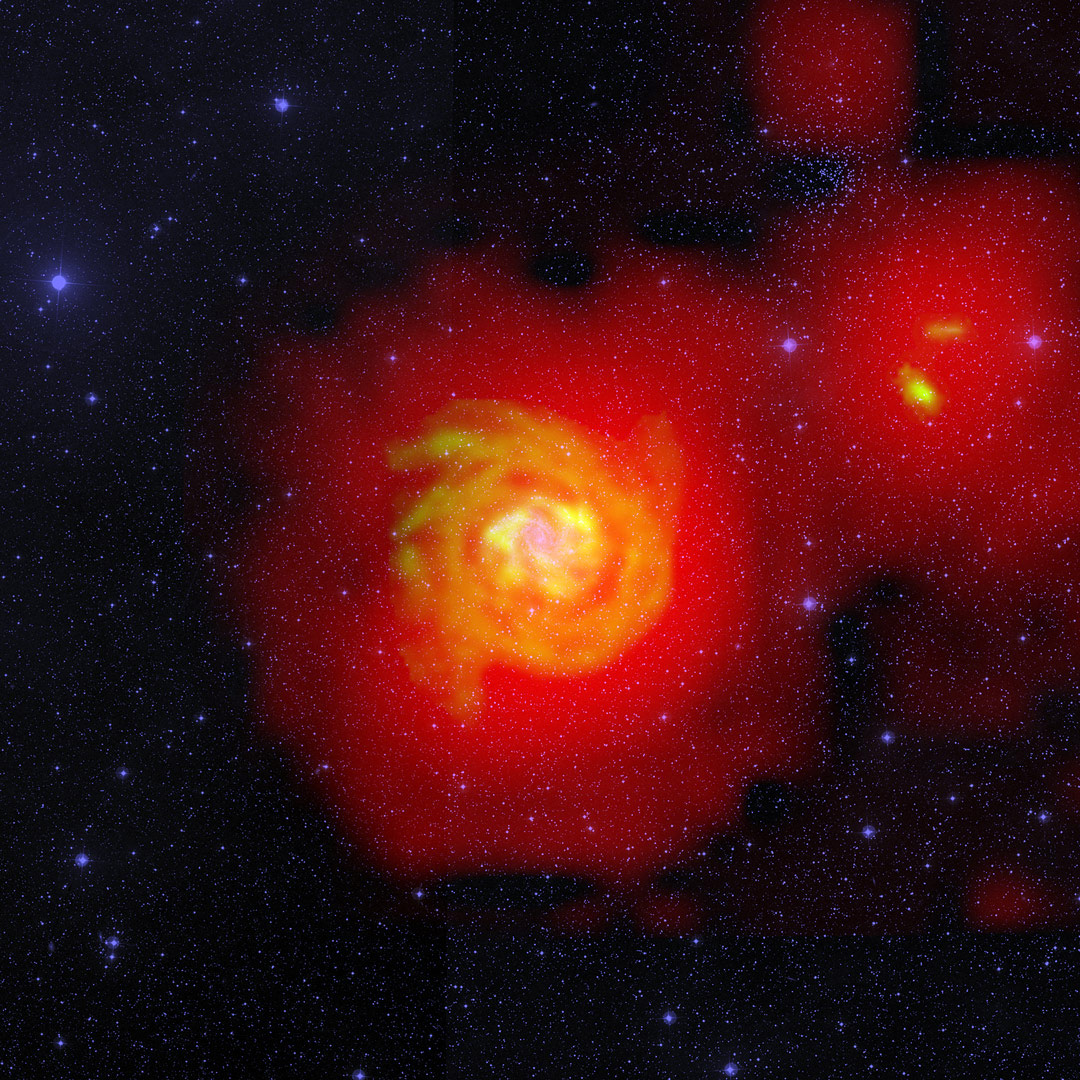
    This composite image contains three distinct features: the bright star-filled central region of galaxy NGC 6946 in optical light (blue), the dense hydrogen tracing out the galaxy’s sweeping spiral arms and galactic halo (orange), and the extremely diffuse and extended field of hydrogen engulfing NGC 6946 and its companions (red). The new GBT data show the faintly glowing hydrogen bridging the gulf between the larger galaxy and its smaller companions. This faint structure is precisely what astronomers expect to appear as hydrogen flows from the intergalactic medium into galaxies or from a past encounter between galaxies. Credit: D.J. Pisano (WVU); B. Saxton (NRAO/AUI/NSF); Palomar Observatory – Space Telescope Science Institute 2nd Digital Sky Survey (Caltech); Westerbork Synthesis Radio Telescope

    The Green Bank Telescope has revealed a never-before-seen river of hydrogen streaming into the nearby galaxy NGC 6946, helping to reveal how certain spiral galaxies keep up their steady pace of star formation.

    Using the National Science Foundation’s Robert C. Byrd Green Bank Telescope (GBT), astronomer D.J. Pisano from West Virginia University has discovered what could be a never-before-seen river of hydrogen flowing through space. This very faint, very tenuous filament of gas is streaming into the nearby galaxy NGC 6946 and may help explain how certain spiral galaxies keep up their steady pace of star formation.

    “We knew that the fuel for star formation had to come from somewhere. So far, however, we’ve detected only about 10 percent of what would be necessary to explain what we observe in many galaxies,” said Pisano. “A leading theory is that rivers of hydrogen – known as cold flows – may be ferrying hydrogen through intergalactic space, clandestinely fueling star formation. But this tenuous hydrogen has been simply too diffuse to detect, until now.”

    Spiral galaxies, like our own Milky Way, typically maintain a rather tranquil but steady pace of star formation. Others, like NGC 6946, which is located approximately 22 million light-years from Earth on the border of the constellations Cepheus and Cygnus, are much more active, though less so than more extreme starburst galaxies. This raises the question of what is fueling the sustained star formation in this and similar spiral galaxies.

    Earlier studies of the galactic neighborhood around NGC 6946 with the Westerbork Synthesis Radio Telescope (WSRT) in the Netherlands have revealed an extended halo of hydrogen (a feature commonly seen in spiral galaxies, which may be formed by hydrogen ejected from the disk of the galaxy by intense star formation and supernova explosions). A cold flow, however, would be hydrogen from a completely different source: gas from intergalactic space that has never been heated to extreme temperatures by a galaxy’s star birth or supernova processes.

    Using the GBT, Pisano was able to detect the glow emitted by neutral hydrogen gas connecting NGC 6946 with its cosmic neighbors. This signal was simply below the detection threshold of other telescopes. The GBT’s unique capabilities, including its immense single dish, unblocked aperture, and location in the National Radio Quiet Zone, enabled it to detect this tenuous radio light.

    Astronomers have long theorized that larger galaxies could receive a constant influx of cold hydrogen by siphoning it off other less-massive companions.

    In looking at NGC 6946, the GBT detected just the sort of filamentary structure that would be present in a cold flow, though there is another probable explanation for what has been observed. It’s also possible that sometime in the past this galaxy had a close encounter and passed by its neighbors, leaving a ribbon of neutral atomic hydrogen in its wake.

    If that were the case, however, there should be a small but observable population of stars in the filaments. Further studies will help to confirm the nature of this observation and could shine a light on the possible role that cold flows play in the evolution of galaxies.

    The 100-meter (330-foot) GBT is operated by the National Radio Astronomy Observatory (NRAO) and located in the National Radio Quiet Zone and the West Virginia Radio Astronomy Zone, which protect the incredibly sensitive telescope from unwanted radio interference.

    Reference: “Green Bank Telescope observations of low column density HI around NGC 2997 and NGC 6946”  by D. J. Pisano, 21 January 2014, The Astronomical Journal.
    DOI: 10.1088/0004-6256/147/3/48
    arXiv:1312.3953


    Never miss a breakthrough: Join the SciTechDaily newsletter.
    Follow us on Google and Google News.

    Astronomy Astrophysics National Radio Astronomy Observatory Telescope
    Share. Facebook Twitter Pinterest LinkedIn Email Reddit

    Related Articles

    Pebble-Size Particles May Represent a New Class of Interstellar Particles

    High-Velocity Smith Cloud Appears to be Encased in a Shell of Dark Matter

    Astronomers Discover Triple System of Two White Dwarfs and Neutron Star

    GBT Reveals Hidden Details in Starburst Galaxy M82

    Astronomers Obtain Precise Measurements of the Two Kepler-16 Stars

    Galaxy Cluster Abell 2256 Undergoing Collisions

    New Technique Leads to the Discovery of 5 New Pulsars

    Using ALMA and VLA to Unveil Astronomical Mysteries

    SN Primo Is Farthest Type Ia Supernova Discovered

    Leave A Reply Cancel Reply

    • Facebook
    • Twitter
    • Pinterest
    • YouTube

    Don't Miss a Discovery

    Subscribe for the Latest in Science & Tech!

    Trending News

    AI Could Detect Early Signs of Alzheimer’s in Under a Minute – Far Before Traditional Tests

    What if Dark Matter Has Two Forms? Bold New Hypothesis Could Explain a Cosmic Mystery

    This Metal Melts in Your Hand – and Scientists Just Discovered Something Strange

    Beef vs. Chicken: Surprising Results From New Prediabetes Study

    Alzheimer’s Breakthrough: Scientists Discover Key Protein May Prevent Toxic Protein Clumps in the Brain

    Quantum Reality Gets Stranger: Physicists Put a Lump of Metal in Two Places at Once

    Scientists May Have Found the Key to Jupiter and Saturn’s Moon Mystery

    Scientists Uncover Brain Changes That Link Pain to Depression

    Follow SciTechDaily
    • Facebook
    • Twitter
    • YouTube
    • Pinterest
    • Newsletter
    • RSS
    SciTech News
    • Biology News
    • Chemistry News
    • Earth News
    • Health News
    • Physics News
    • Science News
    • Space News
    • Technology News
    Recent Posts
    • What if Your Memories Never Happened? Physicists Take a New Look at the Boltzmann Brain Paradox
    • Students Found an Ancient Star That Shouldn’t Be in the Milky Way
    • Astronomers Solve 50-Year Mystery and Reveal Hidden Culprit Behind Strange X-Ray Emissions
    • One of the Universe’s Largest Stars May Be Getting Ready To Explode
    • Scientists Discover Enzyme That Could Supercharge Ozempic-Like Weight Loss Drugs
    Copyright © 1998 - 2026 SciTechDaily. All Rights Reserved.
    • Science News
    • About
    • Contact
    • Editorial Board
    • Privacy Policy
    • Terms of Use

    Type above and press Enter to search. Press Esc to cancel.