
Close Menu
    Facebook X (Twitter) Instagram
    SciTechDaily
    • Biology
    • Chemistry
    • Earth
    • Health
    • Physics
    • Science
    • Space
    • Technology
    Facebook X (Twitter) Pinterest YouTube RSS
    SciTechDaily
    Home»Space»No Significant Evidence That Distant ULIRGs Are Less Involved in Mergers
    Space

    No Significant Evidence That Distant ULIRGs Are Less Involved in Mergers

    By Harvard-Smithsonian Center for AstrophysicsJune 27, 2014No Comments3 Mins Read
    Facebook Twitter Pinterest Telegram LinkedIn WhatsApp Email Reddit
    Share
    Facebook Twitter LinkedIn Pinterest Telegram Email Reddit
    Astronomers Examine the Collision Rate of Ultra-Luminous Galaxies
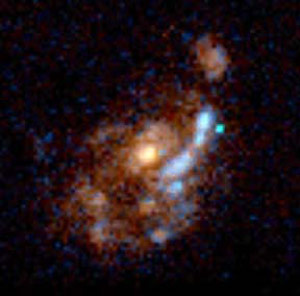
    An image taken by the Hubble Space Telescope of a luminous distant galaxy disrupted by a merger. A new study of 2084 distant, luminous infrared galaxies finds that, contrary to some earlier results, there is no strong evidence that most are not in a merger process. Credit: NASA/Hubble

    Using the Hubble Space Telescope and quantitative measures of galaxy distortion, CfA astronomers reveal that there is only a slight 20% decrease in the collision rate of distant ultra-luminous infrared galaxies from that of local galaxies.

    Ultra-luminous infrared galaxies ((ULIRGs) are galaxies whose luminosity exceeds that of a trillion suns, By way of comparison, our Milky Way galaxy has a typical modest luminosity of only about ten billion suns. ULIRGs were discovered by an all-sky infrared survey satellite in the 1980s, and since then the origin(s) of their powerful emission has been widely debated. Extreme infrared activity is known to be associated with interacting galaxies, and optical imaging shows that many ULIRGs are indeed in collision. The two primary known sources of global energy production in galaxies are star formation and accretion activity around a massive black hole in the nucleus (a so-called active galactic nucleus). Both of them produce radiation that heats up the dust. Mergers might result in intense infrared emission because they help to drive this kind of active star formation.

    The issue takes on an even sharper focus because earlier in our universe – about ten billion years after the big bang when most of the stars in the current universe were formed – some evidence suggests that ultra-luminous galaxies are not merging – implying that the dominant star formation mechanisms did not involve mergers. These distant, bright galaxies are rich in molecular gas among other features, for example, and perhaps their active star formation has little to do with the merger scenario? Either way it remains unclear exactly what physical mechanisms power the luminosity. Determining whether these galaxies are in fact colliding or not is difficult because merging galaxies are identified by morphological distortions in their shapes, and in distant galaxies such distortions are difficult to see.

    CfA astronomers Chao-Ling Hung and Howard Smith joined with their colleagues to study a selection of 2084 infrared luminous galaxies using the Advanced Camera for Surveys on the Hubble Space Telescope. Using quantitative measures of galaxy distortion, they conclude that, contrary to some earlier suggestions, there is no significant evidence that most distant ULIRGs are less involved in mergers than local ones; only a slight 20% decrease is detected. The result challenges conventional wisdom and, if confirmed, would mean that the processes driving star formation have not changed much in the past few billion years.

    Reference: “Comparison of the Morphological Properties Between Local and Z 1 Infrared Luminous Galaxies. Are Local and High−Z (U)LIRGS Different?” by Chao-Ling Hung (洪肇伶), D. B. Sanders, Caitlin M. Casey, Michael Koss, Kirsten L. Larson, Nicholas Lee, Yanxia Li, Kelly Lockhart, Hsin-Yi Shih, Joshua E. Barnes, Jeyhan S. Kartaltepe and Howard A. Smith, 28 July 2014, The Astrophysical Journal.
    DOI: 10.1088/0004-637X/791/1/63
    arXiv: 1406.4509


    Never miss a breakthrough: Join the SciTechDaily newsletter.
    Follow us on Google and Google News.

    Astronomy Astrophysics Galaxy Evolution Harvard-Smithsonian Center for Astrophysics
    Share. Facebook Twitter Pinterest LinkedIn Email Reddit

    Related Articles

    Astronomers Use Globular Clusters to Measure Galaxy Evolution

    Chandra Reveals Shock Heated Gas in Colliding Galaxies

    12 Billion Year Old Explosion Illuminates a Galaxy from the Dark Ages

    The First Systematic Analysis of the Energy Distribution of Interacting Galaxies

    New Computer Simulations Help Reveal How Spiral Galaxies Get Their Arms

    Researchers Study Early Galaxies and Their Specific Properties

    Centaurus a Hides a Gaseous Spiral at Its Core

    Arepo Software Helps Simulate the Birth and Evolution of Galaxies

    Using Infrared Images from Hubble & Spitzer, Scientists Discover 25 Distant Galaxies

    Leave A Reply Cancel Reply

    • Facebook
    • Twitter
    • Pinterest
    • YouTube

    Don't Miss a Discovery

    Subscribe for the Latest in Science & Tech!

    Trending News

    Scientists Uncover Potential Brain Risks of Popular Fish Oil Supplements

    Scientists Discover a Surprising Way To Make Bread Healthier and More Nutritious

    After 60 Years, Scientists Uncover Unexpected Brain Effects of Popular Diabetes Drug Metformin

    New Research Uncovers Hidden Side Effects of Popular Weight-Loss Drugs

    Scientists Rethink Extreme Warming After Surprising Ocean Discovery

    Landmark Study Links Never Marrying to Significantly Higher Cancer Risk

    Researchers Discover Unknown Beetle Species Just Steps From Their Lab

    Largest-Ever Study Finds Medicinal Cannabis Ineffective for Anxiety, Depression, PTSD

    Follow SciTechDaily
    • Facebook
    • Twitter
    • YouTube
    • Pinterest
    • Newsletter
    • RSS
    SciTech News
    • Biology News
    • Chemistry News
    • Earth News
    • Health News
    • Physics News
    • Science News
    • Space News
    • Technology News
    Recent Posts
    • Strange 65-Foot Dinosaur Discovered in Argentina
    • Researchers Uncover Source of Strange Deformation in Earth’s Largest Continental Rift
    • Scientists Solve Mystery of Where the Colorado River Vanished Millions of Years Ago
    • Not Just Alzheimer’s: Scientists Uncover Clues to a Second, Overlooked Disorder
    • Scientists Uncover Dangerous Connection Between Serotonin and Heart Valve Disease
    Copyright © 1998 - 2026 SciTechDaily. All Rights Reserved.
    • Science News
    • About
    • Contact
    • Editorial Board
    • Privacy Policy
    • Terms of Use

    Type above and press Enter to search. Press Esc to cancel.