
Close Menu
    Facebook X (Twitter) Instagram
    SciTechDaily
    • Biology
    • Chemistry
    • Earth
    • Health
    • Physics
    • Science
    • Space
    • Technology
    Facebook X (Twitter) Pinterest YouTube RSS
    SciTechDaily
    Home»Space»Galactic Genesis: Webb Space Telescope Reveals Massive Star-Forming Complex
    Space

    Galactic Genesis: Webb Space Telescope Reveals Massive Star-Forming Complex

    By European Space Agency (ESA)January 23, 20243 Comments4 Mins Read
    Facebook Twitter Pinterest Telegram LinkedIn WhatsApp Email Reddit
    Share
    Facebook Twitter LinkedIn Pinterest Telegram Email Reddit
    Large Magellanic Cloud H II Region Webb
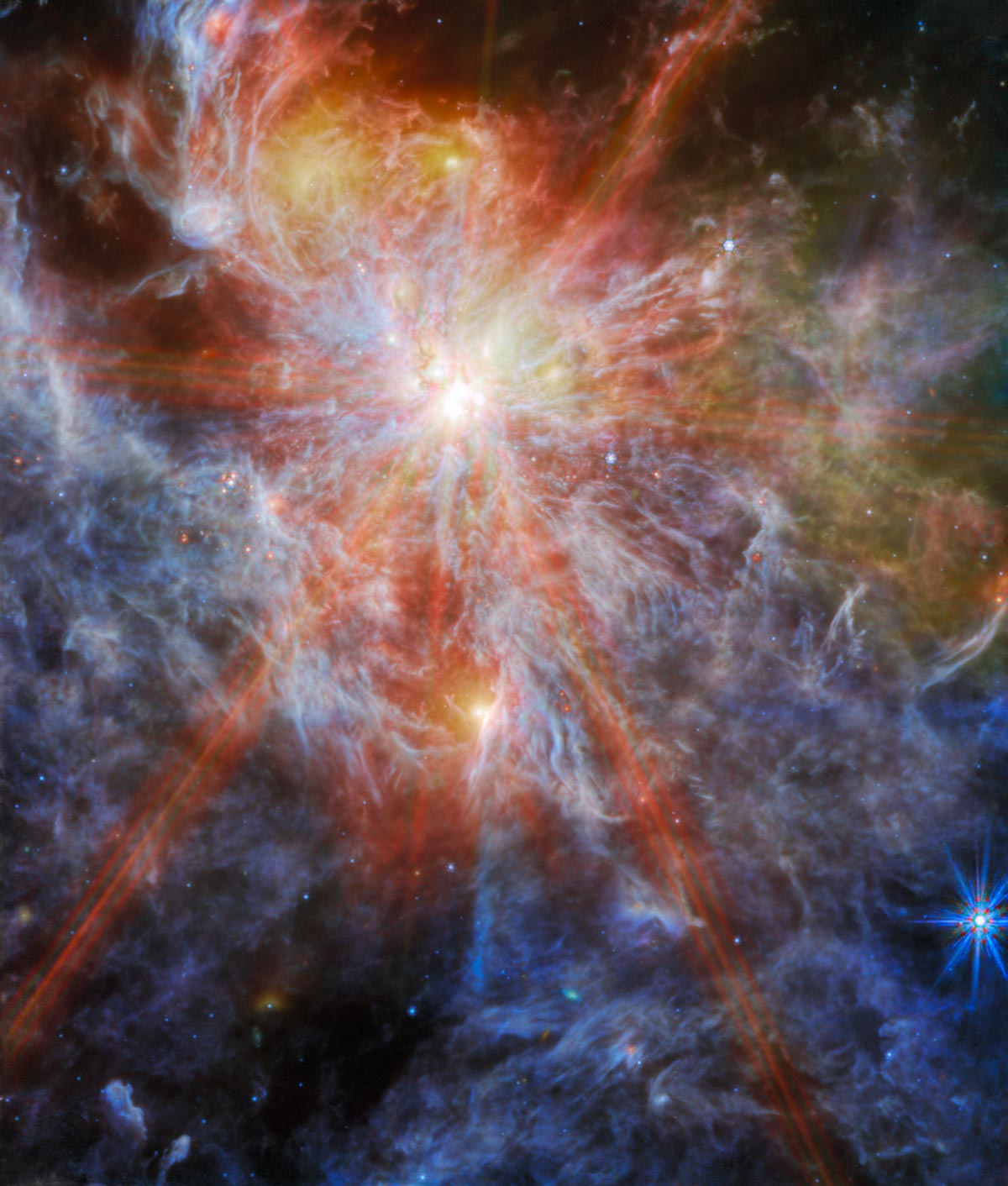
    The James Webb Space Telescope has captured a stunning image of N79, a vibrant star-forming region in the Large Magellanic Cloud, highlighting its potential as a younger version of the Tarantula Nebula. This observation, revealing the area’s glowing gas and dust through mid-infrared light, offers valuable insights into the early Universe’s star formation processes and chemical compositions, differing markedly from those in our Milky Way. Credit: ESA/Webb, NASA & CSA, O. Nayak, M. Meixner

    The James Webb Space Telescope reveals the inner workings of N79, a key star-forming region in the LMC, showcasing its efficiency and chemical uniqueness compared to the Milky Way.

    This image from the James Webb Space Telescope features an H II region in the Large Magellanic Cloud (LMC), a satellite galaxy of our Milky Way. This nebula, known as N79, is a region of interstellar atomic hydrogen that is ionized, captured here by Webb’s Mid-InfraRed Instrument (MIRI).

    N79 is a massive star-forming complex spanning roughly 1630 light-years in the generally unexplored southwest region of the LMC. N79 is typically regarded as a younger version of 30 Doradus (also known as the Tarantula Nebula), another of Webb’s recent targets. Research suggests that N79 has a star formation efficiency exceeding that of 30 Doradus by a factor of two over the past 500,000 years. 

    This particular image centers on one of the three giant molecular cloud complexes, dubbed N79 South (S1 for short). The distinct ‘starburst’ pattern surrounding this bright object is a series of diffraction spikes. All telescopes which use a mirror to collect light, as Webb does, have this form of artifact which arises from the design of the telescope.

    In Webb’s case, the six largest starburst spikes appear because of the hexagonal symmetry of Webb’s 18 primary mirror segments. Patterns like these are only noticeable around very bright, compact objects, where all the light comes from the same place. Most galaxies, even though they appear very small to our eyes, are darker and more spread out than a single star, and therefore do not show this pattern.

    Webb’s Mid-Infrared Insights into Stellar Formation

    At the longer wavelengths of light captured by MIRI, Webb’s view of N79 showcases the region’s glowing gas and dust. This is because mid-infrared light is able to reveal what is happening deeper inside the clouds (while shorter wavelengths of light would be absorbed or scattered by dust grains in the nebula). Some still-embedded protostars also appear in this field.

    Star-forming regions such as this are of interest to astronomers because their chemical composition is similar to that of the gigantic star-forming regions observed when the Universe was only a few billion years old and star formation was at its peak. Star-forming regions in our Milky Way galaxy are not producing stars at the same furious rate as N79, and have a different chemical composition. Webb is now providing astronomers the opportunity to compare and contrast observations of star formation in N79 with the telescope’s deep observations of distant galaxies in the early Universe.

    These observations of N79 are part of a Webb program that is studying the evolution of the circumstellar discs and envelopes of forming stars over a wide range in mass and at different evolutionary stages. Webb’s sensitivity will enable scientists to detect for the first time the planet-forming dust discs around stars of similar mass to that of our Sun at the distance of the LMC.

    This image includes 7.7-micron light shown in blue, 10 microns in cyan, 15 microns in yellow, and 21 microns in red (770W, 1000W, 1500W, and 2100W filters, respectively).

    Never miss a breakthrough: Join the SciTechDaily newsletter.
    Follow us on Google and Google News.

    Astronomy Astrophysics European Space Agency James Webb Space Telescope Popular
    Share. Facebook Twitter Pinterest LinkedIn Email Reddit

    Related Articles

    Webb Reveals What Happens When a Sun Like Ours Dies

    Webb Captures “Impossible” Glow From Galaxy at the Edge of Time

    Webb Peers Into Frozen Heart of Molecular Cloud – Unveils Dark Side of Pre-Stellar Ice Chemistry

    Major Milestone: NASA’s Webb Space Telescope Discovers Earliest Galaxies in the Universe

    Galactic Collision: Webb Space Telescope Explores Frenzied Star Formation in Merging Galaxies

    Webb Space Telescope To Provide Details of Two Intriguing “Super-Earths” in the Milky Way

    Webb Space Telescope’s Infrared Universe: A New Window to the Cosmos

    Webb Space Telescope: Uncovering Hidden Parts of Our Solar System

    First James Webb Space Telescope General Observer Scientific Programs Selected

    3 Comments

    1. Me on January 23, 2024 10:44 pm

      Star forming region ? 😆

      Reply
      • Mike on January 25, 2024 2:45 am

        ChatGPT can make a more convincing foto of a star forming region!!! This is just a campaign to get there budget increased…

        Reply
    2. Piet on January 25, 2024 2:45 am

      ChatGPT can make a more convincing foto of a star forming region!!! This is just a campaign to get there budget increased…

      Reply
    Leave A Reply Cancel Reply

    • Facebook
    • Twitter
    • Pinterest
    • YouTube

    Don't Miss a Discovery

    Subscribe for the Latest in Science & Tech!

    Trending News

    Common Laxative May Help Reverse Depression-Related Brain Fog

    Younger Generations Are Aging Faster – and It May Be Fueling a Surge in Cancer

    New Discovery Could Unlock Quantum Computers the Size of a Coin

    Shingles Vaccine Linked to 24% Lower Dementia Risk in Older Adults

    Scientists Found a Wordle Trick That Solves 99% of Puzzles

    A Hidden Galaxy Called Shadow Blaster May Explain One of Astronomy’s Biggest Mysteries

    These 3 Common Sleep Habits May Be Aging Your Brain Faster

    Rare Goblin Shark Spotted Alive in Its Natural Habitat for the First Time

    Follow SciTechDaily
    • Facebook
    • Twitter
    • YouTube
    • Pinterest
    • Newsletter
    • RSS
    SciTech News
    • Biology News
    • Chemistry News
    • Earth News
    • Health News
    • Physics News
    • Science News
    • Space News
    • Technology News
    Recent Posts
    • Scientists Built a Mars Rover That “Swims” Through Sand
    • This Strange New Magnet Could Transform Future Electronics
    • Scientists Discover Quantum Entanglement in a Crystal You Can Hold
    • Scientists Create Tiny “Mini Livers” That Could One Day Replace Liver Transplants
    • This Surprising Factor May Predict Heart Disease Decades Before It Strikes
    Copyright © 1998 - 2026 SciTechDaily. All Rights Reserved.
    • Science News
    • About
    • Contact
    • Editorial Board
    • Privacy Policy
    • Terms of Use

    Type above and press Enter to search. Press Esc to cancel.